
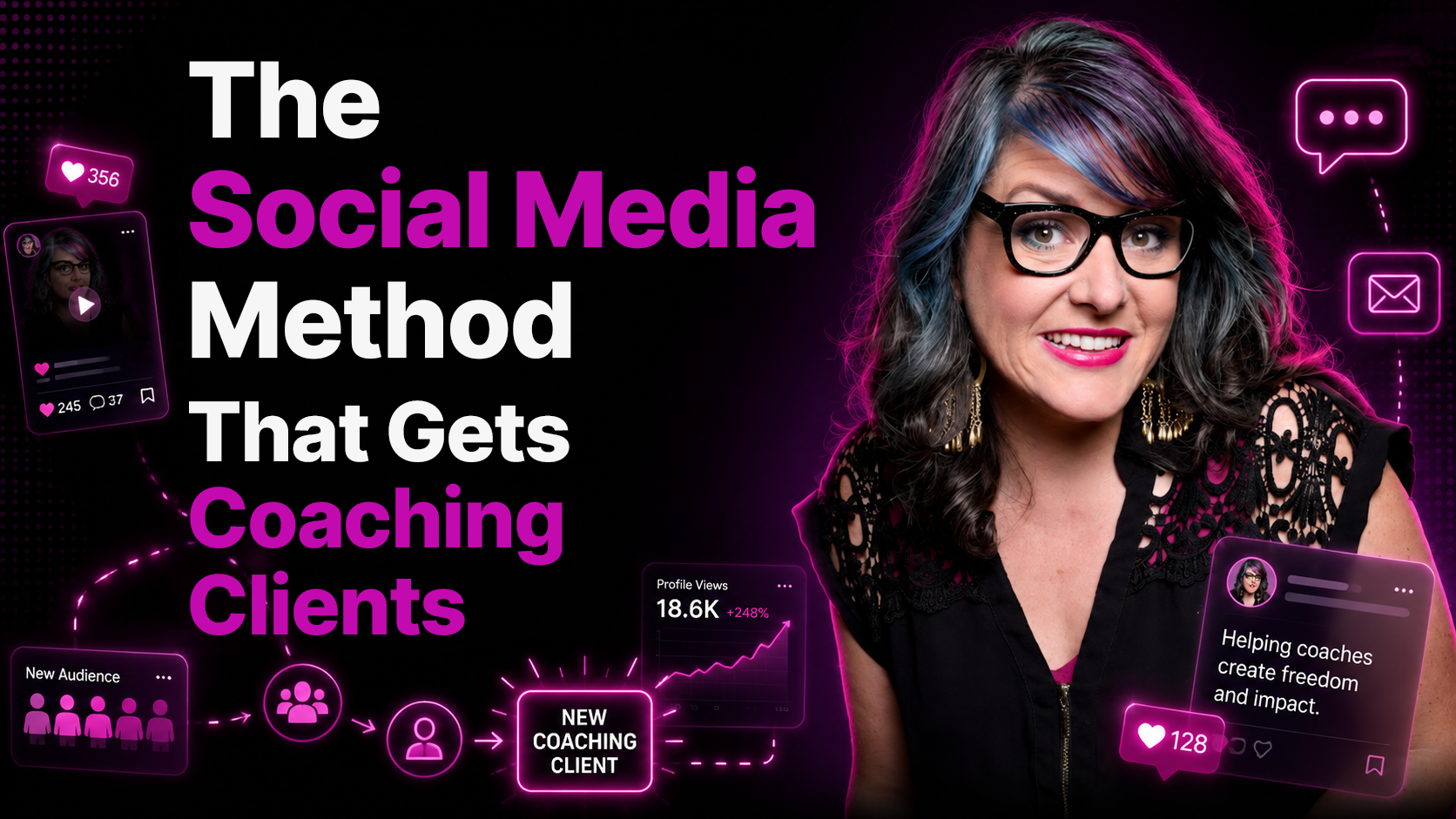

What is organic social selling with AI?
Get coaching clients with AI through organic social selling is a content strategy that uses artificial intelligence tools to create, schedule, and optimize social media posts that attract and convert coaching clients without paid advertising. Instead of running ads or relying on cold outreach, coaches train AI on their authentic voice and use it to produce consistent, belief-based content that builds trust and generates inbound leads over time.
Who This Is For
This guide is for established coaches and consultants who are already making money but struggling with consistency. If you have a proven offer, clients who love you, and a growing frustration that your content isn’t converting the way it should… this is for you. You don’t need to be a tech person. You don’t need a big following. You need a system that works in your authentic voice, and this guide shows you exactly how to build one.
Key Takeaways
- AI can write in your voice when trained correctly, but it requires intentional setup, not just a generic prompt.
- Belief-based content converts better than tips-and-tricks content because it meets ideal clients where they already are.
- Consistent posting (4 times per week minimum) compounds over time and creates inbound lead flow without paid ads.
- The biggest mistake coaches make with AI content is skipping the voice training step.
- Organic social selling is a long game that pays dividends for months and years after content is created.
- You can build a full month of content in a fraction of the time once your AI system knows your voice, your offer, and your ideal client.
Table of Contents
What Is Organic Social Selling with AI?
Organic social selling is the practice of using social media content, not paid ads, to attract, build trust with, and convert ideal clients into paying customers.
The “organic” part means you are not spending money to distribute the content. The algorithm does that work based on how well your content connects with people.
The “AI” part means you are using tools like Claude, ChatGPT, or other language models to help you produce that content faster, more consistently, and with less mental energy.
Here is the key distinction that most coaches miss: AI does not replace your voice. It amplifies it. When you give AI tools the right inputs – your specific phrases, your belief system, your stories, your frameworks… the output sounds like you having your best writing day. Not a robot. Not a generic template.
That is the difference between coaches who try AI and give up in frustration and coaches who build a content system that generates leads while they are on vacation.
The step-by-step process for getting there is exactly what this guide covers.
Why Coaching Clients Respond to Belief-Based Content
Most coaches post tips. How to do X. Three steps to Y. Seven mistakes to avoid.
Tips are useful. They are also forgettable. And they attract people who want information, not transformation.
Belief-based content works differently. It speaks to the things your ideal client already believes or the things they are afraid to admit they believe and meets them there.
Example of a tip: “Post five times per week for better engagement.”
Example of a belief-based statement: “The coaches who are doing well but not growing are almost always missing the same thing. Not talent, not offer, not time. They’re missing a system that works when they’re not watching.”
Which one makes you stop scrolling?
Belief-based content converts better because it creates recognition. The ideal client reads it and thinks: “That is exactly my situation. This person understands me.” That moment of recognition is the beginning of trust. Trust is what converts to clients.
The framework for building belief-based content is called a Tree of Beliefs. It maps out every belief your ideal client needs to hold in order to say yes to your offer and organizes them into seven categories:
- Why Me — why they personally want this result
- Why This — why this type of solution is the right answer
- Why You — why you are the right guide
- Why Now — why this moment is the moment
- Why Not — dissolving money, time, and self-doubt objections
- Why Stay — why continued investment is worth it
- Why Worse — the real cost of doing nothing
Each category becomes a content pillar. Each belief inside it becomes a specific post, video, or conversation starter. When you have a full Tree of Beliefs mapped for your offer, you never run out of content ideas. Every piece you create is directly connected to moving your ideal client closer to saying yes.
How to Train AI to Write in Your Authentic Voice
This is the step that separates coaches who get great results from AI from coaches who get generic content.
The problem is not AI. The problem is context.
When you open ChatGPT and type “write me an Instagram post about getting clients,” the tool has no idea who you are. It produces the most statistically likely response for that prompt, which is the same response it would produce for any other coach who typed the same thing.
Generic in, generic out.
Here is the step-by-step process for training AI to write in your voice:
Step 1: Capture your voice document.
Write down 10–20 phrases that are specific to you. How you open posts. How you end them. The words you use that feel yours distinctly. The topics you come back to again and again. If you have existing posts that performed well, paste those in too. The best voice training material is content you have already written that got a positive response.
Step 2: Define your beliefs.
AI cannot guess your worldview. Tell it what you believe about your niche, your ideal client, the industry, and the transformation you provide. These become the through-line in every piece of content it helps you create.
Step 3: Name your ideal client specifically.
Not “female entrepreneurs.” Something real. “Rachel is 47, has been coaching for 6 years, makes $7K a month, and is completely exhausted from creating content that doesn’t convert.” The more specific you are, the more specific and useful… the output.
Step 4: Create a reusable prompt template.
Combine your voice document, belief statements, and ideal client description into a single prompt template that you paste at the start of every content session. This is your AI briefing document. The more complete it is, the less editing you will do.
Step 5: Review, edit, and train from corrections.
AI gets better over time when you flag what is wrong. When you receive output that doesn’t sound right, tell it why. “That sounded too corporate. I would never say “leverage your network.” Try again and make it sound like something I’d text a friend.” That feedback loop is how the system compounds.
A well-trained AI content system can reduce content creation time from 3 hours per post to 20 minutes per post. The setup investment is real. The return on that investment is compounding.
What Is a Tree of Beliefs and Why Do Coaches Need One?
A Tree of Beliefs is a strategic content framework that maps every belief your ideal client must hold in order to buy your offer.
Think of it as the decision tree inside your client’s head. Before someone says yes to a $1,500/month mastermind, they have to first believe they are meant for more than where they are. They have to believe that AI-powered content is the right type of solution. They have to trust you specifically. They have to believe now is the right time. They have to dissolve their objections about money, time, and past failures. They have to believe staying invested is worth it. And they have to understand what staying stuck actually costs them.
Those are not random beliefs. Those are the predictable psychological steps between “stranger on the internet” and “paying client.”
When you have your Tree of Beliefs mapped, content creation becomes fill-in-the-blank. You are not starting from “what do I post today?” You are starting from “which belief do I want to speak to this week?” That is a completely different creative experience.
Here is a simplified example for a coach who sells a high-ticket mastermind:
Why Me belief: “I am meant for more than this plateau. I have built something real, and I know I am not at my ceiling yet.”
Content that speaks to this belief does not mention the offer. It speaks to the identity and desire of the ideal client. It creates recognition and resonance.
Why Not belief: “The investment is one new client. I have already proven I can close clients.”
Content that speaks to this belief addresses the money objection before it is ever voiced. It reframes cost as investment and points to evidence the ideal client already has.
Every coach who does this content mapping finds the same thing: they are not short on content ideas. They are short on a framework that connects content to conversion. The Tree of Beliefs is that framework.
How to Build a Week of Content from a Single Belief
Once you have your beliefs mapped, the content structure is straightforward. Here is a step-by-step guide for building a full week of content from one belief using the AI Super Prompt structure:
Monday: Community Question
An open-ended, fun question that invites conversation without selling. It relates loosely to the belief category.
Example: “What was the last thing about running the business that genuinely surprised you in a good way? Drop a month and year.”
Tuesday: Barnum Statement
A broad, confident statement that virtually anyone in your ideal client pool would find true. This is not a question. It is a declaration that creates immediate recognition.
Example: “The coaches who are doing well but not growing are almost always missing the same thing: not talent, not offer, not even time. They’re missing a system that works when they’re not watching.”
Wednesday: Long-Form Video
A 10–20 minute video or Reel that goes deep on the belief. The structure is:
- Title: Clear, curiosity-driven
- Hook: Pattern interrupt or relatable statement in the first 5 seconds
- Validation question: Asks viewers to confirm by commenting a keyword
- Description: Problem, Agitate, Solution format (without using those words)
- Bullet points: 5 specific, actionable topics covered in the video
Thursday: Conversation Prompt
A reflective question that drives comments and real engagement. It should make people want to share their own experience.
Example: “What’s the version of your business you know is possible but feels just out of reach right now?”
Friday: Snarky Barnum or Meme
A playful, bold statement with an edge. Challenges a limiting belief in a way that makes people laugh and feel seen simultaneously.
Example: “A friendly reminder that ‘I just need to work harder’ has never once been the answer for a smart person who is already working hard.”
Five posts, built around one belief, in a single creative session with AI. That is a repeatable weekly workflow.
What Does a Full Month of AI-Powered Coaching Content Look Like?
A full month of belief-based content for a coaching offer follows this arc:
Week 1: Identity and desire (Why Me)
Posts that speak to who the ideal client is and what they know they are capable of. Content warms the audience and creates recognition before anything is being sold.
Week 2: The solution category (Why This)
Posts that establish why this type of approach, organic social selling with AI, is the right answer. Not “buy my thing.” Why this method.
Week 3: The investment math (Why Not)
Posts that pre-address objections. Money, time, past failures. Delivered through stories, Barnum statements, and vulnerable conversations… not a pitch.
Week 4: The cost of inaction (Why Worse)
Posts that help the ideal client feel the reality of staying stuck. This week often runs concurrent with a launch event like a masterclass or challenge.
By the end of the month, an ideal client who has followed along has had their beliefs shaped in a specific direction. They feel seen. They trust the guide. They understand the cost of waiting. And there is a clear next step in front of them. And there is a clear next step in front of them.
That is how organic social selling converts without pressure, cold DMs, or ads.
The Most Common Mistakes Coaches Make with AI Content
Mistake 1: Skipping voice training.
Using AI without giving it your voice context produces generic content. Generic content is ignored. The fix is a voice document created before any prompting begins.
Mistake 2: Posting when inspired instead of consistently.
Inspiration is not a strategy. A system is a strategy. The algorithm rewards consistency. Ideal clients trust consistent presences. Posting when you feel like it produces inconsistent results.
Mistake 3: Giving away tips instead of speaking to beliefs.
Information is abundant. Recognition is rare. Content that speaks to the ideal client’s specific beliefs converts at a far higher rate than instructional content.
Mistake 4: Writing for a crowd instead of one person.
Social media posts that try to speak to everyone speak to no one. The best-converting content makes one specific person feel like you are talking directly to them.
Mistake 5: Stopping before the compound effect kicks in.
Organic content compounds over time. Most coaches stop before the 90-day mark where the algorithm begins prioritizing their content. The coaches who stay consistent past that threshold see dramatic results. The ones who quit call organic social “not working.”
How Long Does It Take to Get Clients from Organic Social?
The honest answer: 60 to 90 days of consistent posting before organic reach begins compounding meaningfully.
The first 30 days: Build the foundation. Train the AI on your voice. Get your belief map in place. Post consistently even when the numbers feel small.
Days 30–60: Engagement begins to grow. Ideal clients who have been watching start to reach out or respond to CTAs. First inbound leads appear.
Days 60–90: The algorithm begins recognizing you as a consistent creator in your niche. Reach expands. Existing followers who trust you start referring others. The content from weeks 1–8 is now working for you while you sleep.
Month 4 and beyond: Every piece of content you have created is a compounding asset. Posts from two months ago are still being found, shared, and acting as lead-generating touchpoints.
This is the fundamental difference between organic social and paid ads. Ads stop working when you stop paying. Organic content compounds. A post from 18 months ago can still be bringing in warm leads today.
Frequently Asked Questions
What is the best AI tool for coaches to create content?
Claude (by Anthropic) is particularly well-suited for coaches because it handles long-form, nuanced, voice-trained content better than most alternatives. It is excellent for brand voice work, belief mapping, and producing social content that sounds human. ChatGPT is also a solid choice. The tool matters less than the voice training you put into it.
Can AI really write in my voice or will it sound generic?
AI will sound generic if you give it generic input. When you train it with your specific phrases, beliefs, and writing samples, the output sounds like you having your best writing day. The voice training setup takes about an hour the first time. After that, the quality of output improves significantly. Most coaches who have done this properly say they cannot tell which content they wrote themselves and which the AI drafted.
How many times should a coach post on social media per week?
Four times per week is the minimum for the compound effect to kick in within 90 days. Five is better. The specific platforms matter less than consistency. If you can only do three platforms four times per week, choose three platforms. Consistency on fewer platforms beats sporadic posting everywhere.
What is a Barnum statement and how do coaches use them?
A Barnum statement is a broad, confident assertion that virtually anyone in your ideal client pool would find true. The name comes from P.T. Barnum’s skill at making audiences feel personally spoken to. In coaching content, Barnum statements are Tuesday posts, quote card text, and video hooks that create immediate recognition. Example: “The coaches who plateau aren’t lacking talent. They’re lacking a system that works when they’re not watching.” Anyone struggling with growth reads that and thinks: yes, that is me.
How do I know which beliefs to speak to first?
Start with Why Me and Why Worse.
Why Me content warms your audience and creates identity recognition before you ever mention your offer.
Why Worse content helps your ideal client feel the real cost of waiting, which is especially powerful in the weeks before a launch or masterclass.
Why Not content belongs in launch week and post-masterclass follow-up sequences.
Is organic social selling realistic for coaches who don’t have a big following?
Yes. Many of the best-converting coaches on social media have audiences of 2,000–5,000 people. What matters is that the right people are watching and that you are building trust consistently. A small engaged audience converts far better than a large passive one. Organic social selling is about depth of connection, not width of reach.
What’s the difference between organic social selling and just posting content?
Posting content is tactical. Organic social selling is strategic. It means every piece of content is intentionally tied to a belief that moves your ideal client closer to your offer. It means your posting is consistent enough to build trust over time. And it means there is always a clear next step available for someone who is ready. Most coaches post. Fewer coaches sell organically.
Can I use AI for video scripts too or just written posts?
AI is excellent for video scripts. The same voice training that powers your written content works for scripts. The video structure in the AI Super Prompt framework gives you a complete Wednesday video every week: title, hook, validation question, video description, and five bullet points that become the structure of the video itself. Many coaches use AI to script, then record a single take because the structure is so clear.
How do I measure whether organic social selling is working?
Track three things: inbound DMs from warm leads, comment quality on Barnum statements and conversation starters, and the direct source of new client conversations. Engagement numbers are secondary to lead quality. If the right people are reaching out, the content is working. If reach is high but no relevant conversations are starting, the content is speaking to the wrong beliefs.
What is the Tree of Beliefs and how long does it take to build?
The Tree of Beliefs is a content framework that maps every belief your ideal client needs to hold to buy your offer. It has seven categories with three to five beliefs each. A guided session to build it takes about 90 minutes the first time. With AI assistance, it can be drafted in 30 minutes. Once built, it becomes the source document for all content strategy for that offer, which is why the initial time investment is worth it.
Is Multiply right for coaches who are just starting out?
Multiply is designed for established coaches doing $5K+ per month who are ready to systematize and scale. Coaches who are earlier in their journey are better served by AI Stars or AI Content Club, which build the foundational skills. Multiply is the high-touch layer for people who have already proven their offer and are ready to build the system around it.
Recommended Tools and Resources
For AI content creation:
Claude (Anthropic) — best for long-form, nuanced, voice-trained content. Excellent for brand voice work and belief mapping.
For content scheduling and posting:
Any tool that allows batch scheduling — Later, Buffer, or native platform scheduling. Consistency matters more than the specific tool.
For video content:
Instagram Reels and Facebook video remain the highest-reach formats for coaching content in 2026. YouTube Shorts is a secondary platform for searchable content.
For a complete system:
Multiply — The Prepared Performer’s high-touch mastermind for established coaches. Includes weekly strategy calls, full AI Stars membership, AI Content Club, StarFunnels Pro, and Millie AI coach. Builds a complete organic social selling system on your authentic voice. Apply here.
Here is what to remember.
Organic social selling with AI works when you do two things right: train AI on your authentic voice, and create content that speaks to what your ideal client already believes. Generic content gets ignored. Belief-based content builds trust. Trust converts to clients.
The system takes about 90 days to compound. The coaches who stay consistent past that mark build lead-generating machines from their content. The coaches who stop at 60 days wonder why organic social doesn’t work.
You do not need a big following. You do not need ads. You need a proven offer, an authentic voice, a belief map, and the consistency to post four times a week. AI handles the production load when you set it up correctly.
If you have been doing this alone and it hasn’t clicked yet, the missing piece is probably not more information. It is a system, a community, and someone who has already built what you are building, holding you accountable.
Ready for the System?
If you are an established coach doing $5K+ per month and you are tired of the feast-famine cycle, the inconsistent content, and the exhaustion of figuring this out alone. Multiply was built for exactly where you are.
Weekly strategy calls with Molly. A full AI toolkit. A community of coaches at your level doing the same work. And an organic social selling system built entirely in your authentic voice.
Applications are open. Apply today.

Leave a Reply