
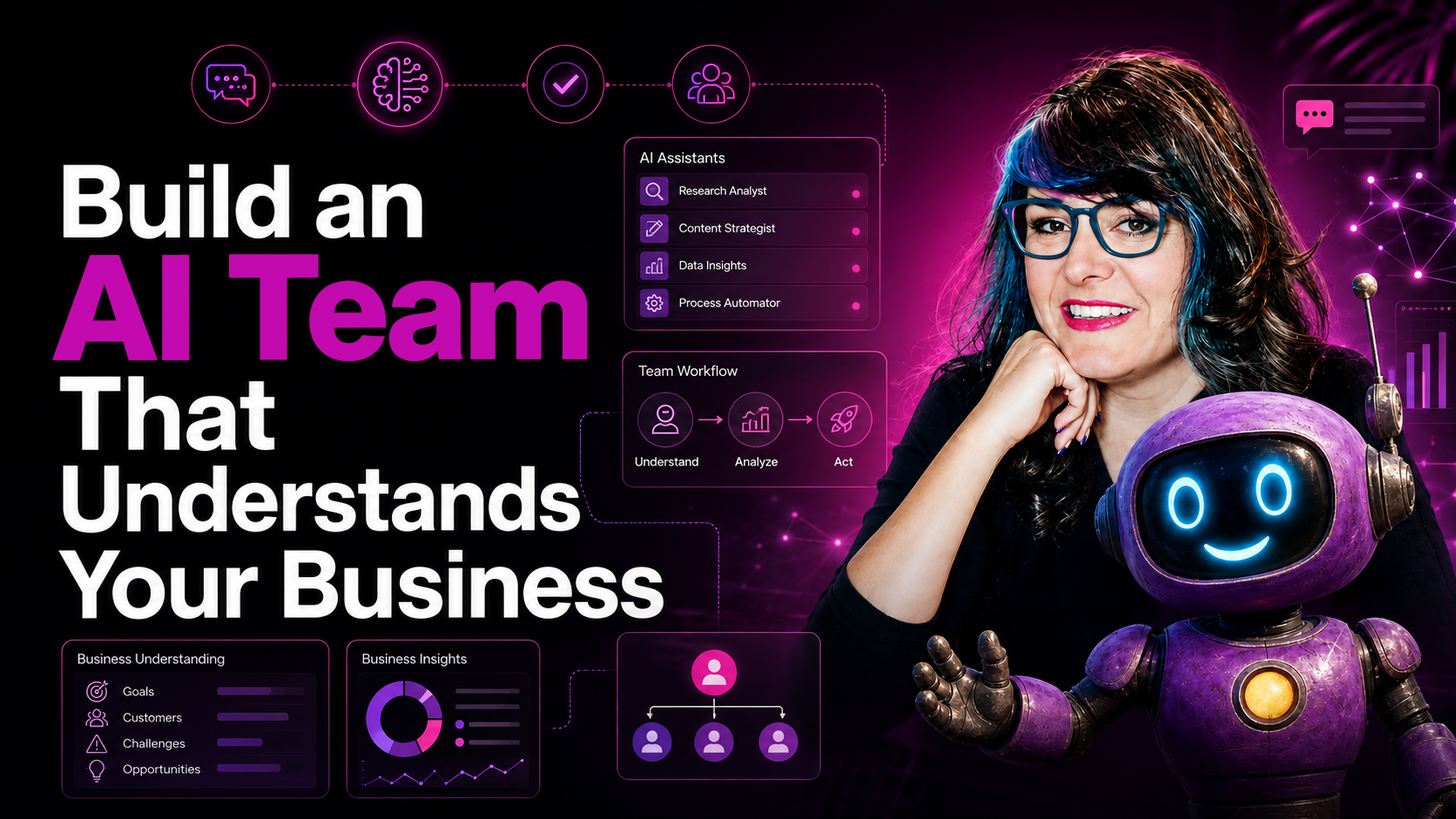

What an AI Team for Your Business Actually Is
Setting up an AI team for your business allows you to transform how you operate by replacing fragmented tools with a coordinated, intelligent workforce. An AI team is a set of AI agents, each trained on a specific job inside your business (content, sales follow-up, operations, and so on), that work together instead of as one generic chatbot doing everything badly. Instead of learning a pile of disconnected AI tools, you build a small department of specialized helpers, each one trained on your actual voice and your actual business, so the output sounds like you and does a real job.
Who Is an AI Team For?
This is for the coach, consultant, or course creator who has tried AI tools before and quit. You’ve got a folder of half-finished courses, a handful of apps you downloaded and used exactly once, and a nagging feeling that everyone else has already figured this out. You’re not looking for one more single-purpose tool. You’re looking for a system that actually runs your content, your follow-up, and your operations without you sitting at your desk every single hour making it happen by hand.
Key Takeaways
- An AI team is departments, not tools. Content, sales, operations, and images each get their own trained agent instead of one generic assistant doing all four badly.
- The single biggest reason AI tools fail to stick is that they were never trained on your specific voice, offers, or ideal client, so the output always needs a rewrite.
- You do not need to be technical to build this. You need to be the expert in your own business. The AI handles the technical execution.
- Building one department first, well, beats attempting five departments badly at once.
- A live build, watched and done alongside someone else, sticks in a way a self-paced course rarely does.
- The system compounds. Every month you keep training and updating your AI team, it gets more useful, not less.
Table of Contents
What an AI Team Actually Is
Think about the team you’d build if you could afford to hire everyone you need today.
Someone writing your content in your voice. Someone following up on every lead so nothing falls through. Someone handling the operational stuff you keep meaning to systematize. Someone generating the visuals you need without you opening five different apps.
An AI team for your business can handle all of that, built out of trained AI agents instead of new hires.
Think of an AI team for your business as a group of specialized digital team members, each with one clear job. One agent might focus on content. Another can handle lead follow-up. Another can help with operations, while another creates the visuals and assets your business needs.
The difference is that these aren’t generic AI tools waiting for you to type in another prompt. Each agent is trained specifically on your business, your ideal client, your offers, your processes, and how you actually sound.
That’s what makes an AI team for your business different from simply using ChatGPT or a collection of disconnected AI tools. Your agents work from the context you’ve given them, so they can support the way your business actually operates.
Instead of asking, “What can AI do for my business?” you can start asking, “What would I delegate first if I had an AI team for my business?”
Because the goal isn’t to replace your team or add another pile of tools to manage. It’s to build an AI team for your business that takes repetitive work off your plate, keeps important tasks moving, and gives you back time to focus on the work only you can do.
Here’s the distinction: this is not the same thing as “using ChatGPT.”
Using ChatGPT for a single prompt is asking a stranger for a favor. Building an AI team is training a department that already knows your business before you ask it anything.
Why Single-Purpose AI Tools Stop Working After Week One
Open your phone right now and count the AI apps you downloaded and used exactly once. Most people have three to five sitting there, unopened for weeks, right next to the flashlight icon.
Here’s why that keeps happening. Each tool solves one narrow problem, and none of them know anything about each other or about your business. You still have to be the one holding the whole picture together, feeding each tool the context it needs every single time, then rewriting the output because it doesn’t sound like you.
A pile of disconnected tools isn’t a system. It’s a graveyard with a subscription fee attached to every headstone.
What actually changes the outcome is training a set of agents once, on your real business, so they carry that context every time instead of starting from zero.
The AI Team Departments Your Business Actually Needs First
Trying to build “AI for my whole business” in one sitting is why most people never start. It’s too big a target to aim at. Breaking it into departments makes it a Tuesday afternoon instead of an abstract someday project.
The departments that show up most often for coaches, consultants, and course creators:
- Content. Writing in your actual voice, not a generic AI tone. This is usually the first department worth building, because content is the thing eating the most hours every week.
- Sales and follow-up. Making sure no lead goes cold because you forgot to reply for four days.
- Operations. The repetitive administrative work you keep meaning to systematize and never do.
- Images and video. Visual content generation trained on your actual brand, not a stock-photo aesthetic.
Pick one. Build it well. Then move to the next. Attempting all four in a weekend is how people end up with four half-finished builds and go back to doing everything by hand.
How to Train an AI Agent on Your Own Voice
The gap between an AI tool that sounds generic and one that sounds like you comes down to one thing: what it was trained on before you ever typed a prompt.
A generic AI tool starts from zero every time. You explain your business, your tone, your ideal client, all over again in every conversation, and it can still drift back toward a generic AI voice by the third paragraph. That makes it difficult to build an AI team for your business that actually feels like an extension of you.
A trained agent starts with that context already built in. It’s been given your actual writing samples, your positioning, who you serve, and what you never say. So the output on the first try sounds more like a rough draft you’d actually send, rather than something you have to completely rebuild from scratch.
That’s what makes an AI team for your business different from simply having a collection of AI tools. Each agent can be trained around a specific role while still understanding the bigger picture of your business.
That’s the difference between simply using AI and actually training AI to work the way your business does. When you’re building an AI team for your business, you’re not just giving AI instructions. You’re giving each agent the context it needs to understand how you work, what your business needs, and how you want things done.
Instead of piecing together AI agents from random prompts, videos, and blog posts, you can build an AI team for your business department by department. Each agent has a specific role, understands your business, and is trained to help you get real work done.
Over time, those individual agents become an AI team for your business that can support different parts of your day-to-day operations without everything starting from scratch every time.
Do You Need to Be Technical to Build an AI Team?
No. You need to be the expert in your own business. That’s the whole swap: you don’t need to be a programmer; you need to be the expert, because AI handles the technical execution once it knows what you know.
That’s what makes building an AI team for your business different. You bring the expertise, and your AI team for your business helps turn that knowledge into real work.
The most common objection here isn’t really about technical skill. It’s about trusting that this won’t turn into another half-finished course sitting in a portal.
Fair.
The difference is that a course is passive and a live build is active. You’re not watching a video about AI agents. You’re building an AI team for your business in real time, in a room, with something actually working by the time the session ends.
Building Your AI Team Live Versus in a Self-Paced Course
If you’ve bought AI courses before and never finished them, that’s not a discipline problem. Self-paced content is designed to be paused, and “I’ll finish it later” is a sentence almost nobody follows through on. There’s no room, no clock, no accountability, just a portal with a progress bar stuck at 12%.
A live build works differently. You show up at a specific time. You build the specific thing in front of you while everyone else in the room is doing the same task at the same moment. That structure is what actually gets people to the finish line, not more willpower.
What a Working AI Team Looks Like in Practice
Once the first department is built and trained, the shift is less dramatic than people expect and more permanent than any single tool. Content that used to take three hours starts as a rough draft that already sounds like you. Follow-up that used to slip through the cracks gets handled the same day.
That’s what an AI team for your business can change. The system keeps running whether or not you sat down at your desk that morning.
It also compounds. The people getting real results aren’t the ones who try AI for thirty days and move on. They’re the ones who keep showing up, keep training their AI team for your business, and keep adding the next department once the first one is running smoothly.
Over time, that’s how an AI team for your business becomes something that actually grows with you.
Frequently Asked Questions
What’s the difference between an AI tool and an AI team?
A tool solves one narrow task and starts from zero every time you use it. A team is a set of agents trained on your specific business, working together with shared context, each handling a defined job.
Do I need to know how to code to build an AI team?
No. You need to know your own business well enough to train the agents on it. The technical execution is handled by the AI once it has the right training.
How long does it take to build one AI agent?
Building your first working agent inside a focused live session, like a masterclass, typically takes under an hour once you have your brand voice and offer details ready to feed it.
Which department should I build first?
Content, for most coaches and consultants, since it’s usually the single biggest time drain and the one most people are already trying to automate badly with disconnected tools.
Will AI-generated content sound like a robot?
Only if it’s never trained on your actual voice. Generic prompts produce generic output. An agent trained on your real writing samples and positioning produces something closer to a real first draft.
What if I’ve tried AI tools before and gave up?
Most people who give up were using single-purpose tools with no shared training, which is exactly the problem an AI team solves. A team is built once and reused, not re-explained every session.
Is this the same as hiring a virtual assistant?
No. A VA is a human doing tasks you assign one at a time. An AI team runs continuously on the training you’ve already given it, without needing daily direction.
Can I build an AI team if I’m not “the tech person” in my business?
Yes. The entire point is that you don’t need to be. You need to be the expert on your business, offers, and ideal client. The AI handles the rest.
What happens after I build the first agent?
You keep training and refining it as your business changes, then move on to the next department. The system is designed to grow with you, not to be a one-time project you finish and forget.
Is there a free way to start building an AI team?
Yes. A live masterclass that walks you through building your first agent from scratch is one of the lowest-friction ways to start, since you get the structure of a guided build without committing to a paid program first.
How is this different from just using ChatGPT for everything?
Using ChatGPT for a single prompt means re-explaining your business every time. An AI team means the training happened once, up front, so every output already carries that context.
What tools are needed to build an AI team?
The specific stack varies, but the core idea is the same regardless of tool: a place to store your brand voice and business context, and an AI system that can be trained on it rather than prompted fresh each time.
Recommended Tools and Resources
- A brand voice and business context document (your “who I am, who I serve, how I sound” reference)
- An AI platform that supports persistent training or memory, not just single prompts
- A content calendar to track what each agent is producing
- A live build environment (a masterclass, workshop, or guided cohort) for your first agent, rather than starting from a blank prompt box alone
- A community of people building the same system, for accountability and troubleshooting
Final Summary
An AI team beats a pile of disconnected AI tools because it’s built once, trained on your actual business, and reused instead of re-explained every session. You don’t need to be technical to build one. You need to be the expert in your own business, and the AI handles the execution.
Starting with one department, built well, beats attempting five at once.
Inside AI PRO, you’ll learn how to build your AI Soul System™, install your AI team, create your own AI-powered offer, and learn how to bring it to market.
Ready to Make AI Work More Like YOU?
Your AI should know your voice, your business, your offers, and all the awesome things that make YOU unique!
Join us on October 17 for our AI Soul System Workshop, where you’ll learn how to build a personalized AI system that understands your business and helps you create content that actually sounds like YOU.
Let’s bring your human magic into AI!

Leave a Reply