
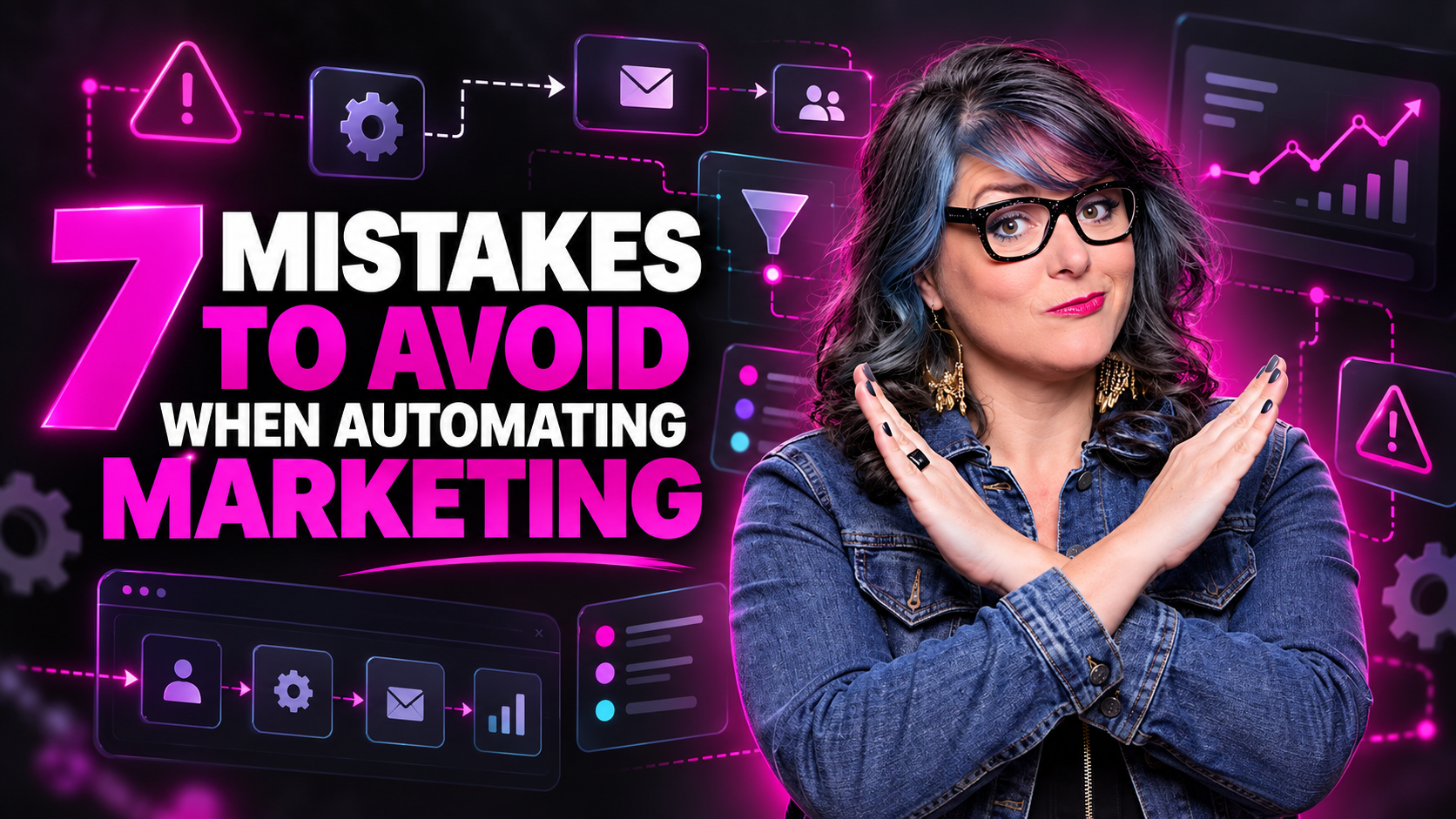

Why Automate Your Marketing?
Automating your marketing, in plain English, means using automation software and artificial intelligence to handle the repetitive marketing tasks that eat your week alive. Email marketing sequences. Social media posting. Follow-ups. Tracking customer data. All the stuff that keeps you glued to your laptop instead of actually talking to the humans you serve.
Done right, effective marketing automation frees you to deepen real relationships, go live, coach your clients, and build the business you actually wanted. Done wrong, it makes you sound like a robot, burns your audience’s trust, and quietly slows your sales.
Here’s what we’ll cover:
- The 7 common marketing automation mistakes that silently sabotage your results
- The real benefits of marketing automation when you do it right
- A simple starter system you can build this week
If you want to automate your way out of ever talking to a human again, this one’s not for you.
What Is Marketing Automation?
Most textbook definitions make marketing automation sound like enterprise software for Fortune 500 companies. In real life, for online coaches and creators, it’s much simpler.
Marketing automation connects your email marketing, social media, landing pages, DMs, and CRM so people move along the customer journey automatically – without you manually dragging each person from step to step. Marketing automation tools automate repetitive marketing tasks so you can focus on what actually requires your brain and your personality.
Core automation features you should know:
- Trigger-based automated workflows (someone downloads your guide → they get an email sequence)
- Tagging and segmentation, which improves the relevance of communications in marketing automation
- Lead scoring to identify your hottest prospects
- Scheduling for social media posting and email campaigns
- Basic AI content support for drafting and repurposing
Currently, 63% of marketers use automation for email marketing, and that number keeps climbing. Automated workflows can handle repetitive tasks efficiently across multiple channels.
Here’s what it looks like in a real 2025 funnel: Someone sees your Reel. They click a link to your free training landing page. They opt in. That triggers a nurture email sequence over several days. Leads who engage get tagged. When someone replies to a DM or clicks a key link, you get a notification. You reach out personally to book a call. After purchase, onboarding flows kick in automatically – prep materials, community invites, credentials.
That’s marketing automation work in practice.
Table of Contents
The Benefits of Marketing Automation (When You Do It Right)
When I first started automating content repurposing and follow-up reminders inside my business, I got back roughly 10 hours a week. That’s 10 hours I could spend going live, coaching clients, or honestly just living my life. That’s the real promise here.
Here are the specific benefits of marketing automation when it’s set up with intention:
- Time and cost savings. Automation reduces manual tasks, improving productivity and efficiency. Small businesses benefit from marketing automation by managing operations on tighter budgets.
- Consistent visibility. Automation helps small businesses maintain consistent marketing campaigns without manual effort. Your audience hears from you even when you’re offline.
- Better use of customer data. You actually know who’s engaging, who’s ready to buy, and who needs more nurturing.
- Improved lead nurturing. Automated sales workflows reduce friction between marketing and sales teams, meaning fewer leads fall through the cracks.
- Fewer dropped opportunities. No more forgetting to follow up with the person who said “I’m interested” in your DMs three weeks ago.
Marketing automation can increase qualified leads by 451%, and nurtured leads make 47% larger purchases. Automation can also improve ROI by reducing manual tasks and errors across your marketing processes.
| Before Automation | After Automation |
| Manually posting content 5x/day | Scheduled across multiple platforms in one batch |
| Forgetting follow-ups, leads going cold | Automated reminders prompt you to reach out |
| Irregular revenue, feast-or-famine months | Consistent nurture = more predictable calls and sales |
| Hours spent on repetitive tasks | Time freed for content that actually converts |
Those aren’t hypothetical. One wellness coach saved roughly 94% of her content creation time via automation, tripled her DM inquiries in 60 days, and added about $8K in monthly revenue.
Mistake #1: Automating Something That Doesn’t Work Yet
Automation is an amplifier. It makes whatever you already have louder.
If your offer is unclear, automation spreads unclear faster. If your nurture emails get zero replies, automating them just gives you more emails that get zero replies. Businesses should avoid automating broken or undefined processes – period.
I’ve seen coaches automate an entire webinar funnel before they’d ever tested it with a live audience. The result? Hundreds of ad dollars spent driving people into a marketing funnel that converted at near zero. Same mistake, scaled.
Do this instead:
- Run your email sequence manually (or at small scale) for 30–60 days
- Post content by hand and track which formats actually generate conversations
- Send the DMs yourself and note which scripts book calls
- Track responses, conversations started, and calls booked by hand
- When something starts getting real, measurable results – that’s your signal to automate it
The rule is simple: validate first, then automate.
Mistake #2: Letting AI Erase Your Voice
You know the posts. They all start with a dramatic one-liner. They all use the same five buzzwords. They all sound like nobody.
AI in marketing automation can personalize messaging at scale, which is powerful. But if every coach is feeding the same generic prompts into the same tools, every coach sounds identical. Your target audience can feel it in two seconds, and they scroll right past.
We treat your voice as your biggest asset. Your quirks, your weird wins, your specific way of saying things – that’s what makes people buy from you instead of the next coach in their feed.
How to build a simple voice guide for your AI tools:
- Collect 5–10 sample posts that sound like you on your best day
- List your signature phrases and the words you’d never say
- Note your tone: casual, warm, bold, playful, direct
- Feed all of this into your AI prompts before generating anything
- Read every draft out loud. If you wouldn’t say it on a live video, rewrite it
If you want to go deeper on building an AI workflow that actually sounds like you, check out how to create a simple AI content workflow – it’s a practical starting point.
Mistake #3: Automating the Relationship Instead of the Busywork
Auto-DMs to every new follower. Generic “Great post!” comments from a bot. Canned pitches sent to people who never raised their hand.
This is where automation goes from helpful to cringe.
People buy high-ticket coaching and memberships from people they trust. Trust gets built in real conversations – not in chatbot loops. Automation enhances lead nurturing through behavior-based communication planning, but the communication itself needs to feel human.
What to automate:
- Appointment reminders and follow-up email sequences
- Content repurposing (one video into ten pieces across marketing channels)
- Lead tagging and segmentation based on customer behavior
- Internal notifications that tell you when a hot lead takes action
- Social media automation for scheduling – not for fake engagement
What to keep live and personal:
- High-intent DM conversations
- Discovery calls and sales conversations
- Personalized messages to people who’ve raised their hand
- Comment replies when possible
Here’s how an “assisted but human” DM workflow actually works: automation tools detect when someone comments a keyword on your post. The system sends a warm, pre-written DM in your voice with a helpful link.
If they reply, you get a notification with full context – what they downloaded, which emails they opened, what they clicked. Then you show up for the actual conversation.
That’s organic social selling with a support system behind it. Humanizing your brand isn’t optional – it’s the whole strategy.
Mistake #4: Buying Automation Tools Before Building a Simple System
A scheduler here. A chatbot there. Three AI writing apps. A CRM you logged into once.
Sound familiar?
Your entire tech stack becomes another login, another bill, and another thing that breaks. Tool overload is one of the fastest ways to burn out – and it’s the same mistake I see over and over with coaches who buy marketing automation platforms before they’ve mapped what they actually need.
Do this instead:
- Document processes before automating to ensure effectiveness
- Map your customer journey on paper: stranger → follower → engaged lead → buyer → member → advocate
- Identify the minimum touchpoints at each stage
- Then pick the fewest tools that support that path
The minimal marketing tech stack for most coaches:
| Category | Purpose |
| Email + CRM | Nurture sequences, tagging, customer relationship management |
| Content scheduler | Social media automation across multiple platforms |
| Landing page / checkout | Lead magnets, landing pages, payment collection |
| Calendar / booking tool | Discovery calls, appointment scheduling |
| Optional: chat automation | DM flows, form submission capture, qualifying leads |
When evaluating the best marketing automation software for your stage, focus on ease of use, user friendly interfaces, segmentation capabilities, and whether it integrates with your existing tools. If you’re exploring how AI connects to your marketing tools, this HighLevel MCP walkthrough is worth a look.
Simple beats shiny every single time.
Mistake #5: “Set It and Forget It” Campaigns
Marketing automation is not a crockpot. You can’t dump everything in and walk away for three months.
Links break. Offers change. A scheduled promo post goes live on a day when the world is having a hard moment, and suddenly your cheerful ad campaigns look tone-deaf. Testing and monitoring workflows are crucial for continuous improvement in automation.
Scheduled campaigns and nurturing sequences ensure consistent communication with leads – but only if they’re still accurate and relevant.
Build in a weekly and monthly review ritual:
- Weekly (15 minutes): Review what’s scheduled across all marketing campaigns. Test your links. Read your automated emails like a stranger would. Check performance weekly if open rates drop below 15%.
- Monthly (30 minutes): Walk through each active sequence as if you’re a new subscriber. Verify tags are applied correctly, messages flow in the right order, and offers are current.
- Quarterly: Revisit your evergreen funnels. Update messaging, pricing, and relevant content. Regularly review and optimize workflows to improve ROI.
Add human checkpoints directly into your automation software: pauses before launching big sequences, manual approval steps, and fixed review dates. One broken link in a marketing funnel can quietly cost you thousands.
Mistake #6: No Clear Path to a Real Human
Someone reads your post. They’re interested. They reply to your automated email and… nothing happens. Or worse, they get stuck in a chatbot loop with no escape hatch.
That hot lead just went cold. For high-ticket offers, this is a deal-breaker. The customer experience falls apart the moment someone realizes there’s no real person on the other end.
Design intentional human handoff points:
- Reply-to addresses in emails that land in a real inbox someone checks daily
- DM keywords (like “ready” or “pricing”) that trigger alerts to you or your marketing team
- A clear “Talk to a human” option in every chatbot flow
- Push notifications to your phone when a high-value lead takes action
Inside our programs like AI Stars and AI Content Club, we use automation software to track and route conversations, but every flow has a clear path to a real person. Automation warms people up and walks them to you. It should never wall you off from them.
Micro-copy that invites connection:
- “Just reply to this email – I actually read these.”
- “Have a question? Hit me up in the DMs. A real human will answer.”
- “Not sure if this is right for you? Let’s talk. Here’s my calendar.”
Personalized customer journeys require that human endpoint. No exceptions for high-ticket.
Mistake #7: Measuring the Wrong Things
Your automated posts got 10,000 views. Cool. How many conversations did they start? How many turned into calls? How many calls turned into clients?
Views feel great. Conversations pay the bills.
AI tools can analyze customer behavior to enhance targeting, and automation provides predictable analytics to track campaign performance and optimize ROI. But only if you’re tracking the right numbers.
Collecting quality data is essential for effective marketing automation. Contact data and customer data are only valuable when they connect to outcomes.
The KPI set that actually matters for coaches and creators:
| Metric | Why It Matters |
| Reply rate (emails + DMs) | Shows if your nurture leads toward real conversations |
| Discovery calls booked | Measures whether your marketing funnel is working |
| Call-to-client conversion rate | Tells you if your sales process converts |
| Show-up rate for calls | Reveals if your reminders and pre-call content land |
| Customer retention / renewal rate | Proves your delivery keeps people coming back |
Detailed analytics matter, but only the ones tied to revenue. Vanity metrics like opens and likes are data points, not destinations.
Frequently Asked Questions
What is marketing automation?
Marketing automation means using software and AI to handle repetitive marketing tasks like email sequences, social scheduling, and follow-ups. You set it up once, and it runs in the background while you focus on your clients.
What are the most common marketing automation mistakes?
The biggest mistakes are automating something that doesn’t work yet, letting AI erase your voice, and automating relationships instead of busywork. Others include buying too many tools, “set it and forget it” campaigns, no path to a real human, and tracking vanity metrics.
Can you automate your marketing without losing the human touch?
Yes. Automate the tasks, not the trust, and keep real conversations and sales calls human.
What should coaches automate first?
Start with a welcome email series, social media scheduling, and call booking with automatic reminders. Pick something that already works by hand, then automate it.
Will using AI make my content sound generic?
Only if you let it. Train your AI on your real posts and phrases, and read every draft out loud before it goes live.
Are automated DMs a bad idea?
Keyword-triggered DMs that share a helpful link work great. Fake-personal pitches to people who never raised their hand do not.
How many marketing automation tools do I actually need?
Most coaches need just 3 to 4: email and CRM, a content scheduler, landing pages, and a booking calendar. Fewer tools that connect well beat a pile of apps that don’t.
How often should I review my automations?
Do a quick 15-minute check every week and a full walkthrough of your sequences once a month. Refresh your evergreen funnels every quarter.
What metrics should I track in marketing automation?
Track replies, calls booked, show-up rates, and client conversions. Views are nice, but conversations pay the bills.
How long does it take to set up marketing automation?
You can build a simple starter system in about a week. Then add one small piece at a time.
Is marketing automation worth it for solo coaches?
Yes, when it’s set up with intention. It gives you back hours every week and makes sure no interested lead slips through the cracks.
Ready to Build Authentic, AI-Powered Automation
Inside programs like AI Content Club, AI Stars, and Multiply, we help you train AI on your actual voice, map your customer journey from first touch to high-ticket sale, and design automation workflows that support real conversations and social selling.
Want to see how this works in action? Join our community, have fun while building your systems, and get the support you need!
Because here’s what I believe down to my bones: the more fun we have, the more money we make.

Leave a Reply