
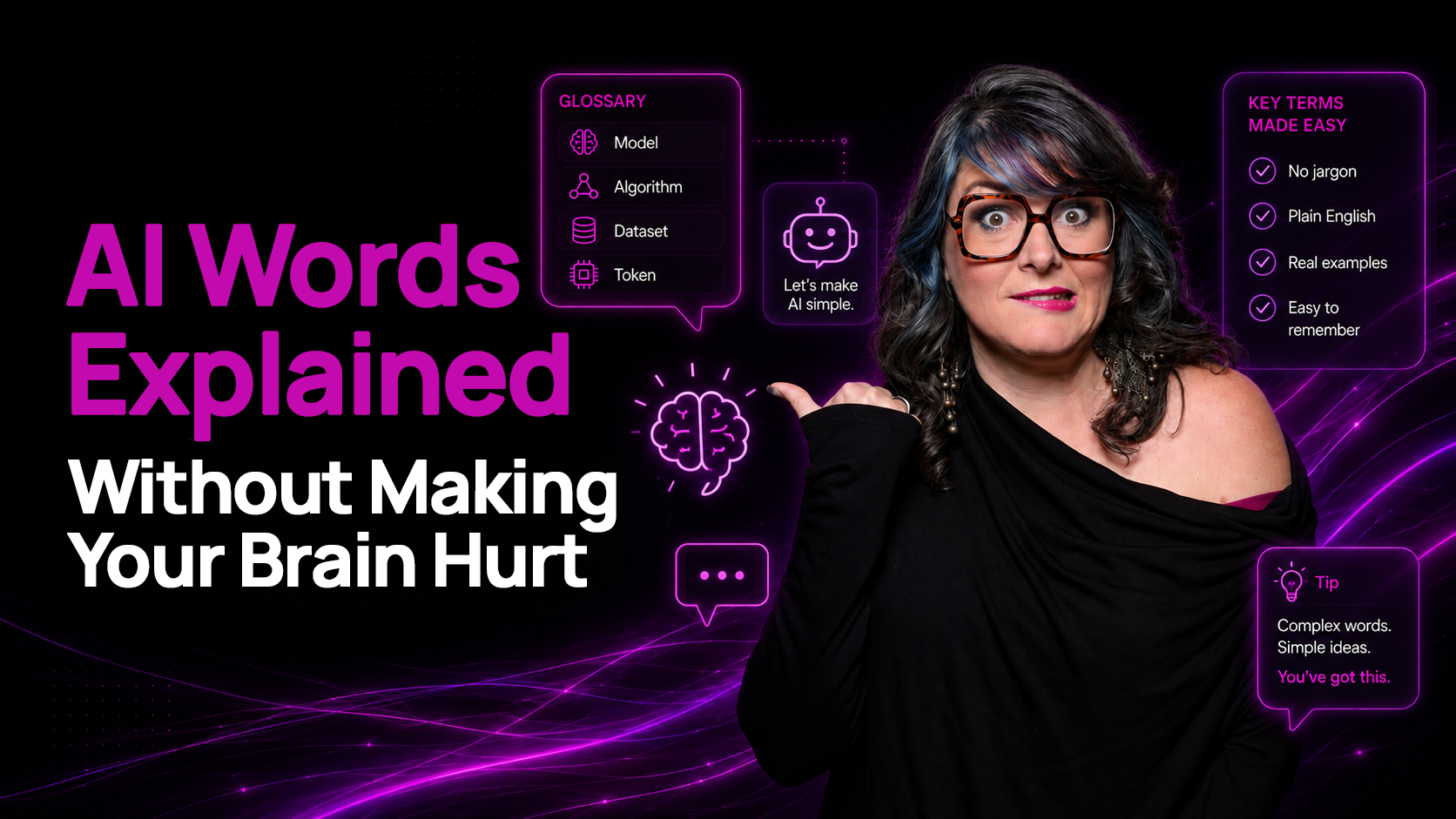

What Is An AI Glossary?
AI terms glossary is your plain-English guide to the AI terms you keep hearing and half-nodding through. No code. No computer science degree required.
If you’ve ever heard someone talk about AI models, prompts, agents, automation, machine learning, or generative AI and thought, “I know these words, but I’m not entirely sure what they mean,” this AI terms glossary is for you.
You don’t need to be a programmer. You need to be the expert. This AI terms glossary simply makes sure unfamiliar AI vocabulary never gets in the way of that.
Think of this as your go-to AI terms glossary whenever you come across a new AI term and want a straightforward explanation without the technical jargon. Every term is defined the way you’d explain it to a smart friend over coffee, not the way a textbook would.
From basic AI terminology to more advanced concepts, this AI terms glossary breaks down the language of artificial intelligence into simple, practical explanations you can actually understand and use.
Because understanding AI shouldn’t require a computer science degree. You just need an AI terms glossary that speaks your language.
Who This Is For
This is for business owners, marketers, coaches, and consultants who keep hitting words like “agent,” “hallucination,” and “context window” in articles, trainings, and sales pages, and nodding along without actually knowing what they mean.
You don’t need to become technical to use AI well. You need enough of the language to have the conversation, ask the right question, and know when something someone’s selling you doesn’t add up. If you’ve ever sat in a training feeling one vocabulary word behind everyone else, this is for you.
Key Takeaways
- You do not need to learn 70 terms to use AI well in your business. You need about five, and they’re listed first.
- Most “AI overwhelm” is vocabulary overwhelm, not skill overwhelm. Once the words make sense, the tools stop feeling intimidating.
- A hallucination is AI confidently telling you something wrong. Knowing that word is the reason you double check anything before it reaches a client.
- An AI agent can complete a chain of tasks toward a goal. Once you understand that difference, you stop thinking of AI as a chatbot and start thinking of it as a team member.
- You don’t need to be a programmer to run an AI-powered business. You need to be the expert, and this glossary hands you just enough language to direct the AI toward what you already know.
Table of Contents
Start Here: The Five Terms That Actually Matter
If you read nothing else on this page, read this part.
- Prompt. What you ask the AI to do.
- Context. What the AI knows while it’s completing your task. Your instructions, your files, your earlier messages.
- Hallucination. An answer that sounds completely believable and is not accurate. Always verify before it goes out the door.
- AI Agent. An AI worker that can complete a series of connected steps toward a goal, not just answer one question.
- Human in the Loop. The person, you, who reviews and approves the AI’s work before anything important actually happens.
Everything else in this glossary is here so you’re never caught off guard. These five are the ones to actually know.
The Full Glossary, A to Z
A
AI Agent: An AI-powered worker that can complete a series of tasks toward a goal. Unlike a basic chatbot, an agent can research information, use tools, update files, or trigger automations on its own.
AI Assistant: An AI tool built to help with tasks like writing, brainstorming, planning, research, customer support, or digging through data.
AI Automation: A workflow where AI handles part of something you already do on repeat. Example: it summarizes the sales call, drafts the follow-up email, and logs the details in your CRM.
AI Avatar: A digital version of a real person that can appear in videos, speak from a script, or interact with an audience.
AI Model: The underlying technology that makes an AI tool work. ChatGPT, Claude, and Gemini are products, each powered by a different AI model underneath.
API: A connection that lets two pieces of software exchange information. Think of it as a digital waiter carrying requests between two systems.
Artificial Intelligence (AI): Technology that can perform tasks that usually require human thinking: understanding language, recognizing images, finding patterns, generating ideas.
C
Chatbot: A tool that talks to people through text. Some follow simple rules. The better ones use AI to understand you and respond in a more natural way.
ChatGPT: An AI assistant built by OpenAI. Handles writing, planning, research, analysis, coding, images, and a long list of other tasks.
Claude: An AI assistant built by Anthropic. Commonly used for writing, analysis, working with documents, coding, and longer projects.
Computer Vision: AI’s ability to understand visual information: photos, videos, screenshots, handwriting, objects.
Connector: A built-in bridge that lets an AI tool reach into another service, like Google Drive, Gmail, Slack, or your calendar.
Context: The information AI can see and use while it’s responding to you. Could include your prompt, earlier messages, uploaded files, project instructions, or saved information.
Context Window: How much information an AI model can hold and consider at one time. A bigger window means it can work with longer conversations and documents.
Custom GPT: A customized version of ChatGPT built for one specific purpose, with its own instructions, reference files, tools, and conversation starters.
D
Deep Learning: A type of machine learning that uses layered, complex networks to recognize patterns in large amounts of information.
Deepfake: AI-generated or AI-edited media that makes it look like someone said or did something they never actually said or did.
E
Embedding: A numerical representation of information that helps AI understand which ideas are related to each other. Shows up a lot in AI search and knowledge bases.
F
Fine-Tuning: Additional training that adjusts an AI model for a specific task, industry, style, or type of information. More technical than just giving the AI instructions or reference files.
Foundation Model: A large AI model trained on a broad range of information that can later be adapted for many different specific uses.
G
Generative AI: AI that creates something new: text, images, audio, video, presentations, or code.
Gemini: Google’s family of AI models and assistants.
GPT: Short for “Generative Pre-trained Transformer.” In plain English, a type of AI model built to understand and generate language.
Guardrails: The rules and restrictions that tell an AI system what it can do, what it should avoid, and when it needs a human to approve something first.
H
Hallucination: This is what happens when AI has too much information (or not enough information), and so it makes up answers without permission. If you get an answer that sounds completely believable, it may actually not be accurate. Always verify before it goes out the door.
Human in the Loop: A process where a person reviews, approves, or adjusts the AI’s work before anything important actually happens.
I
Image Generation: Using AI to create a new image from written instructions or reference images.
Inference: The moment when a trained AI model uses what it has learned to create an answer, prediction, image, or other result.
Input: The information you give an AI system. Could be a prompt, a file, a photo, a spreadsheet, a voice recording, a video.
K
Knowledge Base: An organized collection of information an AI system can search and use. Might include company documents, policies, offers, training materials, or FAQs.
L
Large Language Model (LLM): An AI model trained on large amounts of text so it can understand and generate language that sounds human.
M
Machine Learning: A way of building software that learns patterns from examples instead of being manually programmed for every possible situation.
Memory: A feature that lets an AI assistant retain useful information across conversations or work sessions. What gets remembered depends on the tool and its settings.
MCP (Model Context Protocol): A standard that helps AI tools connect to outside systems, data, and actions. Think of it as a universal adapter for AI.
Multimodal AI: AI that can work with more than one type of information at once: text, images, audio, video, files.
N
Natural Language Processing (NLP): Technology that helps computers understand, interpret, and create human language.
Neural Network: A computing system loosely inspired by the way the human brain identifies patterns. One of the major building blocks of modern AI.
O
Open Source Model: An AI model whose code, technical details, or model files are made available for others to inspect, use, or modify, depending on the license.
Output: The result produced by AI: an answer, an image, a summary, a spreadsheet, a video, a piece of code.
P
Parameter: One of the internal values an AI model learns during training. More parameters can mean more capability, but size alone does not determine quality.
Prompt: The instructions, question, or information you give an AI tool.
Prompt Engineering: The practice of writing and refining your instructions so AI produces something more useful.
Prompt Injection: An attempt to trick an AI system into ignoring its rules or revealing information it should be protecting. These hidden instructions can sometimes live inside websites, emails, or documents.
R
RAG (Retrieval-Augmented Generation): A method that lets AI search approved information before it answers. Example: it looks through your program materials, then answers a client’s question using exactly that material.
Reasoning Model: An AI model built to spend more effort working through a complicated problem before giving you an answer.
S
Speech-to-Text: Technology that converts spoken words into written text.
Structured Data: Information organized in a predictable format: a spreadsheet, a database, a form, a CRM record.
System Prompt: The core instructions that define an AI assistant’s role, behavior, priorities, and boundaries.
Synthetic Data: Information created artificially, often with AI, instead of being collected from real-world events or people.
T
Temperature: A setting that affects how predictable or varied an AI’s response may be. Lower settings usually create more consistent answers. Higher settings can produce more variety.
Text-to-Image: Technology that creates images from written descriptions.
Text-to-Speech: Technology that turns written words into spoken audio.
Token: A small piece of text processed by an AI model. Tokens may be whole words, parts of words, punctuation marks, or spaces.
Training Data: The information used to teach an AI model how to recognize patterns and produce responses.
Transformer: The technical architecture behind many modern language models. It helps AI understand how words and ideas relate to one another.
V
Vector Database: A specialized database that helps AI find information based on meaning instead of only matching exact words.
Voice Clone: An AI-generated version of a person’s voice. Only ever create or use one with the speaker’s permission.
W
Workflow: A defined series of steps used to complete a process. AI may handle one step, several steps, or nearly the entire workflow.
Z
Zero-Shot Prompting: Asking AI to complete a task without giving it an example first.
Few-Shot Prompting: Giving AI a few examples so it can better understand the style, format, or result you want.
Frequently Asked Questions
Do I need to learn every term in this glossary to use AI in my business?
No. Start with the five terms at the top: prompt, context, hallucination, AI agent, human in the loop. The rest of the glossary is here so you’re never caught off guard in a conversation, not homework you need to finish.
What’s the difference between an AI assistant and an AI agent?
An assistant helps you with one task at a time when you ask it to. An agent can complete a whole chain of connected tasks on its own toward a goal, like researching a topic, drafting a document, and saving it to the right folder.
Is ChatGPT the same thing as AI?
No. ChatGPT is one product built on top of an AI model. AI is the broader technology underneath it. Claude and Gemini are other products built the same way, on different models.
What is a hallucination and why does it matter for my business?
A hallucination is when AI confidently gives you an answer that is wrong or made up. It matters because if that answer goes straight to a client without a human checking it, the mistake becomes yours, not the AI’s.
Do I need to understand tokens or parameters to use AI tools well?
No. Those are behind-the-scenes numbers that matter to the people building the models. You don’t need them to use the tools day-to-day.
What does “context” actually mean when people talk about AI?
It’s everything the AI can see while it’s working on your request: your prompt, your uploaded files, your earlier messages, your saved instructions.
Is prompt engineering something I need to study formally?
No. It just means getting specific and clear about what you want, the same way you would when directing a new team member.
Do I need to know what MCP or RAG means to use AI in my business?
Only if you’re building something more advanced, like connecting AI to your files or your CRM. Most day-to-day AI use never touches these.
What’s the one term that changes how people think about AI once they actually understand it?
AI agent. Once you realize AI can complete a chain of tasks instead of just answering one question, you stop thinking of it as a chatbot and start thinking of it as a team member.
Why does this glossary avoid technical explanations?
Because you don’t need to be a programmer to use AI well in your business. You need to be the expert in your business, and know just enough of the language to direct the AI toward what you already know.
Recommendation
Bookmark this page. Copy the five terms at the top into your notes app, or print them and tape them above your desk.
That’s genuinely enough vocabulary to sit in any AI conversation, training, or sales pitch without feeling behind.
If you want the next step- structured help actually putting this language to work in your business instead of just knowing what it means- that’s exactly what AI Stars is built for.
Final Summary
You don’t need seventy AI terms. You need five: prompt, context, hallucination, AI agent, and human in the loop. This AI terms glossary gives you the essential vocabulary you actually need to understand and talk about AI with confidence.
Everything else in this AI terms exists so a strange word never stops you mid-conversation again. Whether you’re learning about AI tools, creating content, automating tasks, or simply trying to keep up with the latest AI conversations, knowing the terminology makes everything easier.
Most AI overwhelm isn’t a skills problem. It’s a vocabulary problem, and vocabulary is the easiest thing on this list to fix. That’s exactly why this AI terms glossary focuses on clear, practical definitions instead of complicated technical explanations.
You don’t need to be a programmer. You need to be the expert. This AI terms gives you the words to match. Once you understand the language, you can ask better questions, understand what AI tools are actually doing, and use them with a lot more confidence.
Ready to Put the Language to Work?
Knowing the words is step one. Using them inside a real AI-powered business is the next one.
AI Stars is where coaches and entrepreneurs go to build that muscle together, with community, live calls, and a clear path instead of 47 open browser tabs.
Join AI Stars today!



Leave a Reply