
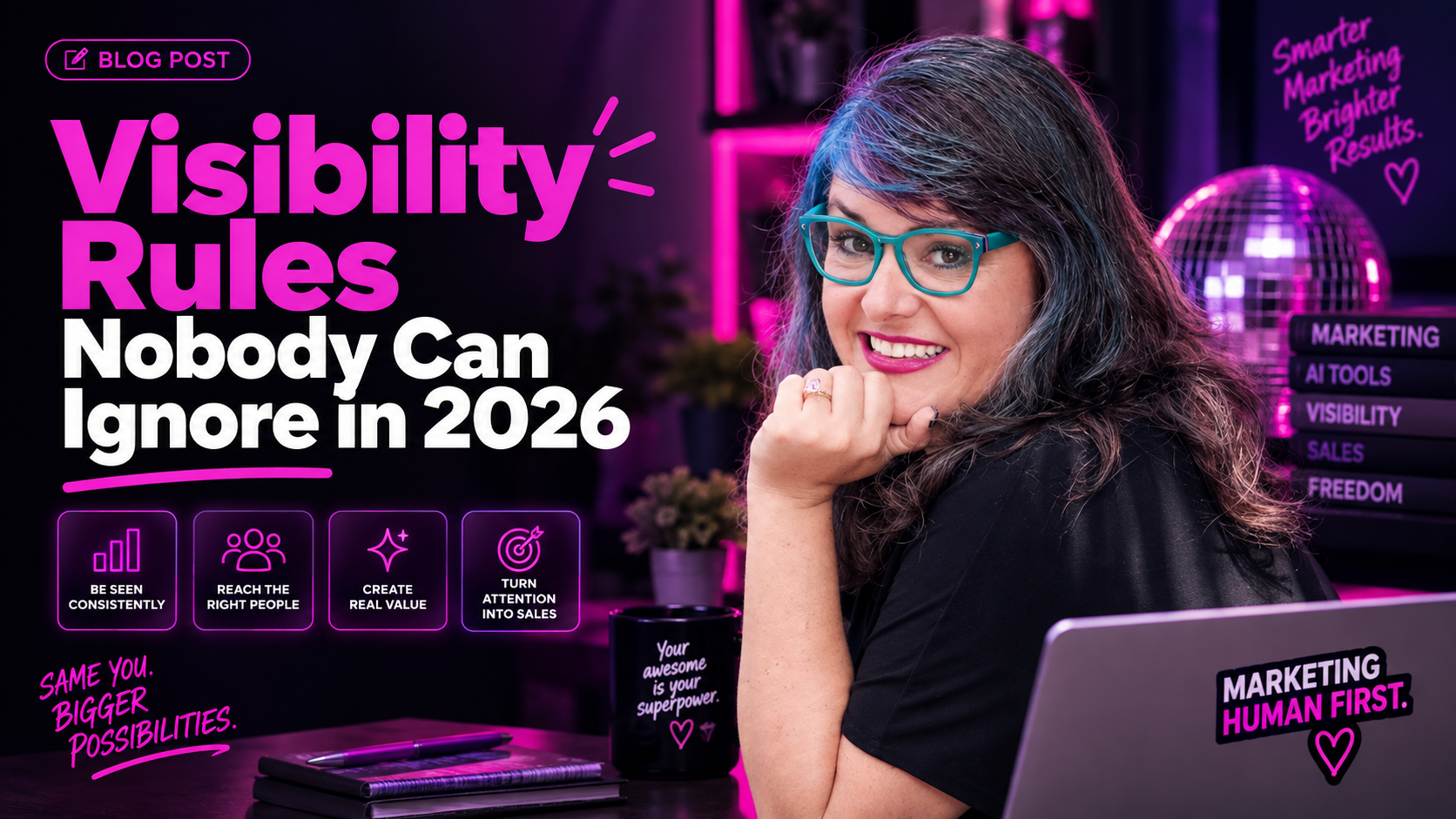

Why Your Social Media Presence Feels Invisible in 2026
I’ll give it to you straight.
Something broke in the last two years, and if you’re a coach, consultant, or course creator posting content every single day and hearing crickets, you already feel it. Your social media presence is shrinking even though you’re working harder than ever. That’s not a mood. That’s math.
Here’s what the numbers actually say. Instagram’s average reach for business and creator accounts dropped to roughly 3.5% of your followers per post. Facebook is sitting even lower, around 1.25%. If you have a hundred thousand followers on your Facebook Page, your typical post might reach five hundred people. Let that land for a second.
Social media consists of digital websites and applications that now serve over five billion users worldwide. Social media users spend an average of 2 hours and 39 minutes daily scrolling through feeds. That’s a staggering amount of attention floating around, and yet your posts are reaching fewer people than ever. The competition for every second of that time spent on these platforms is brutal.
Getting seen on social media in 2026 isn’t one game anymore. It’s two. And if you only play one, you lose both.
Content visibility now means two things: what social media algorithms choose to show real humans in their feeds, and what AI systems like ChatGPT, Perplexity, and Google’s AI Overviews choose to quote when someone asks a question in your space. In this guide, I’m breaking down exactly what changed and what to do about it.
If you’re making at least $5K a month and wondering why your reach quietly died while you were busy creating content, I wrote this for you.
Table of Contents
The Two Visibility Games in 2026: Algorithms vs. AI
Let me make the distinction crystal clear because most people are only playing one of these games.
Game one is the algorithm. Every time you post on Instagram, Facebook, TikTok, LinkedIn, or YouTube, the platform’s ranking system decides who sees it. This has always been the game. It’s driven by signals like watch time, shares, saves, comments, and relationship strength between you and your followers. Social media algorithms scan your post, score it, and decide whether to push it to ten people or ten thousand.
Game two is AI. When someone types “How do I price my coaching program?” into ChatGPT, Perplexity, or Google’s AI Overviews, a completely different system decides whose content to cite. It doesn’t care about your follower count. It cares about depth, structure, authority, and whether other people are talking about you.
Here’s a concrete example. You post a Reel that gets 50,000 views in 48 hours. Great for game one. But that Reel almost never gets quoted by AI because it’s too short to extract meaningful information from. Meanwhile, a 20-minute YouTube video you recorded last month, with a full transcript and detailed description, gets cited in an AI Overview six months later and drives coaching inquiries from people who never followed you on any social media platform.
Social media’s role has evolved dramatically since the first social media sites like SixDegrees, Friendster, and MySpace launched. Social media allows for two-way interactive communication, and that’s still true. But now these platforms also serve as training data and source material for AI systems. Social media evolves through technological advancements and user patterns, and this is the biggest shift since the rise of smartphones changed social media from desktop to mobile.
You need to understand both games because they reward different things. Algorithms want engagement right now. AI wants depth and authority over time.
What Changed in Social Media Platforms From 2023–2026
Before we get into the rules, let’s look at the numbers. These aren’t vibes. These are benchmarks from real datasets.
Social media had over five billion users by 2025, up from around 3.96 billion in 2022. More people, more content, more competition for the same finite attention. Here’s the snapshot:
- Instagram organic reach dropped roughly 12–14% year over year. The average business or creator post now reaches about 3.5% of followers, down from approximately 4% in 2024. Median reach across all formats (carousels, images, Reels) fell 30–40% in the first half of 2025 alone.
- Facebook Page reach averaged about 1.25% of followers per post across a dataset of over 872,000 brand posts. Pages with 100K–1M followers saw just 0.50% reach. Link posts were worst at 0.20%.
- Shares overtook likes as the primary quality signal. Emplifi’s 2026 benchmark report showed shares per reach increased approximately 150% year over year on Instagram.
- Watch time and video completion now outweigh passive engagement on every major platform. Posts that get skipped in the first few seconds are deprioritized quickly.
- Content goes stale fast. Social media algorithms increasingly treat posts older than 48–72 hours as irrelevant unless they continue earning saves, shares, or external traffic.
- AI citations favor long-form content. On YouTube, approximately 94% of AI citations go to videos over five minutes long. Shorts receive about 5.7%.
Remember: 53% of U.S. adults get news from social media often or sometimes, according to the Pew Research Center. That means social platforms remain massively influential, but the rules for who gets seen have fundamentally changed.
The Four New Visibility Rules You Must Follow in 2026
Everything I found boils down to four rules. Two are about the algorithm. Two are about AI. Here’s the overview before I break each one down:
Rule 1: Engagement quality beats engagement quantity. Watch time and shares carry more weight than likes on every major platform. This means your content needs to hold attention, not just attract a quick tap.
Rule 2: Formats shift fast, so stay flexible. Social media platforms keep reshuffling what they favor. Building your entire strategy around one content type that worked in 2023 is a recipe for declining reach this quarter.
Rule 3: Long-form content is how AI learns your name. Short videos are great for human discovery. But if you want AI to know you exist and quote you as an authority, you need depth that Reels and Shorts cannot provide.
Rule 4: Other people’s platforms amplify you. Most of what AI says about you comes from somewhere other than your own feed. Guest appearances, podcast mentions, and collaborations do more for your online visibility than another solo post ever could.
Each rule gets its own section with examples and action steps below.
Rule 1: Watch Time and Shares Beat Likes on Every Major Platform
I used to celebrate every like. I still appreciate them. But likes have quietly lost their power as ranking signals across Instagram, Facebook, TikTok, YouTube, and LinkedIn between 2024 and 2026.
What replaced them? Dwell time and shares.
Dwell time is how long someone actually stays with your content. Did they watch the full Reel or swipe away at second two? Did they read the entire carousel or just glance at the cover slide? That duration now directly affects the content visibility property of your post in the feed. The longer people stay, the more the algorithm interprets your content as relevant and worth showing to other users.
Shares are even more powerful. When someone taps “send” and forwards your content to a friend, the platform reads that as the highest form of endorsement. It’s why Emplifi found a 150% increase in share-per-reach on Instagram alone.
Here’s a quick example. A Reel with 200 likes but a 75% completion rate and 40 shares will outperform a Reel with 800 likes but a 20% completion rate and 3 shares. The second post got more surface-level approval. The first post actually held attention and got forwarded. The algorithm knows the difference.
Do this now:
- Rewrite the first three seconds of every video. Use a pattern interrupt, a curiosity hook, or a direct call-out of your target audience. “Coaches making $10K a month, stop scrolling” beats “Hey everyone!”
- Add subtitles. Many social media users watch on mobile devices with sound off. If they can’t follow your content silently, they scroll past.
- End with a shareable moment. Ask a question, make a bold statement, or deliver a takeaway someone would forward to a colleague.
- Stop checking likes first. Open your analytics and look at average watch time and share count. That’s your truth metric now.
- Track which posts get the most engagement through saves and shares, not just hearts. Those are your best posts, and you need to make more like them.
One thing that’s helped our community enormously is building a small content strategy that drives real revenue without going viral. Virality is not the goal. Retention and shares are.
Rule 2: Format FOMO-Why You Can’t Marry Just One Content Type
Social media platforms are constantly shifting what formats they push. Instagram’s currently favoring Reels and carousel posts. TikTok popularized short-form video content and infinite-scroll algorithms that keep users locked in. YouTube is pushing both Shorts and long-form concurrently. LinkedIn just expanded its newsletter and video features.
Instagram and Snapchat popularized visual storytelling formats years ago, and the platforms haven’t stopped innovating since. Social media posts with visuals get more engagement than text-only posts, which is why every platform keeps leaning into richer media. As platforms evolved, photo sharing became a core feature that pushed richer visual behavior on apps like Instagram. But the specific format that gets rewarded changes season to season, and visual posts are competing not just with text but with other content users scroll past in the same feed.
The creators getting buried right now? They’re the ones still doing the exact same content type that worked in 2023. Only static image quotes on Instagram. Only Stories. Only text tweets. The platform moved, and they didn’t.
Here’s what I’d suggest instead: maintain consistency with two to three formats per platform rather than going all-in on one.
- Instagram: Reels + carousels + occasional Stories. Carousel posts in particular are generating strong saves right now.
- YouTube: One long-form video per week + two to three Shorts cut from that same content.
- LinkedIn: Text posts + document carousels + native video.
- TikTok: Short videos with multiple images or text overlays, plus occasional longer pieces (three to five minutes are getting traction).
Social media algorithms tend to give extra reach to new features when they launch. Early adopters of Reels saw massive reach boosts. The same pattern repeats with every new feature rollout. Experimenting early pays off, but that boost decays once the format becomes saturated.
A client of mine spent all of 2024 posting only Instagram Stories. Reach was fine-until it wasn’t. She started mixing in Reels and carousels in early 2025 and saw her reach jump back up within six weeks. She didn’t change her message. She changed the container.
Stay loose. Watch what your platform is rewarding right now. Don’t fall in love with one format when the platform is already flirting with the next.
Rule 3: Long-Form Content is How AI Learns Your Name
This is the rule that changed everything about how I plan content now.
On YouTube specifically, about 94% of AI citations go to long-form videos, while Shorts get roughly 5.7%. A more detailed breakdown from research by OtterlyAI and Authoricy shows that 32.1% of cited videos fall in the 10–20 minute range, 26.1% in the 5–10 minute range, and 17.6% over 20 minutes. Videos under three minutes barely register, regardless of view count.
Why? A twenty-minute video with your face, your expertise, and a full transcript reads like an authoritative source. AI can extract discrete, quotable segments from it. A fifteen-second clip doesn’t give AI enough context to work with.
The surrounding text matters enormously too. Video content with detailed descriptions, chaptering, and transcripts correlates strongly with citation rate-more so than pure viewership numbers. AI engines prefer content they can parse and segment.
Here’s the ladder approach I recommend:
- Start with one pillar piece per week. A YouTube video, a long-form podcast episode, or a deep blog post. This is your anchor content.
- Slice it. Cut three to five short videos from that pillar piece for Reels, TikTok, and Shorts.
- Transcribe everything. Always add full transcripts, accurate titles, and detailed descriptions so AI can understand your authority.
Keep making short videos. They’re still how people find you day to day on social platforms. But if you want AI to know your name when someone searches for expertise in your niche, post the long version somewhere and structure it well.
I’ve been experimenting with this approach using our AI content workflow, and the difference in how often my content surfaces in AI-generated answers has been noticeable.
Rule 4: Social Proof Visibility-Why AI Quotes Others Talking About You
Here’s a stat that shook me: roughly 85% of what AI says about anyone comes from somewhere other than their own page.
Not your Instagram feed. Not your YouTube channel. Not your website’s “About” page.
It comes from a podcast someone else hosted. A blog post someone else wrote mentioning your name. A review. A comment thread. User-generated content drives social media platforms, and it also drives what AI models learn about you.
Off-platform mentions, guest content, and features serve as high-authority sources that AI trusts more than your own marketing copy. When a podcast host introduces you as an expert, and you spend 45 minutes teaching, that transcript becomes source material. When a colleague tags you in a LinkedIn post about industry trends, that’s a signal, and showing up on other social networks expands the pool of mentions AI can learn from.
Your 30-day outreach mini-plan:
- Identify 10 creators or business owners aligned with your niche.
- Pitch 3 guest opportunities: a podcast appearance, a guest training in someone’s membership, or a co-hosted live.
- Comment daily in 1–2 high-value communities where your ideal clients hang out. Not spammy self-promotion-genuine, helpful responses that position you as the go-to expert.
- Accept every opportunity to be on someone else’s platform this month.
Some of our biggest visibility wins came not from our own social media posts but from showing up in other people’s ecosystems. Speaking on stages, guesting on podcasts, teaching inside other memberships. Every one of those appearances builds a community around your brand that extends far beyond your own feed.
Showing up on other people’s platforms multiplies both your algorithmic visibility and your AI citations. It’s the leverage play most creators ignore.
How Social Media Algorithms Actually Decide to Hide or Show Content
Let’s demystify what’s happening behind the curtain. Social media features include user profiles and interaction tools, but the real engine is the algorithm that decides who sees what. Here are the key factors across major social networks:
- Interests: The algorithm predicts whether you’ll care about a post by inferring what matters to you from past behavior and engagement patterns. If you consistently engage with business coaching content, you see more of it.
- Recency: Newer posts get priority. Content older than 48–72 hours gets treated as off-screen content unless it’s still generating engagement.
- Relationship: Posts from accounts you interact with frequently rank higher. The algorithm tracks DMs, comments, profile visits, and story views.
- Engagement quality: Comments, saves, and shares dramatically outweigh likes. Social media algorithms can increase political polarization partly because high-emotion content drives these deeper engagement actions.
- Negative signals: When users tap “not interested,” mute your Stories, or scroll past quickly, the algorithm learns to hide content from you in future feeds. These signals quietly suppress your reach.
Platform-specific notes:
- Instagram: Prioritizes Reels completion rate, shares via DMs, and saves. The element’s rendering in the feed heavily favors video.
- Facebook: Favors content from Groups and personal profiles over Pages. Facebook users engage more with native content than outbound links.
- TikTok: Watch time and rewatches are king. The algorithm will show your video to non-followers aggressively if early retention signals are strong.
- LinkedIn: Comment depth matters. Long comments signal interest. Document posts and newsletters get extended shelf life.
- YouTube: Session watch time and click-through rate determine whether your video gets recommended beyond subscribers.
Stop obsessing over likes alone. Start paying attention to whether people are staying, saving, and sharing.
The Double Funnel: Human Feed vs. AI Discovery
A single post can travel through two entirely different funnels in 2026.
Funnel one is immediate. You post, the algorithm evaluates, and your content appears (or doesn’t) in followers’ feeds within hours. This is the rendering state most creators focus on: how many people saw it, how many engaged, how quickly it happened.
Funnel two is long-term. If your content has enough depth, structure, and external validation, AI systems may surface it weeks or months later when someone asks a relevant question.
A “How to price your coaching program in 2026” YouTube video with a proper transcript and description could appear in Google AI Overviews, Perplexity answers, and ChatGPT citations long after the social media buzz faded.
Here’s how to feed both funnels simultaneously:
- Use question-based titles. “How do I grow my coaching business without ads?” performs better in both algorithmic search and AI retrieval than “My thoughts on growth.”
- Answer one specific query deeply. Don’t try to cover ten topics in one piece. Go deep on one.
- Mention your name and brand clearly. AI needs to associate your identity with your expertise. Say your name in video intros. Include it in descriptions.
- Use consistent terminology. If you always call it “authentic AI marketing,” AI will learn to associate that phrase with you.
Social media content can drive traffic and convert visitors, and it can also plant long-term seeds in AI knowledge bases. The creators who understand both funnels will own their categories.
Designing a 2026 Social Media Content Calendar That Serves Algorithms and AI
A content calendar in this context isn’t just a posting schedule. It’s a 30–90 day plan that balances formats, online platforms, and topics across both short-form and long-form content.
Here’s the split I recommend:
- 60% fast social content: Reels, carousels, Stories, Lives, TikToks, LinkedIn posts. These feed the algorithm and keep your audience engaged day to day.
- 40% anchor content: YouTube videos, podcast episodes, blog posts, deep-dive trainings. These feed AI systems and build long-term authority.
Map your content around three to five core pillars. For example:
- Educate (teach a skill your target audience needs)
- Inspire (share stories, client wins, personal connection moments)
- Authority (deep dives, data, expert takes)
- Sell (offers, testimonials, case studies)
- Entertain (behind the scenes, humor, trends)
Example week:
- Monday: Record a 15-minute YouTube video on one core topic (anchor content)
- Tuesday: Slice three Reels from that video + post an Instagram carousel summarizing key points
- Wednesday: LinkedIn text post expanding on one idea from the video + engage in comments
- Thursday: TikTok short video with a hot take from the same content pillar
- Friday: Go Live on Instagram or Facebook answering audience questions on the topic
- Weekend: Batch plan next week using AI-powered tools for outlines and hooks
The creator economy has emerged with individuals earning directly from creating content, and one in five social media users considers themselves a professional content creator. The bar is higher than ever, which means your content calendar needs to be intentional, not random.
Using AI Ethically to Create Social Media Content Without Losing Your Voice
Here’s where I’ll be direct about something I care deeply about.
AI is a collaborator, not a ghostwriter. Your stories, your values, your voice come first. Always.
We teach entrepreneurs to use AI for the parts of content creation that drain energy-outlines, hook ideas, batch topic generation, content calendar planning-while the human adds personality, lived experience, and that irreplaceable personal connection that builds trust.
Here’s what 85% of marketers see as their primary challenge: content creation itself. AI solves the “staring at a blank page” problem. It doesn’t solve the “sounding like a real human” problem.
What to avoid: copy-paste generic AI posts that feel robotic. They get low engagement, and both algorithms and AI systems are getting better at recognizing templated content. If your posts sound like everyone else’s, you’ll blend into the noise.
Try these practical prompts to maintain authenticity:
- “Give me 10 Instagram Reel hooks about [your topic] written in a conversational, slightly irreverent tone for [your audience].”
- “Create a YouTube video outline for a 15-minute deep dive on [specific question your clients ask]. Include timestamps.”
- “Write 5 LinkedIn post openings that challenge a common myth in [your industry].”
The key is to use AI for structure, then inject your own set of stories, opinions, and energy. That’s exactly how we approach it inside programs like AI Content Club and AI Stars. If you want to see how we’ve systematized this, check out our guide on humanizing your brand in 2025.
Social media marketing includes paid, earned, and owned media strategies. AI helps you execute all three faster. But the authenticity has to come from you.
Tuning Your Message for Each Social Media Platform Without Burning Out
You don’t need to be everywhere doing everything. But you do need to respect that each platform has its own culture, and posting the same content verbatim across all social media apps is a fast track to mediocre results.
The core message stays the same. The container changes.
Here’s how the same idea-“Why your coaching offer isn’t converting”-looks across platforms:
- Instagram Reel: 30-second hook-heavy video with text overlay, ending with “save this for later”
- Instagram Carousel: Five slides breaking down the three pricing mistakes, using multiple images and clean design
- LinkedIn Post: 800-word thoughtful essay version with a personal anecdote about a client win
- YouTube Video: 12-minute deep dive with screen shares, examples, and a structured transcript
- TikTok: 15-second punchy clip with the single most surprising stat
Social media offers networking opportunities for professional connections, especially on LinkedIn, where educational content performs differently than on Instagram. It’s also where many professionals share content like industry analysis or company updates to build credibility. The tone shifts. LinkedIn rewards professional depth. Instagram rewards visual punch and shareability. TikTok rewards energy and immediacy. YouTube rewards thoroughness.
Repurposing wisely-not copying blindly-keeps your content calendar full while respecting each platform’s algorithm and culture. This is how you maintain consistency across multiple accounts without burning yourself out managing every single post from scratch.
If Facebook’s algorithm is suppressing your links, we’ve written about bypassing Facebook’s link-sharing limits while still driving traffic.
Balancing Evergreen and Timely Content for Lasting Visibility
Not all content has the same shelf life, and understanding the difference is essential for long-term content visibility.
Evergreen content answers questions your audience will always ask. “How to launch a course.” “How to price coaching.” “How to get clients on Instagram.” This content performs better for AI and search visibility over time because it remains relevant for months or years.
Timely content reacts to current events, platform updates, or industry trends. A post about Instagram’s latest algorithm change or a breakdown of a trending topic. These posts spike reach in social media feeds because algorithms love recency, but they fade fast.
My recommendation: aim for approximately 70% evergreen, 30% timely.
Start by listing 10 evergreen questions your clients always ask:
- How do I get more visible without paid ads?
- What should I post on social media?
- How do I create engaging content that converts?
- How do I start a coaching business?
- What’s the best content type for my industry?
Turn each of those into a pillar post, a YouTube video, and a series of short clips. That library compounds over time while your timely posts keep you relevant in the feed today.
Signals That Tell Algorithms and AI You’re a Trusted Authority
Both social media algorithms and AI retrieval systems are looking for the same thing: signals that you’re a credible, consistent expert in a specific space.
Here’s what builds that brand presence:
- Consistent posting schedule. Not daily necessarily, but predictable. Algorithms reward accounts that show up regularly.
- Depth of explanation. Surface-level tips are everywhere. The experts who go deep, who explain the “why” behind the “what,” earn higher trust signals.
- High save and share rates. These engagement metrics tell the algorithm your content has lasting value.
- Off-platform citations. Podcasts, guest posts, reviews, and features. These are the signals AI systems weight most heavily when deciding whose content to cite.
- Niche focus. If you talk about twenty different topics, neither algorithms nor AI can figure out what you’re known for. A consistent brand voice around a specific niche (like “social selling for health coaches”) helps both systems associate you with that topic.
Social media can enhance brand awareness and customer insights, but only if you’re recognized as a trusted source. I encourage publishing at least one “deep dive” per month, a masterclass-style session or 30–60 minute video that truly answers a problem in detail.
Over 93% of B2C brands use social media for lead generation, which means your potential customers are actively looking for expertise in feeds and AI answers. The question is whether they find you or your competitor.
Measuring Visibility: Metrics That Actually Matter in 2026
Stop measuring vanity. Start measuring behavior.
For algorithmic success, track:
- Reach (per post and trend over 30 days)
- Watch time and average view duration
- Saves and shares (your real engagement metrics)
- Profile taps and website clicks
- Comment quality (not just count)
For AI success, track:
- Search impressions for your name and brand (Google Search Console)
- Branded search growth over time
- Mentions in AI tools (search yourself in ChatGPT, Perplexity, Google AI Overviews monthly)
- Inbound leads who say “I found you through…” and mention search or AI
Monthly visibility review (takes 30 minutes):
- Export analytics from your primary platform
- Identify your top 5 posts by watch time and shares
- Map those posts to your content pillars
- Note what format, hook style, and topic drove the most engagement
- Do more of that next month
The single post that got the most engagement often reveals exactly what your audience wants more of. Pay attention to it.
Common Mistakes That Quietly Hide Your Content (and How to Fix Them)
These are the content visibility killers I see over and over again. None of them are hard to fix.
1. Posting only promotional content. If every post is “buy my thing,” users will scroll past, mute you, or tap “not interested.” That’s a hide-content signal that tanks your future reach.
Fix: Follow the 80/20 rule. Eighty percent value, twenty percent promotion.
2. Ignoring hooks. Your first line or first three seconds determine whether someone stays or leaves. Weak openings mean low dwell time, which means the algorithm deprioritizes you.
Fix: Spend as much time on your hook as you do on the rest of the post. Test different approaches weekly.
3. Inconsistent posting. Disappearing for two weeks and then flooding the feed confuses both algorithms and your audience.
Fix: Batch-create content. Even two to three posts per week posted consistently outperforms daily posting followed by silence.
4. No clear niche. If you talk about business coaching on Monday, recipes on Wednesday, and politics on Friday, algorithms can’t categorize you. Neither can AI.
Fix: Tighten your content pillars to three to five closely related topics.
5. Keyword-free descriptions. Your video descriptions, captions, and alt text are how AI understands your content. Leaving them blank is leaving more visibility on the table.
Fix: Write descriptive captions with natural keywords relevant to your expertise.
6. Deleting underperforming posts too quickly. Some posts take 48–72 hours to gain traction. Deleting them in frustration removes any chance of recovery.
Fix: Give every post at least a week before evaluating. The element’s content might find its audience on a delay.
7. Sharing links without context on Facebook. Outbound link posts on Facebook get roughly 0.20% reach. The platform actively suppresses them.
Fix: Share the value natively and put the link in the comments, or use strategies specifically designed to work around platform limitations.
8. Ignoring negative feedback signals. When other users mute your stories, mark posts as “not interested,” or unfollow, those actions train the algorithm to show your content to fewer people.
Fix: Create content that encourages comments and interaction rather than passive consumption. Encourage users to engage, not endure.
Mini 7-Day Visibility Reset Plan for Your Social Media Marketing
Ready to stop being invisible? Here’s your seven-day plan. Budget 30–60 minutes per day and pick one primary platform for this sprint.
Day 1: Audit your last 10 posts. Which ones actually held attention? Check watch time, saves, and shares. Identify your top 3 and your bottom 3. Note what was different about each.
Day 2: Rewrite your hooks. Take your bottom-performing posts and rewrite just the first line or first three seconds. Save them as templates for future content.
Day 3: Record one long-form piece. This is your anchor. Film a 10–20 minute video answering a question your target audience always asks. Get it transcribed.
Day 4: Slice 3–5 short clips. Cut your long-form video into Reels, TikToks, or Shorts. Each clip should stand alone with its own hook and takeaway. These become your social content for the week.
Day 5: Guest outreach. Reach out to three people in your niche about guesting on their podcast, co-hosting a live, or contributing to their community. This builds the off-platform authority that AI relies on.
Day 6: Comment sprint. Spend 30 minutes leaving thoughtful, substantive comments on 20–30 posts from creators and potential customers in your space. Not “great post!” but actual insights that showcase your expertise.
Day 7: Review analytics. Check what moved. Compare this week’s reach, shares, and watch time to the previous week. Adjust and repeat.
If you follow this plan, share your results. I’d love to see what shifts for you.
Case Study Snapshot: Turning Invisible Posts Into a Visible Personal Brand
Let me share a quick story from inside our community.
A health coach came to us in mid-2025 stuck at about 1.5% reach on Instagram. She was posting five times a week-beautiful graphics, thoughtful captions-and getting almost no traction. Her content was good. The algorithm just wasn’t distributing it.
Here’s what we changed together. First, she introduced one long-form YouTube video per week, properly transcribed and chaptered. Second, she revamped her hooks on Instagram, leading with bold pattern interrupts instead of soft greetings. Third, she increased off-platform collaborations: two podcast guest spots and one guest training inside a colleague’s membership over 60 days. Fourth, she tightened her content pillars from eight loosely related topics down to three.
Within 90 days, her Instagram reach climbed back above 4%. Her YouTube videos started appearing in AI Overviews.
Her email list grew by 35%. And for the first time, she started receiving inbound coaching inquiries from people who said, “I found you through a Google search” or “ChatGPT recommended you.”
She didn’t go viral. She got strategic. That’s what building a visible personal brand looks like in 2026.
How Social Media Content, SEO, and AI Search Work Together
These three systems aren’t separate anymore. They feed each other.
Your social media content drives traffic to your website and YouTube channel. Your website and YouTube channel (when properly optimized) get indexed by search engines and picked up by AI systems. Your AI visibility then drives new people back to your social profiles. It’s a loop.
Here’s how to make the loop work:
- Use consistent keywords between your social media captions, video titles, blog posts, and website copy. If you always talk about “AI-powered content for coaches,” AI learns to associate you with that phrase.
- Update your bio links across all social media sites to point to your most important landing pages or long-form content.
- Add descriptive keywords in your YouTube and podcast descriptions. Generic descriptions get ignored by AI.
- Cross-link between your socials and your site. When sharing links from your blog on social, drive the connection between platforms.
Influencer marketing effectively reaches younger consumers who trust endorsements, but for coaches and consultants, the bigger play is building your own searchable, citable body of work that AI recognizes as authoritative. Google’s AI Overviews often pull from authoritative pages supported by social engagement signals. Your social media marketing feeds that ecosystem.
Your Next Steps: Putting the New Visibility Rules Into Action
Here’s the core idea one more time: visibility in 2026 is two games. Social media algorithms want watch time and shares. AI wants long-form content and other people talking about you. Play both, and you’re not just seen. You’re remembered.
The four rules, one more time:
- Watch time and shares beat likes. Engineer your content to hold attention and get forwarded.
- Formats shift fast. Stay flexible and experiment with what your platform is currently favoring.
- Long-form content fuels AI. Post the deep version somewhere. Get it transcribed.
- Other people’s platforms amplify you. Show up where you’re not the host.
Don’t try to overhaul everything at once. Pick one platform and one rule to implement this week. Small, consistent tweaks beat sporadic big efforts every single time.
If you want a deeper dive into how to plan all of this, explore our guide on authentic AI marketing for experts. And if you’re ready for the full system, keep reading.
Work With Us: AI Stars and Next-Level Visibility
I built AI Stars for exactly this moment.
The system for showing up on social media and getting picked by the algorithm and by AI-without losing your actual personality in the process.
Here’s what AI Stars helps you achieve:
- Build an AI-backed content system that produces engaging content across platforms without burning out
- Grow your organic social reach using the exact strategies in this guide, implemented with support and accountability
- Show up confidently on video so your long-form content actually gets made (not just planned)
- Get remembered by both algorithms and AI as the go-to expert in your space
Like any powerful tool, social media can help young people keep in touch and make more friends, but here the focus is on using it to build real visibility for your business.
This is for entrepreneurs already at or near $5K/month who are ready to scale and want a proven system, not another course collecting dust.
👉 Learn more about AI Stars here
You didn’t build your business to be invisible. You built it to make an impact. That is how you make sure the world-and the algorithms, and the AI-actually sees it.

Leave a Reply