

AI Stars is worth considering if you’re a coach looking for AI marketing training focused on authentic content strategy not a substitute for a clear offer or your own judgment. Choose based on whether the current program addresses a specific marketing task you need help with, rather than the appeal of adding more AI tools.
- Is AI Stars worth it for coaches? Consider it for authentic content strategy, not as a shortcut to sales.
- We offer AI marketing training for coaches, creators, and entrepreneurs.
- Compare guided training with independent practice against a specific task in your coaching business.
- Before enrolling, check the current curriculum, participation requirements, and terms against your actual needs.
Why this matters
Your coaching business doesn’t need content that sounds impressively automated. It needs content that helps the right person understand what you do, how you think, and what to do next. That’s a different buying decision from choosing software that generates text.
We offers AI-powered marketing coaching and training, including AI Stars, for coaches, creators, and entrepreneurs.Our AI marketing training is best considered by coaches who want help with authentic content strategy. That is a fit statement, not a promise of business results.
For your 2026 decision, separate the category from the purchase. Wanting help with AI marketing doesn’t automatically mean a particular program is right for you. The useful question is whether its current teaching matches a problem you can name and work on.
Is AI Stars worth it for coaches in 2026?
AI Stars belongs on your shortlist when your priority is learning to use AI in your marketing while staying recognizably yourself. Before enrolling, compare the current program details with the work you actually need to do: explaining your offer, developing content, or improving how you communicate with prospective clients.
Don’t judge the purchase by how much content you hope to produce. Judge it by the decisions you want to make better. A longer content queue isn’t much use if every post avoids your buyer’s real question.
Use this comparison to choose a learning approach. These are decision criteria, not claims about AI Stars’ current curriculum or delivery format.
| Approach | Best for | Main advantage | Main limitation |
|---|---|---|---|
| Consider AI Stars | Coaches seeking AI marketing training connected to authentic content strategy | The stated training focus matches that learning goal | You still need to verify that the current program covers your specific task |
| Practice independently | Coaches who can define a task and evaluate their own drafts | You control the topic, pace, and exercises | You must select learning material and judge the work yourself |
| Clarify your marketing before choosing training | Coaches who cannot yet explain their buyer, offer, or message | You establish criteria for a useful purchase | This does not teach you how to use AI |
The strongest reason to consider AI Stars is a match between its stated focus and your learning goal. The weakest reason is feeling behind because everyone else seems to be using AI.
A program name isn’t a decision framework. Your business task is.
Start with a real task, not a wish list
Write down one job you want to do more confidently. Be precise: turning your own explanation into an educational post is a task. Becoming better at marketing is too broad to evaluate.
Bring the original material you want to work from, such as your description of a coaching problem or an example you have permission to share. Then define what a useful finished piece should help a reader understand.
That gives you a concrete question to ask about the current program. Does the teaching address this kind of work? If the answer stays vague, don’t replace it with enthusiasm.
Who should consider AI Stars?
Best for: coaches seeking training around authentic, AI-assisted marketing. Your starting point should be a business message you want to communicate—not an expectation that technology will invent your expertise.
You are ready to evaluate training when you can explain whom you help and identify where your content process gets stuck. Perhaps you know what you want to say but struggle to organize it. Perhaps your drafts lose the personality that clients hear when you speak.
Those are useful learning goals because you can inspect the output. Does the draft answer the intended question? Does it use examples you actually stand behind? Would you say those words to a prospective client?
The advantage of considering this training category is its relevance to your marketing work. The limitation is equally important: training still requires application. A lesson doesn’t become useful content until you make decisions, revise the work, and use it appropriately.
For 2026, write your goal in business language before writing it in tool language. Start with the message you need to communicate. Choose the technology afterward.
Who should wait before deciding?
Best for waiting: coaches whose immediate problem is an undefined offer or buyer. If you cannot explain what you’re inviting someone to do, settle that question before evaluating content training.
An AI-assisted draft can contain polished sentences without answering the questions that matter. Who is this for? What problem does your coaching address? Why is this particular message relevant to that person?
Waiting is also the right decision when you haven’t checked the current program details. Don’t assume that a named training program includes the format, feedback, access, or subject coverage you prefer. Check those items directly before committing.
The benefit of waiting is a clearer purchase decision. The drawback is that waiting alone doesn’t improve your skills. Use the pause to identify the task, gather an example, and decide what kind of instruction you need.
Wait with a purpose, not indefinitely. A specific unanswered question is a reason to pause; a vague fear of choosing imperfectly is not a useful evaluation method.
Why AI Stars’ value varies by coach
The same learning goal doesn’t apply to every coaching business. Evaluate AI Stars against these factors rather than treating another person’s enthusiasm as your answer.
- Your content goal. Decide whether you need help planning, drafting, or revising marketing content. Those tasks require different exercises and different evidence of progress.
- Your existing message. Bring a clear description of your buyer and offer. Without that foundation, you cannot judge whether generated content represents your business accurately.
- Your voice requirements. Identify what makes your communication recognizable: your phrasing, examples, opinions, or teaching style. Authenticity needs an editing standard, not just an instruction to sound human.
- Your learning needs. Compare the current teaching format and subject coverage with how you intend to apply the material. Verify details rather than inferring them from the program name.
- Your intended use. Decide where the content will appear and what readers should understand or do next. A draft for an educational post needs a different brief from a direct invitation to discuss coaching.
These factors don’t establish that a program will produce results. They establish whether you have a sensible reason to investigate it.
How to make the decision before enrolling
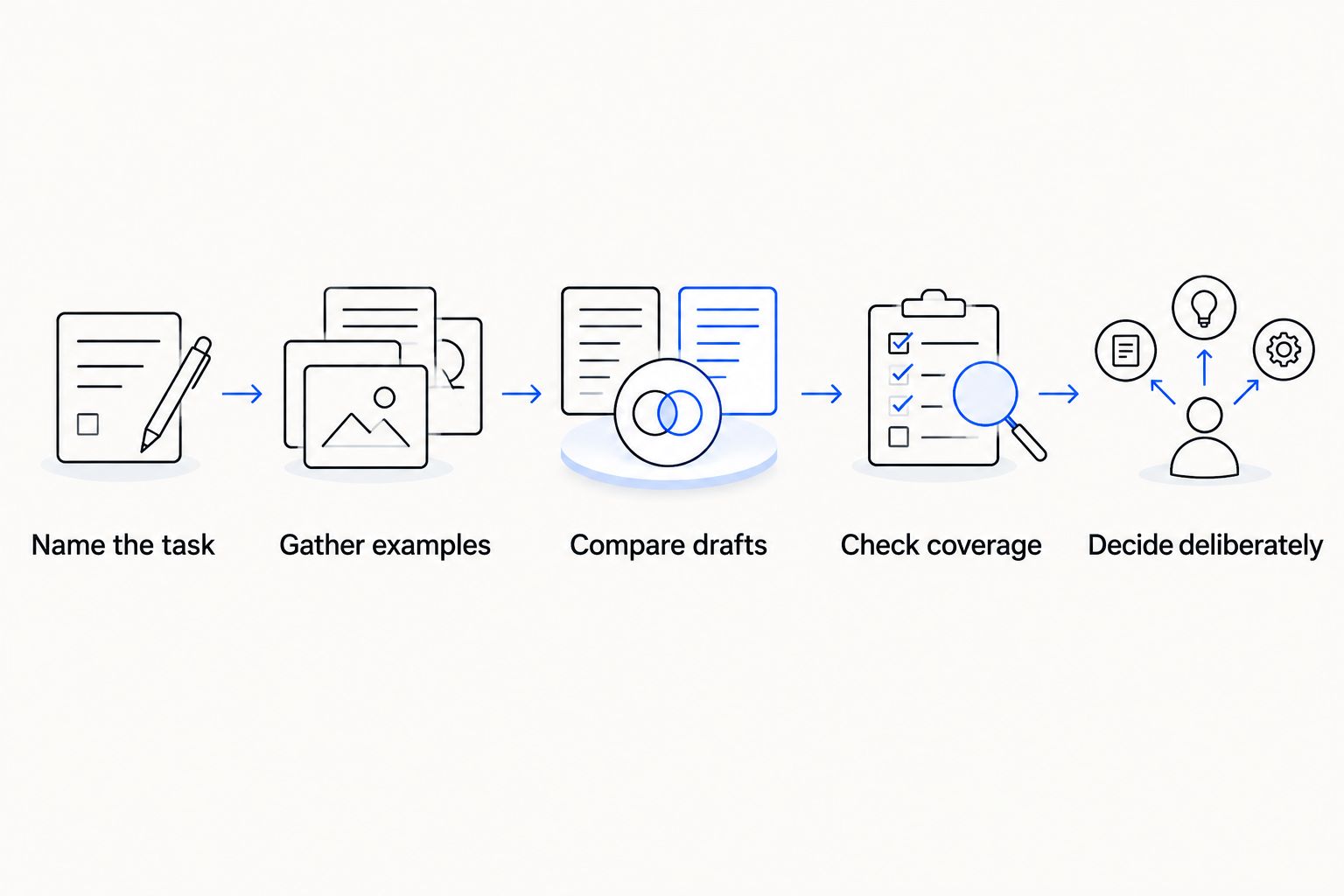
Use this exercise to turn a broad interest into a purchase brief. It is a suggested evaluation process, not an AI Stars lesson or a description of its curriculum.
1. Name the task
Choose 1 coaching offer as the focus. Write a plain-language sentence explaining whom it serves and what the coaching addresses.
Keep this narrow enough that you can recognize an irrelevant draft. If the content could advertise almost any coaching business, your brief needs more detail.
2. Gather examples
Collect 3 existing posts that reflect how you want to communicate. They can be your own published work or unpublished drafts you genuinely stand behind.
Mark the useful elements: a specific explanation, a direct question, or a phrase you naturally use. Don’t ask a tool to imitate someone else’s personality when your goal is to preserve yours.
3. Compare drafts
Create 2 drafts for the same audience question using your existing process. Compare how clearly each answers the question, represents your expertise, and connects to the intended next step.
This isn’t a performance test or proof of future results. It’s a way to find the skill you want instruction to address. Name the weak point before you shop for the solution.
4. Check coverage
Review the current program information against that weak point. Look for explicit coverage of the task you want to learn, then check the participation requirements and terms.
Ask directly about anything that determines your decision. Treat an unanswered question as unresolved not as an invitation to assume the answer you want.
5. Decide deliberately
Finish this sentence: I am considering this training because I need help with this specific task. Then state how you will recognize useful learning in your own work.
If you can complete both statements clearly, you have a basis for evaluating the purchase. If not, refine the brief first.
How do you keep AI-assisted content sounding like you?
Give the draft something real to work from, then edit it against your own standards. Your examples, explanations, and point of view belong in the brief before generation not only in a final request to make the writing less generic.
For a 2026 content workflow, keep a short voice reference beside your drafts. Include phrases you use naturally, language you avoid, and examples of how you explain a difficult idea. Treat it as an editing aid, not a guarantee of accuracy.
Read the draft aloud. Replace sentences you wouldn’t say, remove unsupported claims, and check that the advice matches what you actually teach. Personality cannot excuse an inaccurate statement.
Our AI marketing positioning emphasizes authentic content strategy. Use that focus as a criterion when evaluating AI Stars: look for a match with the communication skills you want to develop, rather than assuming that all AI training teaches the same thing.
Should you learn independently before choosing AI Stars?
Independent practice is a useful first step when you can define a task and judge the resulting work. It gives you an example to bring to your program evaluation instead of a general feeling that you need help.
But don’t confuse experimenting with collecting endless prompts. Choose a real audience question, draft an answer, and identify where your judgment or process breaks down.
Best for independent practice: coaches with a clear brief and an editing standard. Its advantage is control over the exercise; its limitation is that you must diagnose the problem yourself. If you want instruction, compare the current program details with that diagnosis.
FAQ
Is AI Stars worth it for coaches in 2026?
AI Stars is worth considering for coaches seeking AI marketing training focused on authentic content strategy. Decide whether its current curriculum and participation requirements match a specific task in your business before enrolling.
What should I check before joining AI Stars?
Check the current curriculum, teaching format, participation requirements, and terms against your learning goal. Ask directly about any detail that determines whether the program fits your needs.
Can AI Stars replace my marketing strategy?
Do not evaluate AI Stars as a replacement for deciding whom you serve, what you offer, and what your content should communicate. Use those decisions as the brief for any marketing training you consider.
Is independent AI practice better than taking a program?
Independent practice fits coaches who can define a task and evaluate their own work; training is an option when they want instruction. Compare the actual program details with the skill you want to learn rather than declaring either approach universally better.
How can I tell whether AI content sounds like me?
Read the draft aloud and compare it with examples of your own communication. Revise unfamiliar phrasing, remove unsupported claims, and check that the advice reflects what you actually teach.
What is a useful goal for AI marketing training?
A useful goal names a specific task, such as turning your explanation of a coaching problem into an educational post. Define what the reader should understand so you can judge the finished work.
One last thing
Before you choose AI Stars in 2026, save a draft that frustrates you and write down exactly why. Too vague? Wrong audience? Nothing you would actually say?
That diagnosis is more useful than a list of tools you haven’t tried. Buy training for a skill you can name, then evaluate the work not the excitement of enrolling.



Leave a Reply