

No, video content is not necessary for coaches in 2027.
While video content can help you build trust, show your personality, and connect with potential clients, it’s NOT the only way to grow your coaching business!
You can attract clients through written content, podcasts, emails, and meaningful conversations that demonstrate your expertise and help people understand how you can support them.
The key is choosing a content strategy that works for YOU and the people you want to serve!
If creating video content feels overwhelming, start with a format that allows you to communicate confidently and consistently.
And if you decide to skip video content, make sure your other content gives potential clients a clear picture of your coaching style, your approach, and what it’s like to work with you.
Because successful marketing isn’t about creating MORE video content. It’s about creating content that builds trust and helps the RIGHT people feel confident choosing you!
- Is video content necessary for coaches? No. Choose a format that demonstrates your coaching and supports client conversations.
- Video shows your delivery; written content gives readers space to examine your thinking.
- We emphasizes authentic content strategy: use AI marketing support without replacing your own perspective.
- Test a manageable video format before committing to a production schedule.
Is video content necessary for coaches in 2027?
Video is a way to communicate your expertise, not a prerequisite for offering coaching. A useful explanation, a relevant example, and a clear next step matter regardless of the format you choose.
We offer AI marketing coaching and training for coaches, creators, and entrepreneurs. AI marketing coaching is for coaches, creators, and entrepreneurs seeking an authentic content strategy. Choose that kind of support for strategy and training not as a substitute for deciding what you want to say.
Here is how the main content options differ. These are practical distinctions, not a ranking of conversion performance.
| Format | Best for | What it lets you show | Main limitation |
|---|---|---|---|
| Video | Demonstrating delivery or a visual process | Your voice, expressions, pacing, and explanation together | Requires recording and visual presentation decisions |
| Written content | Detailed explanations people can scan and revisit | Your reasoning, examples, and structure | Does not directly show your spoken delivery |
| Audio | Spoken explanations without a camera | Your tone, pacing, and conversational style | Cannot show a visual demonstration on its own |
Choose the format that makes your coaching easier to understand not the format that makes your calendar look busiest. You can combine formats, but you do not need to launch all of them at once.
Why this matters
If you treat video as mandatory, content planning becomes a production problem before you have answered a business question: what does a prospective client need to understand before taking the next step?
Start there. A coach explaining a difficult decision needs different supporting material from a coach demonstrating a movement. The subject should influence the format.
For your 2027 content plan, separate visibility from usefulness. Publishing a clip completes a task; answering a relevant question gives that task a purpose. Neither the camera nor the word count decides whether the explanation is useful.
Video: best for showing how you communicate
Video content lets potential clients see your personality, hear your voice, and get a feel for your coaching style before working with you.
It’s especially useful when your coaching involves demonstrations, personal guidance, or explaining ideas that benefit from a visual example.
You don’t need fancy equipment or a perfectly polished script to create valuable video content.
Start by answering a question your clients frequently ask, just as you would in a real conversation.
The advantage: Video content helps demonstrate your expertise while giving potential clients a better understanding of how you teach, communicate, and support others.
The limitation: Creating video content takes time, from planning and recording to editing and publishing.
And posting more videos doesn’t automatically mean attracting more clients.
The key is to create video content with PURPOSE!
Focus on answering real questions, providing useful insights, and helping the RIGHT people understand how your coaching can help them.
Written content: best for explaining your reasoning
Writing gives you room to make distinctions. You can define a problem, explain where common advice falls short, and help a reader decide what applies to their situation.
That makes written content a sensible choice for questions that need careful qualification. Readers can pause, compare sections, and return to a sentence without replaying a recording.
The advantage: writing makes your reasoning available for inspection. A useful article or email can explain both your recommendation and the circumstances in which you would recommend something else.
The limitation: polished writing does not show what a spoken coaching conversation feels like. You need concrete examples and clear boundaries so the content does not become a collection of broad promises.
If writing is your strongest format, use it. Do not abandon an explanation you can deliver clearly just to satisfy an imagined video requirement.
Audio: best for spoken teaching without a camera
Audio gives you a way to communicate through voice without managing your appearance or surroundings on screen. It fits explanations where pacing, emphasis, and a conversational tone carry the idea.
You can outline the point before recording and remove tangents afterward. The goal is a complete answer, not an uninterrupted stream of thoughts.
The advantage: audio preserves spoken delivery while removing visual production choices. It gives you a practical alternative when the camera is the obstacle rather than speaking itself.
The limitation: listeners cannot inspect a diagram or watch a demonstration. Include a written summary when the explanation depends on steps, terminology, or material someone needs to reference.
Audio is not automatically easier to understand than writing. Match the format to the explanation, then check whether a person can follow it without extra context.
Why the need for video varies
There is no universal video requirement for coaches in 2027. Your decision depends on what you teach, how you communicate, and what the content needs to accomplish.
- Demonstration needs: a visible action calls for different treatment from an abstract question. Ask whether seeing the process changes the explanation.
- Communication style: if your spoken explanation is clearer than your draft, recording is worth testing. If writing sharpens your thinking, start there.
- Buyer questions: list the uncertainties people raise before discussing your services. Build content around those questions rather than around a format quota.
- Production capacity: recording, checking captions, editing, and publishing all require attention. Choose a process you can actually complete.
- Privacy and consent: coaching examples can involve sensitive information. Use your own explanations and obtain permission before sharing identifiable client material.
- The next step: decide whether the content should prompt a reply, explain your approach, or prepare someone for a conversation. Make that action explicit.
These factors help you choose a format; they do not predict a conversion rate. Keep the distinction clear when reviewing your results.
How to test video without turning it into another job
Run a small publishing experiment before rebuilding your content calendar. The following time limits are suggested working boundaries, not performance benchmarks or promises.
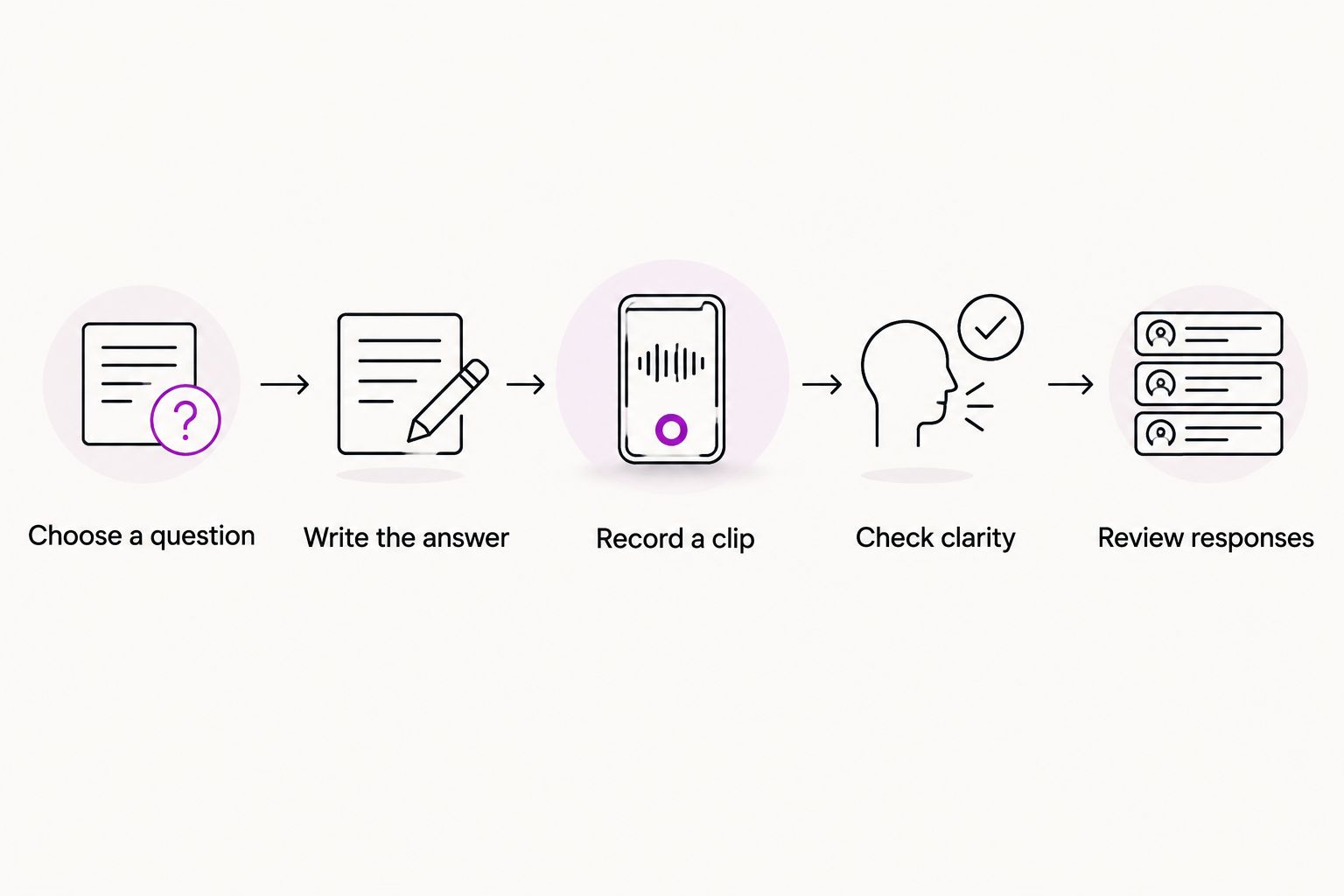
1. Choose a question
Pick something a prospective client genuinely asks. Narrow it until you can answer without delivering an entire workshop.
For example, explain how someone can prepare for an introductory coaching conversation. State what they should consider and what the conversation is intended to clarify, without promising an outcome.
2. Write the answer
Spend 10 minutes drafting your explanation. Include the direct answer, a practical example, and a next step that fits the subject.
Read it aloud. Remove phrases you would never say to a person, and keep any qualification that changes the meaning of the advice.
3. Record a clip
Try a 60-second explanation as a constraint, not a rule. If the point needs more space, narrow the question or choose a longer format rather than rushing.
Record 3 clips answering different questions before deciding whether video fits your process. This is a suggested test size, not a publishing frequency you must maintain.
4. Check clarity
Watch each recording as if you had not written the outline. Does the answer arrive early? Can you understand it without reading the caption or knowing your background?
Correct factual errors and remove private information. Add accurate captions, and check whether the explanation still makes sense when someone reads those captions without sound.
5. Review responses
Give each piece a relevant next step, such as replying with a question or reading a supporting explanation. Review the responses alongside the effort required to publish.
Keep a simple record of what you published, what question it answered, and what happened next. Distinguish questions about your services from general compliments; they tell you different things.
For a 2027 experiment, compare your own formats against the job you assigned them. A video intended to explain your approach needs a different evaluation from a written guide intended to answer a detailed question.
Where AI belongs in your content process
AI can make creating video content easier, especially when you’re juggling coaching sessions, client work, and everything else that comes with running a business!
Instead of starting from scratch every time, use AI to organize your ideas, turn your expertise into scripts, and repurpose existing content into something your audience will find valuable.
For example, you can take a question a coaching client recently asked, write out your answer, and use AI to turn it into a short video script, social media post, or email.
You can even turn one piece of video content into multiple posts without having to record something new every day!
But here’s what matters: Your AI-generated content should still sound like YOU!
Give AI your actual explanations, experiences, and examples instead of asking it to create opinions or stories you’ve never shared.
And before publishing any video content, review the script to make sure the information is accurate, the message is clear, and the words sound like something you’d naturally say.
Programs like AI Stars can help you learn how to use AI more effectively in your content creation process while keeping your authentic voice at the center of your marketing.
Remember, AI should help you create better video content with LESS effort, not replace the personality, expertise, and human connection that make your coaching valuable!
Can I get coaching clients without posting videos?
Yes. Video is not a prerequisite for explaining your services or inviting a prospective client into a conversation. Written content and audio give you other ways to communicate your approach.
Make the alternative concrete. Explain who your coaching is for, what a prospective client should understand before inquiring, and how to take the next step. Avoid replacing a video plan with a content plan that never mentions your services.
Should I force myself to be on camera in 2027?
Test whether being on camera helps you explain something that matters to your prospective clients before committing to it.
Separate unfamiliarity from a genuine format mismatch. A simple recording exercise can help you assess the process; if the visual element adds nothing, writing or audio remains a valid choice for your 2027 plan.
FAQ
Is video content necessary for coaches who are just starting?
No, video content is not necessary for coaches who are just starting. Begin with a format that lets you explain your approach accurately and give prospective clients a clear next step.
What’s the best content format for a coach who hates being on camera?
Written content is a sensible starting point if being on camera prevents you from publishing useful explanations. Audio is another option when you prefer speaking but do not need a visual demonstration.
Is video better than written content for getting coaching clients?
Neither format is automatically better for getting coaching clients. Video shows your delivery, while writing lets readers examine your reasoning; evaluate each against the purpose of the content.
Do I need to post coaching videos every day?
No, you do not need a daily video schedule simply because you offer coaching. Choose a publishing commitment you can maintain without displacing client work or sacrificing accuracy.
Can I use AI to write my coaching video scripts?
Yes, you can use AI to draft or organize coaching video scripts. Check every claim, remove invented examples, and revise the language until it reflects your actual perspective.
Do coaching videos need professional production?
Professional production is not a prerequisite for explaining a coaching idea on video. Prioritize understandable sound, readable captions, and a clear answer before adding production complexity.
How do I know whether my coaching videos are useful?
Assess coaching videos against the job you assigned them. Review whether viewers ask relevant questions, understand your approach, or take the next step you offered, alongside the work required to publish.
One last thing
Your best next video might start as a paragraph.
Write the answer first, then ask whether seeing or hearing you deliver it adds meaning.
If the answer is no, publish the paragraph.
Choose the format after you choose the point.
That keeps your content connected to your coaching instead of making everything about being on camera.
And if you’re spending MORE time figuring out what to post than actually connecting with potential clients, it’s time for a better system!
Ready to make AI work for your business?
Inside AI Stars, we help coaches and business owners use AI to create content, build smarter marketing systems, and share their expertise without losing the personality that makes them AWESOME!
Because you don’t need to be everywhere or create every type of content to grow your business.
You need a strategy that works for YOU!
Explore AI Stars and let’s make some MAGIC!


Leave a Reply