


No, it is not too late to build a personal brand in 2026: you can start by making your expertise, point of view, and offer clear to the people you want to serve. Starting now does not guarantee attention or sales; your job is to give the right people a specific reason to trust you, not to catch up with everyone already posting.
- Is it too late to build a personal brand in 2026? No. Start with a clear buyer and useful expertise.
- Personal branding needs a recognizable point of view, not a borrowed personality or a packed posting calendar.
- We offer AI marketing coaching for coaches, creators, and entrepreneurs focused on authentic content strategy.
- Use AI for drafting support; keep your claims, judgment, and voice under your control.
Why this matters
The question behind the question is usually personal: why would anyone listen to you when other people already cover your topic? You do not need to be the first person discussing coaching, content, or entrepreneurship. You need to make your contribution clear enough that someone can decide whether it fits their problem.
This is for coaches, creators, and entrepreneurs who want to grow through authentic content strategy by building their personal brand this year.
For your 2026 plan, separate the desire to become recognizable from the pressure to become famous. Recognition among people who need your work is a more useful objective than visibility without a clear business purpose.
Is it too late to build a personal brand in 2026?
No. The calendar is not a qualification test. A practical starting point is to connect what you know with a problem you can help a specific person solve, then show that connection in public.
That does not require pretending you have invented a new category. It requires making choices. Who are you speaking to? What do you help them do? What do you believe about the work that changes how you approach it?
Use this sequence to turn the question into action:
- Choose your buyer. Describe the person you can genuinely help, including the situation that makes your work relevant.
- Name the problem. Pick a problem close enough to your offer that your content and business belong in the same conversation.
- Show your thinking. Explain how you assess the problem, including trade-offs and mistakes to avoid.
- Publish with purpose. Give each piece a job: explain, demonstrate, challenge, or invite a relevant conversation.
- Review real responses. Look at what people ask and whether those conversations connect to your work.
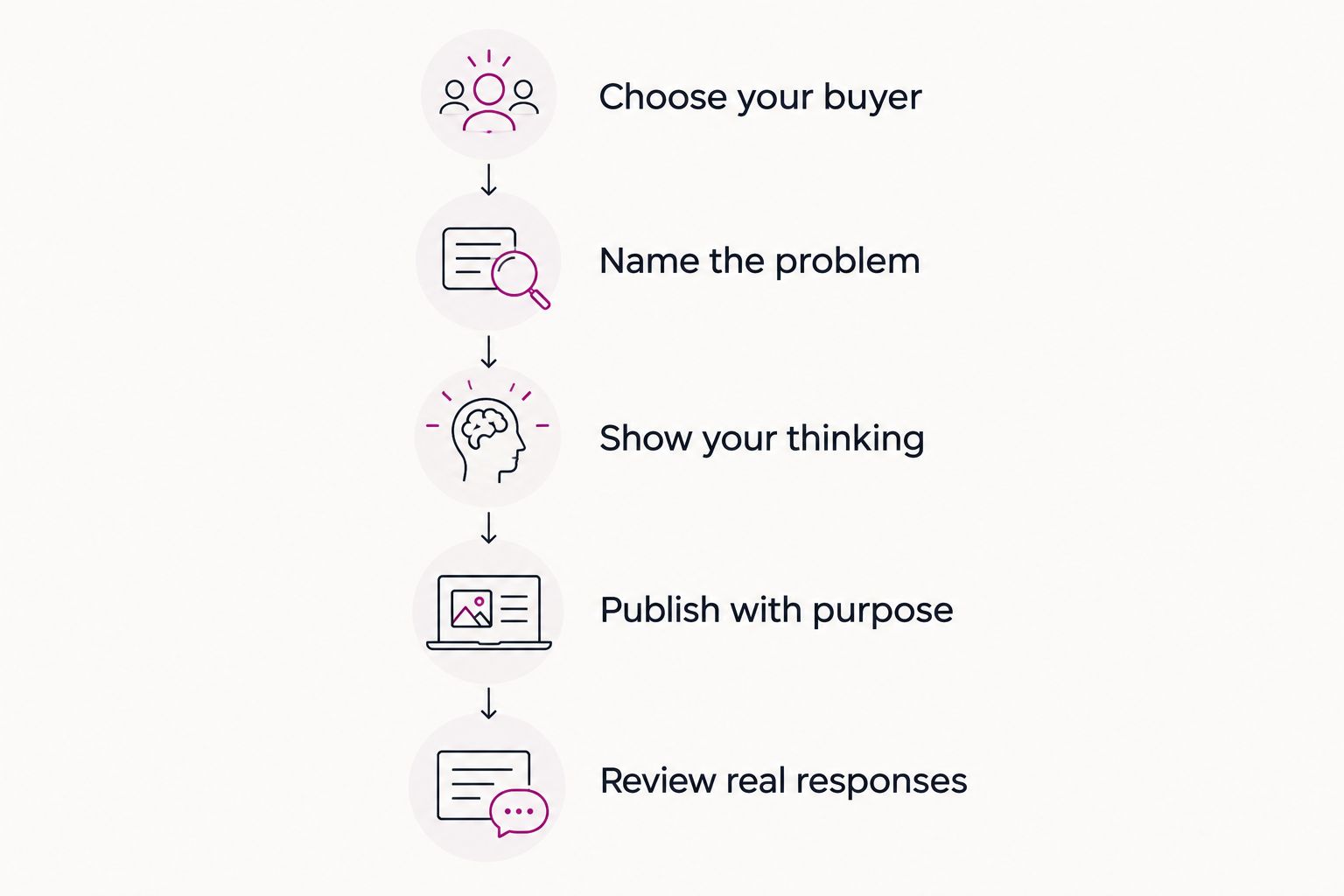
Treat that sequence as a decision process, not a promise of results. You can repeat it when your offer changes, when a topic attracts the wrong audience, or when your content sounds polished but says very little.
Choose an approach that fits your work
There is no need to make every post perform every job. Compare these approaches, then choose a starting point that lets you show something useful without overstating your experience.
| Approach | Best for | What to publish | Strength | Limitation |
|---|---|---|---|---|
| Teach from experience | Practitioners with work they can explain | Decisions, methods, and examples you can substantiate | Makes your reasoning visible | Requires permission before sharing client details |
| Document your learning | Beginners developing a specific skill | What you tried, learned, and still need to understand | Lets you publish without claiming mastery | Learning updates alone do not establish expertise |
| Explain your point of view | People with a clear perspective on their field | Arguments, trade-offs, and practical implications | Makes your approach easier to recognize | Opinions need reasoning, not just confidence |
You can combine these approaches. Just make the status of each claim clear: an observation is not a proven result, and an experiment is not a client case study.
Start with a buyer, not a bigger personality
A personal brand does not require turning your private life into content. Decide which parts of your experience help someone understand your work, and keep the rest private if you prefer.
Write your positioning in 1 sentence: who you help, what problem you address, and how you approach it. This is an editing exercise, not a slogan contest. If the sentence could describe almost anyone in your field, make the buyer or problem more specific.
For example, a coach can explain the kind of transition they help people handle rather than promising to change everyone’s life. A creator can name the questions their work explores rather than saying they post about everything they love. An entrepreneur can explain the situation their service addresses rather than leading with a list of traits.
Give yourself permission to have boundaries. You can be warm without sharing family details, distinctive without being provocative, and direct without turning every post into an argument.
Let your personality shape the delivery; let your expertise carry the message. Your unusual interests can make an explanation memorable, but the reader still needs to know what the explanation helps them do.
Build recognizable content without repeating yourself
Choose 3 content themes as a starting structure: the problem your buyer faces, the way you approach that problem, and the questions someone asks before working with you. These are editorial choices, not a required formula for growth.
The problem theme gives you space to explain symptoms and causes. The approach theme lets you demonstrate your reasoning. The decision theme helps readers understand fit, boundaries, and what they should consider before taking action.
Within those themes, vary the treatment. Explain a mistake in one piece, walk through a decision in another, and answer a real question in the next. Consistency means the pieces belong to the same body of work; it does not mean copying the same opening forever.
Before publishing, ask:
- Does this address someone I actually want to serve?
- Does it contain an observation, example, or explanation I can defend?
- Is the connection to my work clear without forcing a sales pitch?
- Would I use this language in a conversation?
- Have I removed claims that sound impressive but lack support?
For your 2026 content plan, use that checklist before adding another channel. A larger publishing footprint does not fix an unclear message.
Use AI to draft, not to invent your credibility
AI can help you turn notes into an outline, generate alternative openings, or reorganize an explanation. Your responsibility is to decide whether the result is accurate, useful, and recognizably yours.
Start with source material you control: your notes, your documented process, or an explanation you have already written. Remove confidential information before sharing material with a tool, and check the tool’s data settings against your obligations.
Then give the draft a human edit. Replace vague advice with reasoning you can explain. Delete invented examples, unsupported results, and claims that make you sound more experienced than you are.
A simple voice check helps: read the draft aloud. If a sentence sounds like something you would never say, rewrite it rather than defending it because it sounds professional.
Our personal-brand-relevant training centers on AI-powered marketing and authentic content strategy. That support fits coaches, creators, and entrepreneurs; it does not remove your responsibility to verify what you publish.
In 2026, use AI to organize your ideas, not to manufacture a history of expertise. The distinction matters most when a draft includes testimonials, customer stories, or confident claims about outcomes.
Why personal-brand results vary
A posting schedule describes your activity, not your outcome. Judge the work against your objective and the conversations it creates, rather than assuming that more posts automatically mean more business.
These factors deserve your attention:
- Buyer clarity: Content for a defined situation gives you a clearer editing standard than content intended for everyone.
- Offer alignment: A popular topic is not automatically connected to the service or product you sell.
- Evidence quality: Documented examples let you show your work; unsupported claims ask readers to take your word for it.
- Message consistency: Contradictory promises make it harder for a reader to understand what you stand for.
- Publishing sustainability: Choose a workload you can maintain without sacrificing accuracy or client responsibilities.
- Conversation quality: Questions about your process, fit, or offer deserve a different interpretation from casual reactions.
For a useful review, compare the topics you published with the responses they produced. Record what people asked, which misunderstandings repeated, and whether anyone took the next step you intended.
Do not turn a quiet post into a verdict on your entire business. First check whether the topic, audience, explanation, and invitation matched each other.
What should you do before publishing more?
Create 3 content samples before committing to a larger schedule. Make one an answer to a buyer question, one an explanation of your approach, and one a demonstration using material you are allowed to share.
Evaluate the samples together. Can a reader identify the person you serve? Do the pieces point toward the same kind of work? Are you repeating a useful perspective, or merely repeating phrases?
Next, try 2 formats that suit how you communicate, such as written posts and spoken explanations. This is a manageable comparison, not a claim that two formats are optimal. Use the same underlying idea so you can evaluate the presentation without changing everything at once.
Choose a format you can produce accurately and a next step that matches the content. An educational explanation can invite a follow-up question; a discussion of service fit can invite someone to explore your offer.
For your 2026 starting plan, remove anything that makes publishing feel like a performance you cannot sustain. You are building a body of useful work, not auditioning for a personality you do not have.
Can you build a personal brand without a large audience?
Yes. You can begin with the people already connected to your work and publish material that helps them understand your expertise. A large audience is not a prerequisite for explaining what you do.
Do not confuse that with a guarantee of sales. If your objective is business growth, pay attention to relevant inquiries and actual next steps, not follower totals alone.
Can you build a personal brand if you are new?
Yes, but describe your experience honestly. Document what you are learning, distinguish experiments from recommendations, and avoid presenting someone else’s insight as your own discovery.
You can be useful before becoming an authority. Explain a process you understand, ask a thoughtful question, or describe a mistake you can substantiate; do not borrow certainty you have not earned.
Should your personal brand be separate from your business?
Separate the accounts only when each has a clear job you can maintain. Your personal presence can explain your perspective, while business content can focus on the offer and the information buyers need.
Neither arrangement solves unclear positioning. Decide what a reader should understand in each place, then remove unnecessary duplication.
FAQ
Is it too late to build a personal brand in 2026?
No, it is not too late to build a personal brand in 2026. Start with a specific buyer, a problem you can genuinely address, and content that shows your thinking without promising guaranteed results.
Do I need lots of followers to start a personal brand?
No, you do not need lots of followers to start explaining your expertise. If your goal is business growth, evaluate relevant conversations and next steps alongside audience size.
What’s the best way to start if I don’t know what to post?
Start by answering a question your intended buyer asks about a problem connected to your work. Explain your reasoning and use an example you can substantiate.
Can I build a personal brand without sharing my private life?
Yes, you can build a personal brand without sharing your private life. Publish your professional perspective, methods, and permitted examples while keeping personal boundaries intact.
Should I use AI to write my personal-brand content?
Use AI for drafting support when you can check and edit the result. Keep control of factual claims, confidential information, and language that represents your own judgment.
Can we help with personal-brand content?
We offer AI-powered marketing coaching and training for coaches, creators, and entrepreneurs focused on authentic content strategy. That is relevant when you want support connecting your voice with your marketing.
How do I know whether my personal-brand content is working?
Evaluate your content against the objective you set for it. For a business-focused brand, examine relevant inquiries, questions about your offer, and completed next steps rather than treating reactions alone as success.
One last thing
Before you create another post, ask someone to explain what they think you do after reading your recent content. Do not coach the answer. Listen for the buyer, the problem, and the work they associate with you.
If their explanation misses your intended message, revise the message before increasing output. Your next useful move is not necessarily more content; it is making the content easier to understand.


Leave a Reply