

Yes, you can scale a coaching business without paid ads by building a repeatable path from useful content to qualified conversations, clients, and referrals. The catch: attracting more leads is not enough, you also need an offer you can sell consistently and a delivery model that can handle growth.
- Can you scale a coaching business without paid ads? Yes, connect organic marketing, qualified conversations, and sustainable delivery.
- Choose one clear offer before expanding your content channels or automating follow-up.
- AI marketing coaching fits coaches seeking training in authentic content strategy.
- Measure qualified inquiries and clients, not just views, followers, or posting frequency.
Can you scale a coaching business without paid ads?
Yes. Paid advertising is a distribution choice, not a requirement for selling coaching. You can attract prospective clients through content, search, referrals, partnerships, and direct conversations. The work is connecting those activities to an offer people understand and a clear next step.
Start with these 3 stages: attract the right people, convert suitable prospects, and deliver what you promised. A growing audience with no sales process is not a scaling system. Neither is a full calendar that leaves you unable to serve another client.
We offer AI-powered marketing coaching and training for coaches, creators, and entrepreneurs. That support fits the content and marketing part of the process; your offer, sales decisions, and delivery capacity still need your attention.
For your growth plan, choose an organic route that matches how your buyers find help. You do not need to show up everywhere.
| Organic approach | Best for | What to do | Limitation to plan around |
|---|---|---|---|
| Search-focused content | Coaches answering specific buyer questions | Publish useful answers connected to your offer | Publishing alone does not guarantee visibility |
| Social content and conversations | Coaches who explain their work well in public | Share useful ideas and invite relevant replies | Engagement does not establish buying intent |
| Email follow-up | Coaches with permission to contact interested readers | Continue the conversation around a specific need | You first need a reason for people to subscribe |
| Referrals and partnerships | Coaches serving a clearly defined audience | Help others recognize a suitable introduction | Introductions depend on relationships you do not control |
Why this matters: attention is not the finish line
A post can get applause without starting a useful sales conversation. A quieter piece of content can answer the exact question someone asks before seeking help. Judge each piece by its purpose, not by whether it looks impressive on your profile.
Ask what happens after someone agrees with you. Can that person identify who you help, understand the problem you address, and find a sensible next step? If not, more reach sends more people into the same unfinished journey.
For 2027, make the goal specific: build a path you can repeat and inspect. Organic growth still requires effort, and a busy content calendar does not prove the effort is producing clients.
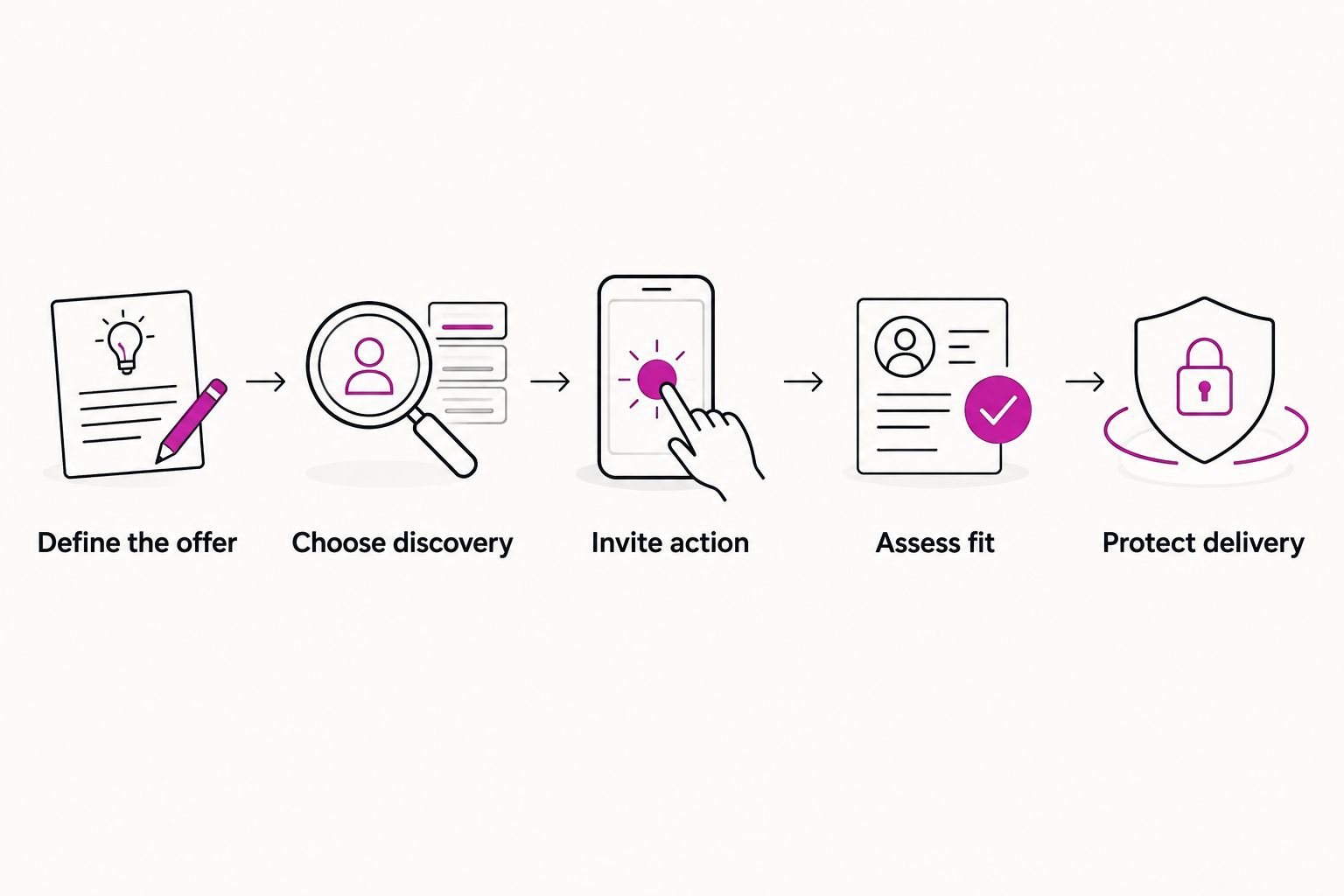
Build the path before adding more content
Start with 1 offer, 1 primary discovery channel, and 1 clear next step. These are planning constraints, not performance benchmarks. They keep your first version simple enough to assess.
Define the offer
Write down who the coaching serves, the problem it addresses, and what the engagement includes. Separate the work you provide from outcomes that depend on a client's decisions or circumstances.
Then check your content against that offer. If your posts attract people with problems you do not help solve, the content and offer need a tighter connection. More posting will not resolve that mismatch.
Make the offer understandable before making the content more frequent. A prospective client should not have to assemble your business model from scattered posts.
Choose discovery
Choose a primary channel based on where you can answer relevant questions well. Use search-focused articles for questions that deserve a lasting reference. Use social content when public discussion helps you explain your perspective.
Keep the trade-off visible. Search content needs a discovery path; social content needs a path beyond the feed. Neither approach removes the need to explain your offer.
Invite action
Give each piece of content a job. An educational article can lead to another useful answer; a post about a buying concern can invite a conversation about fit.
Match the invitation to the reader's situation. Someone learning to name a problem needs different information from someone comparing coaching support. Do not make every interaction an immediate sales pitch.
Assess fit
Use inquiries to understand the prospect's goal, current situation, and expectations. Explain what your coaching includes and what it does not include before asking for a commitment.
A suitable client is not simply someone willing to say yes. Check whether the person needs the work you actually provide and whether you can deliver it responsibly.
Protect delivery
Map what happens after a client joins: preparation, sessions, feedback, administration, and follow-up. Identify which activities require your judgment and which can follow a documented process.
Protect delivery before increasing lead volume. If every new client adds work you cannot accommodate, adjust the service model before expanding promotion.
Why your organic growth plan needs to vary
There is no universal posting schedule that makes a coaching business scalable. Build your 2026 plan around the decisions below rather than copying another coach's content volume.
- Buyer clarity: Name the person you serve and the situation that makes coaching relevant. A broad audience description gives you little guidance about what to publish.
- Offer clarity: Explain the engagement and its boundaries. Content cannot substitute for a prospect understanding what they are considering.
- Discovery route: Choose how people will encounter your work. Publishing an article, sending an email, and receiving an introduction require different follow-through.
- Conversation quality: Review whether inquiries concern problems your coaching addresses. Attention from an unsuitable audience is not a reason to expand that content theme.
- Delivery capacity: Account for preparation and support, not only the visible coaching session. Your growth plan must include the work clients receive.
- Relationship ownership: Keep permission-based contact details and useful context where appropriate. A public follow does not give you permission to add someone to an email list.
Revisit these choices when your offer or audience changes. Keep the process consistent enough to inspect, but do not preserve a channel simply because maintaining it has become a habit.
What should you measure besides followers?
Measure the movement from attention to suitable clients. Start with a simple record of where inquiries came from, what the person wanted, whether the inquiry fit your offer, and what happened next.
Use consistent definitions. A comment is a response; it is not automatically an inquiry. An inquiry is not automatically a qualified prospect, and a booked conversation is not a client.
| Signal | What it helps you assess | What it does not establish |
|---|---|---|
| Relevant replies | Whether a topic starts useful conversations | Whether anyone intends to buy |
| Qualified inquiries | Whether your content reaches suitable prospects | Whether the sales process works |
| Sales conversations | Whether interested prospects take the next step | Whether your offer fits their needs |
| New clients | Whether conversations lead to engagements | Whether delivery can support further growth |
| Delivery workload | What serving clients requires | Whether demand will remain consistent |
For your review, compare these stages instead of celebrating a single total. If inquiries are suitable but conversations stall, inspect the invitation and follow-up. If clients join but delivery becomes unmanageable, solve that constraint before chasing more inquiries.
Record what prospects say in their own words, with appropriate permission and privacy safeguards. Those questions can inform your next article without turning a private client story into public content.
Where does AI help without flattening your voice?
Use AI for a defined task: organizing your notes, proposing an outline, or turning your explanation into a draft you review. Keep your own examples, judgments, and offer boundaries in the process. A polished sentence is not evidence that its claim is true.
AI marketing coaching is best for coaches seeking training in authentic content strategy. The fit is the combination of marketing education and your own voice, not a replacement for understanding your clients.
The benefit of drafting assistance is practical: you have material to edit rather than an empty page. The limitation deserves equal attention. Generated drafts need checks for accuracy, unsupported promises, generic language, and details you would never actually say.
For your workflow, separate drafting from approval. Check every claim about results, every client example, and every invitation before publication. Do not publish a supposed testimonial or outcome that you cannot substantiate.
Can referrals alone scale a coaching business?
Referrals can bring coaching inquiries, but relying only on introductions leaves you dependent on other people's actions. Give referral partners a plain explanation of whom you help and what a suitable introduction looks like.
Then give referred prospects something useful to read or watch before a conversation. A referral opens a door; it does not explain your offer or establish fit on its own.
Do you need to post every day to grow without ads?
Daily posting is not a requirement for growing a coaching business without paid ads. Choose a publishing rhythm you can maintain while answering relevant questions and following up appropriately.
If content production crowds out client work or useful conversations, reduce the output and inspect its purpose. Consistency means keeping a useful promise, not filling every available slot.
Can you grow without taking more private clients?
You can plan growth without adding more private clients by reviewing how you package and deliver your coaching. Group delivery, documented resources, or a more focused engagement are options to assess, not automatic upgrades.
A group format suits shared learning needs but changes individual attention. Private coaching suits individualized work but ties more delivery to your direct involvement. Choose around the work clients need, not the appeal of calling a format scalable.
FAQ
Can you scale a coaching business without paid ads in 2026?
Yes, you can scale a coaching business without paid ads in 2026 by connecting organic discovery, qualified conversations, and manageable delivery. More attention alone does not create that system.
What’s the best organic channel for a coaching business?
The best organic channel is one where you can reach suitable prospects and answer their relevant questions. Choose a primary route, then assess the inquiries it produces rather than follower growth alone.
Do I need a large audience to sell coaching?
A large audience is not a prerequisite for selling coaching. Focus on reaching people whose needs match your offer and giving them a clear way to discuss fit.
Should I automate all my coaching business follow-up?
No, automate defined administrative steps rather than every conversation. Keep personal review where a reply involves individual circumstances, suitability, or sensitive information.
Can AI write my coaching content for me?
AI can help draft coaching content, but you remain responsible for its accuracy and voice. Review claims, examples, confidentiality, and the invitation before publishing.
Is Molly Mahoney relevant if I want organic coaching leads?
Molly Mahoney offers AI-powered marketing coaching and training centered on authentic content strategy. That focus fits coaches seeking marketing education; it does not replace your offer, sales process, or delivery decisions.
What should I fix first if my content gets attention but no inquiries?
Check the connection between the content, your coaching offer, and the next step. Make sure readers can recognize whom you help and understand how to discuss their situation with you.
One last thing
Your next content idea might already be sitting in an unanswered buyer question. Before adding another channel, list the questions prospects ask before deciding whether your coaching fits.
Pick one and answer it plainly. Explain the trade-off, name who the advice suits, and give the reader an appropriate next step. That is a more useful assignment than trying to sound like every other coach in the feed.
Related guides

Leave a Reply