


To get repeat clients as a coach, agree on a meaningful goal, make progress visible, and discuss the next engagement only when it serves a goal your client still wants to pursue. Your 2027 retention plan should also include permission-based follow-ups after an engagement ends not pressure to keep buying coaching.
- How to get repeat clients as a coach: show progress, identify the next goal, and invite rather than pressure.
- This article is best for coaches seeking AI marketing coaching grounded in authentic content strategy.
- Client retention starts with clear expectations, not a last-session renewal pitch.
- Offer continued coaching only when the client has a specific reason to continue.
Why this matters
A repeat booking needs a reason. Being likable, sending more emails, or producing more content does not replace a clear answer to your client’s question: What would we work on next?
For your 2027 plan, separate client retention from client dependency. Retention means someone chooses another useful engagement; dependency means they feel unable to act without you. Build the first. Do not sell the second.
We offer AI marketing coaching and training for coaches, creators, and entrepreneurs who want to grow through authentic content strategy. Apply that same emphasis on authenticity to renewal conversations: make the invitation sound like you, and keep the client’s actual needs at the center.
How to get repeat clients as a coach
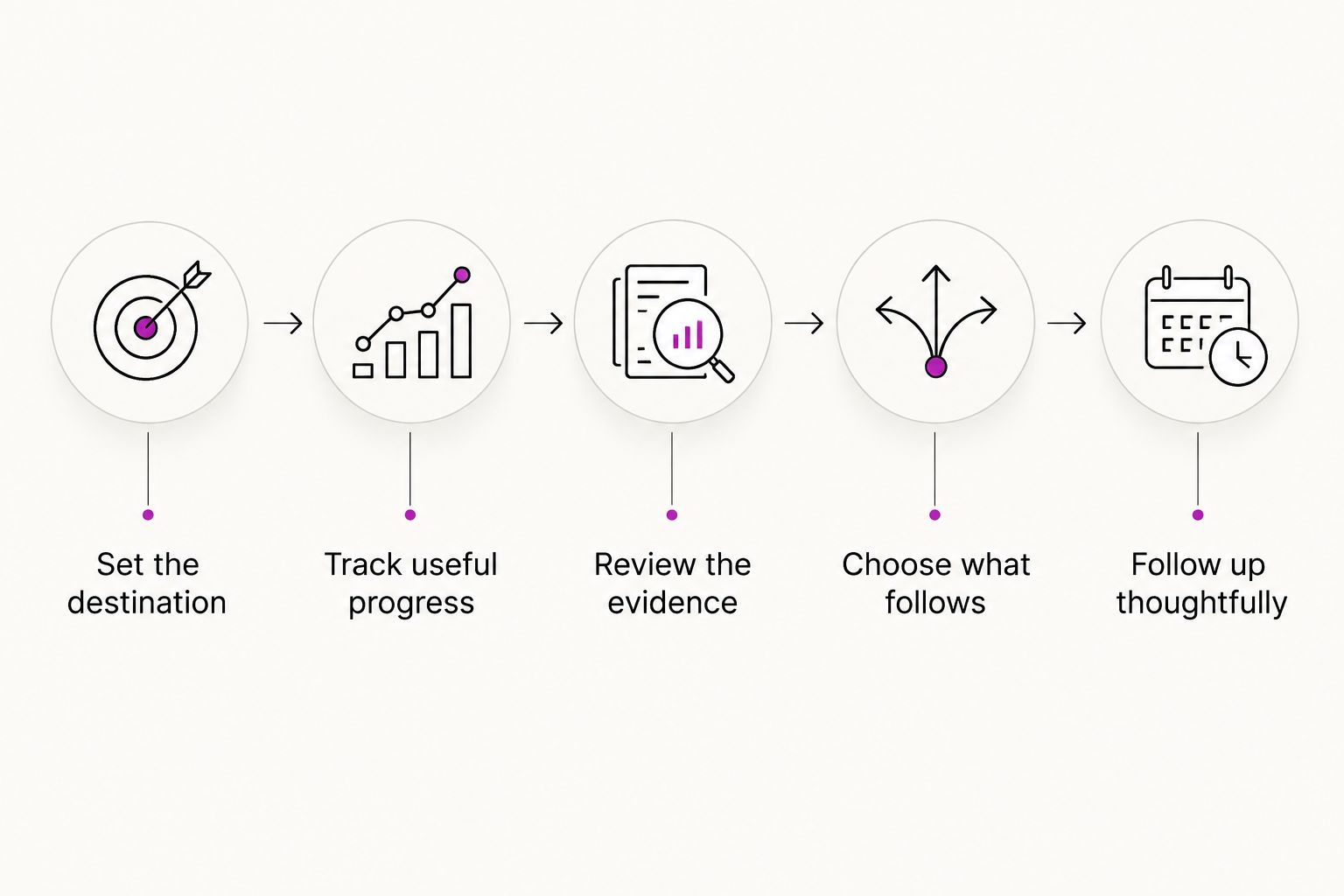
Start before the first engagement ends. Use the following process to connect the original goal, the work completed, and a legitimate next step.
1. Set the destination
Ask your client what they want to be different when your work together finishes. Replace vague ambitions such as feeling more successful with something the client can recognize in their own work or decisions.
For a coach helping entrepreneurs communicate their offers, that might mean being able to explain the offer clearly and use it in real sales conversations. This is an example of a coaching goal, not a promised business result.
Record the starting point in the client’s own words. Ask these 3 questions:
- What are you trying to change?
- What is getting in the way right now?
- What would tell you this engagement was useful?
Agree on what your engagement covers and what it does not. A renewal conversation gets muddy when the client believes unfinished work was included in the original agreement.
2. Track useful progress
Keep a simple record of the goal, actions taken, obstacles, and decisions. Let your client correct the record; your interpretation of progress is not automatically theirs.
Useful evidence depends on the engagement. It can include a completed action, a decision the client had avoided, a new behavior they can repeat, or a business measure they already track.
For your 2027 client reviews, separate actions from outcomes. Publishing content is an action; receiving a qualified inquiry is an outcome. Do not describe the first as proof of the second.
End each session with 1 next action the client understands and accepts. This is a suggested working format, not a claim that every coaching session requires the same structure.
3. Review the evidence
Before discussing another engagement, revisit the original goal. Ask what changed, what remains difficult, and which parts of the work the client found useful.
Use these 3 prompts to keep the review specific:
- What can you do now that was difficult before?
- What still needs attention?
- What do you want to handle independently?
Give the client room to say that something did not help. Treat that answer as information to address, not an objection to overcome.
If you missed an agreed commitment, discuss the gap directly. Do not turn an undelivered promise into the reason someone needs to buy again.
4. Choose what follows
Name the next goal before naming the next package. If you cannot explain what another engagement would address, pause the sales conversation.
A useful invitation connects the client’s stated priority with a clear scope. Explain what you would work on together, what the client would do between sessions, and how you would review progress.
Give the client an actual choice. Continuing, returning later, and finishing can all be appropriate outcomes; the decision should follow the client’s needs rather than your preference for recurring revenue.
5. Follow up thoughtfully
Before closing an engagement, ask whether the client wants a future check-in and what would make that contact useful. Agree on the channel and timing rather than assuming permission to send repeated sales messages.
Keep your 2027 follow-up messages connected to the work you actually did together. Reference an agreed action or goal, ask a relevant question, and make any invitation easy to decline.
Avoid the empty check-in that exists only to reopen a sale. A thoughtful message has a clear purpose even if the client does not book anything.
Choose the right next engagement
Do not make every client fit the same continuation offer. Compare the paths below before deciding what to recommend.
| Path | Best for | Advantage | Limitation |
|---|---|---|---|
| Continue now | Clients with a clear next goal requiring active support | Keeps the work connected to an identified priority | Becomes an open-ended commitment if the scope stays vague |
| Return later | Clients who need time to apply what they learned | Creates room for independent practice | Requires an agreed reason to reconnect rather than a presumed booking |
| Finish the engagement | Clients whose agreed goal is complete | Respects completion and client autonomy | Does not create an immediate repeat engagement |
Continue now: define a fresh scope
Recommend continued coaching when you can name the next objective and explain why your support fits it. Distinguish the new work from anything already promised.
Put the scope in writing. Include the focus, responsibilities, boundaries, and review point so the client can assess the invitation without decoding a sales pitch.
Return later: give independent work room
Recommend a pause when the client needs to apply decisions before more coaching becomes useful. Ask what experience or obstacle would justify another conversation.
A future check-in is not a confirmed renewal. Keep that distinction clear in your communication and your business planning.
Finish the engagement: make completion useful
Recommend finishing when the agreed work is complete and there is no clear next coaching need. Summarize the client’s progress and the actions they intend to maintain.
Leave the door open without making the ending feel incomplete. Someone should not need another package to receive a clear handover from the current one.
Why repeat-client decisions vary
Use these factors to guide the renewal conversation. They are questions to examine with your client, not excuses to push harder when the answer is no.
- Goal completion: A completed goal calls for a different conversation than an unfinished one. Establish which situation you are discussing.
- A relevant next need: Another engagement needs its own purpose. General enthusiasm about coaching is not a defined scope.
- Time to apply the work: Ask whether the client needs more support or more room to practice independently.
- Fit with your expertise: Recommend only work you are equipped to support. A new need does not automatically belong in your offer.
- The client’s willingness to continue: A useful proposal still requires a willing buyer. Respect a clear decline without turning it into a persuasion exercise.
Recommend the next engagement because it fits, not because the current one is ending. That rule keeps your offer tied to a client need you can explain.
What should you say when asking a coaching client to renew?
Start with the client’s stated goal and their assessment of progress. Then describe the next issue you could help address and ask whether they want to discuss working on it together.
Use this conversation outline rather than a memorized pitch:
- Progress: Review what changed and ask whether your summary matches their experience.
- Priority: Ask what matters next and why it matters now.
- Invitation: Explain the relevant support and ask if they want the details.
Do not assume that a positive review means someone wants to renew. Appreciation and buying intent are different answers.
How do you reconnect with former coaching clients?
Reconnect through a relevant, permission-based message tied to the client’s previous work. Ask about the goal they were pursuing instead of opening with a generic announcement about your services.
Keep these 2 messages separate: a genuine check-in and a specific invitation to work together. Combining them without being clear about your intent can make the check-in feel like a disguised pitch.
If you have a relevant offer, say so plainly. Explain the connection to their needs without claiming you know their current situation better than they do.
Can AI help you get repeat coaching clients?
Yes… AI can help you get repeat coaching clients by handling the follow-through that keeps people coming back: drafting check-in messages, organizing review agendas, and tracking what each client is working on.
You’re still the coach.
You own the accuracy, the consent, and the tone of everything that goes out.
A few rules keep AI helpful here:
- Give it real context. The more it knows about the session and the goal, the less it guesses.
- Cut anything it made up. If a draft mentions a win that didn’t happen, delete it.
- Edit for your voice. If you wouldn’t say a line out loud to your client, rewrite it.
- Keep praise honest. A glowing recap is no substitute for a true picture of where your client is.
- Protect private details. Keep confidential client information out of AI tools unless your client agreements and data rules allow it. You can build a great follow-up template without sharing anyone’s private story.
Here’s where most coaches get stuck…
You can do all five repeat-client steps by hand for three clients.
At fifteen clients, the progress notes stop getting written, the review call slides to next month, and the follow-up you meant to send in March never goes out.
That’s usually when a great client quietly drifts away.
So in my business, these steps happen after every single session without me chasing them.
My clients know their calls are recorded and agree to it, so my AI teammate Memo can do the heavy lifting.
After every coaching call, Memo pulls the notes, the wins, and the agreed next action from the Grain recording and files them where my team can find them.
When it’s time for a review call, the evidence is already waiting.
And I still read everything before it reaches a client.
FAQ
What’s the best way to get repeat clients as a coach?
Connect a clear record of progress with a specific next goal the client wants to pursue. Invite another engagement only when your coaching fits that goal.
When should I bring up renewing a coaching package?
Bring up renewal after reviewing progress and before the client has to make a rushed decision about continuing. Set expectations about the review process when the engagement begins.
Should I offer a discount to get a coaching client to return?
Do not use a discount as a substitute for a relevant coaching goal. First establish whether another engagement is useful and clearly different from work already promised.
What should I do if a client says they are finished with coaching?
Respect the decision and close the engagement clearly. Summarize progress, confirm any remaining commitments, and ask permission before arranging future contact.
How often should I follow up with former coaching clients?
Follow up at the timing and through the channel the client agreed to. Ask what kind of contact would be useful rather than imposing a standard sales sequence.
Can we help with marketing communication for coaches?
We offers AI-powered marketing coaching and training for coaches, creators, and entrepreneurs. The stated focus includes authentic content strategy, which is relevant to drafting communication that stays true to your voice.
One last thing
Before you add another follow-up sequence to your 2027 marketing plan, review how your current engagements end. Can each client explain what changed, what they will do independently, and what would justify returning?
Write a clear completion summary before you write a renewal pitch. If another engagement makes sense, that summary gives you something specific to discuss. If it does not, you have still finished the work with care.
Build Your Repeat Client System With AI Stars
If you finished this post thinking “I know I should do this… I just don’t have the hours,” AI Stars was made for you.
AI Stars is our monthly membership where you build an AI system for each part of your business, one certification at a time.
That includes client success, the part of your business that decides whether people come back.
Inside AI Stars, you’ll:
- Set up your AI Soul System. Your AI learns your clients’ goals, your offers, and how you talk, so it stops starting from scratch.
- Build your AI team. Your AI teammates draft session recaps, progress check-ins, and review agendas, and you approve them before anything goes out.
- Write follow-ups that sound like you. Friendly check-ins tied to real work, easy for a client to say “not right now” to.
You stay the coach.
Your AI handles the tracking and the reminders.
AI Stars isn’t for you if you want AI to coach your clients for you.
It’s for coaches who want to show up for every client like they only have three.



Leave a Reply