
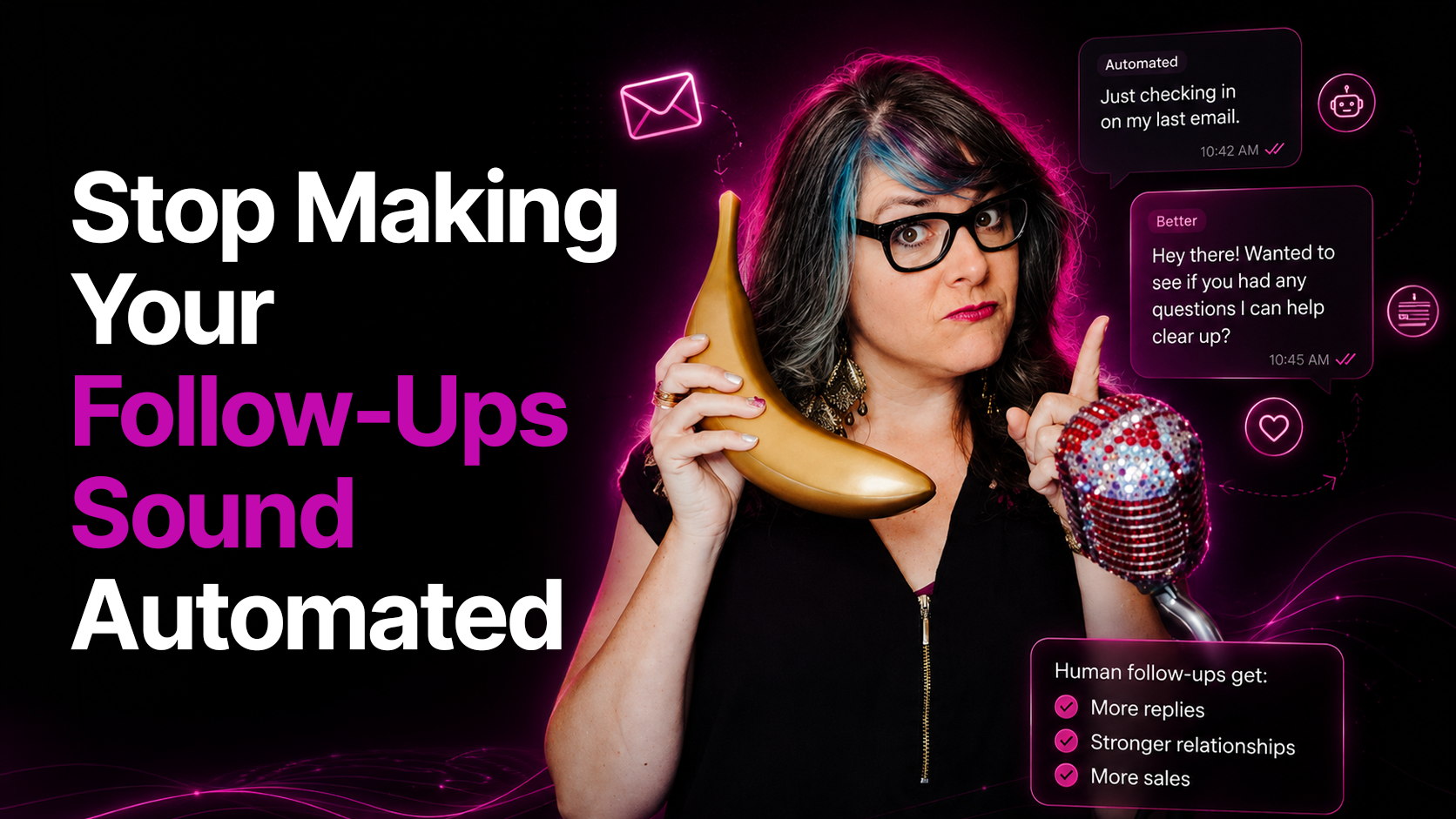

What Does It Mean To Automate Follow-Up Without Sounding Like A Robot?
Automate client follow-up without sounding like a robot by building messages that send themselves on time, every time, while still reading as if they came from an actual human who knows the recipient. It is the combination of two things people usually treat as opposites: a system reliable enough to run without you, and language warm enough that nobody can tell it ran without you.
Most automation fails at the second half. It nails the timing and guts the voice. The fix is not less automation. It is better-written automation, built once, from your actual voice, so speed and personality stop competing.
Who This Is For
You are a coach, consultant, course creator, or small agency owner who has tried automation before and quietly turned half of it off, because it made you sound like a company instead of a person. Maybe you have real leads sitting cold right now because manual follow-up does not scale and automated follow-up made you cringe. You are not against automation. You are against automation that costs you your voice to get it. This is for you.
Key Takeaways
- Robotic-sounding automation is almost always a writing problem, not a technology problem. The tool is rarely the reason a message sounds canned.
- The messages that convert are built from your actual sentences, your actual phrases, and your actual rhythm, not a generic template swapped with a first name field.
- A follow-up sequence needs a spine: trigger, timing, and tone, decided once, so every message downstream inherits the same voice instead of drifting.
- AI can draft in your voice if you feed it real examples of you talking, not a one-line personality description.
- The businesses that keep their voice through automation review and edit their sequences quarterly. The ones that lose it set it and forget it for two years.
- You can test a fully built, voice-matched follow-up system for 30 days at no charge before deciding anything.
Table of Contents
1. Why Does My Automated Follow-Up Sound Like A Robot In The First Place?
Because most follow-up templates were written to be generic on purpose. They were built to work for everyone, which means they were built to sound like no one.
Here is the pattern almost every business falls into. You sign up for a platform. The platform ships with default follow-up templates, written by someone who has never met your clients and never will. You either use the template as-is, which sounds like nobody, or you swap in your name and a few details, which sounds like nobody with your name attached.
Neither version sounds like you, because neither version was written by you. It was written to be inoffensive at scale. Inoffensive at scale and “sounds like a real person” are different goals, and most default automation was only ever built for the first one.
This is the part nobody tells you…
The problem gets worse the more “professional” the template sounds. Corporate-safe language reads as automated precisely because it avoids the specific, casual, slightly imperfect phrasing real humans actually use when they talk to someone they like. The more polished and careful the wording, the more obviously synthetic it feels to the person reading it.
2. Is This A Tool Problem Or A Writing Problem?
It is a writing problem wearing a tool costume.
You can hand the exact same CRM to two different business owners. One will send follow-up that reads like a text from a friend who happens to also run a business. The other will send follow-up that reads like a terms-of-service update. Same software. Completely different result.
The tool decides whether the message sends on time. The writing decides whether anyone believes a human wrote it. Most people troubleshoot automation problems by switching tools, when the actual fix was rewriting the message.
This matters because it changes where you spend your effort. If you think it’s a tool problem, you spend months comparing platforms. If you recognize it’s a writing problem, you spend an afternoon writing five real messages in your own voice and feeding them to whatever tool you already have.
3. What Actually Makes A Message Sound “Human”?
A handful of specific things, and none of them are complicated.
Specificity. “I noticed you downloaded the pricing guide” beats “Thanks for your interest.” Specific beats generic every time, because generic is the fingerprint of a template.
Sentence rhythm that isn’t uniform. Real people write short sentences next to long ones. Automated copy tends to normalize everything into the same length, which reads as flat even when the words themselves are fine.
A real opinion, even a small one. “This is my favorite part of the whole process” sounds like a person. “This step is important” sounds like a manual.
Something slightly imperfect. A sentence that starts with “and.” A trailing thought. An aside in parentheses. Real writing has texture. Polished-flat writing does not.
Your actual phrases. If you say “dahlink” or “let’s get weird” out loud to clients, and your automated messages never say it, the automation is quietly a different person than you are.
None of these require more time to write. They require writing the message yourself once, in your own voice, instead of accepting whatever the platform shipped with.
4. How Do I Teach An AI Tool To Write Like Me Instead Of Like Everyone Else?
Feed it real examples of you, not a description of you.
Telling an AI tool “write in a warm, friendly tone” produces warm, friendly, generic output, because “warm and friendly” describes a thousand different voices. The tool has nothing specific to imitate.
Instead, give it three to five actual messages you have sent. A real email. A real DM reply. A real voice memo transcript. The specific phrasing, the actual rhythm, the real jokes you make. That is what lets a tool draft something that sounds like you rather than sounding like “friendly business owner, generic flavor.”
This is the exact gap my AI Marketing Toolkit is built to close. It is not a set of prompts for generic marketing copy. It is a way of training your own automation on your own voice, so what goes out under your name still sounds like something you would actually say.
A simple test
Read an automated message out loud. If it sounds like something you would genuinely text a friend, keep it. If it sounds like something a company would post to its help center, rewrite it before it goes anywhere near a real lead.
5. What Should My Follow-Up Sequence Actually Include?
Fewer messages than you think, each one earning its place.
Message 1, immediate. Confirms you got their information, in your voice, with something specific to what they actually did.
Message 2, within 24 hours. A genuine value-add, not a check-in. Answer a question they probably have before they ask it.
Message 3, day 3 to 5. A soft nudge tied to a real outcome, not a generic “just following up.”
Message 4, day 7 to 10. Permission to say no. Counterintuitively, this is often the message that gets the most replies, because it removes pressure instead of adding it.
A branch, not just a line. If they engage, the sequence should shift tone, not just keep firing the same script at someone who already responded.
Four to five messages beat fifteen. A shorter sequence that sounds like a person outperforms a longer sequence that sounds like a drip campaign, because people can feel the difference between “someone is thinking about me” and “a machine has me on a schedule.”
6. How Do I Keep My Voice Consistent As The Sequence Grows?
Write a short “voice spine” once, and check every new message against it before it ships.
A voice spine is not a full brand guide. It is three or four sentences: how you’d greet someone, a phrase you’d never use, a phrase you use constantly, and how you’d close a message. Every automated touchpoint gets checked against that spine before it goes live.
Without it, sequences drift. Someone new joins the team. A new tool gets added. A message gets copied from a template “just this once.” Eighteen months later, half your automation sounds like you and half sounds like a stock template nobody remembers approving.
Review your sequences on a quarter, not a whim. Once every three months, read every automated message out loud, back to back. If any of them make you wince, that is the one leaking trust the fastest, and it is usually the oldest one nobody has touched since setup.
7. Won’t This Take Forever To Set Up?
Less time than the version you are currently maintaining by hand.
The setup is a few hours, once: write the messages, build the sequence, connect the trigger. Compare that to the actual time cost of manual follow-up, which is fifteen minutes here and there, forever, distributed across every single week you run this business, with no end date.
The migration is not extra time. It is the time you are already spending, in small unrecorded pieces, spent once, up front, so it stops recurring.
8. What Should I Do In My First 30 Days?
Week 1. Write your voice spine. Four sentences. Pull three real messages you have actually sent to clients or leads.
Week 1. Build message 1 and message 2 of your sequence using your real phrasing, not a template’s.
Week 2. Add the branch logic. What happens if they reply. What happens if they don’t.
Week 3. Read the whole sequence out loud, back to back, exactly as a lead would receive it.
Week 4. Turn it on with real leads, not test data. Fake data will not tell you whether it sounds like you. Real replies will.
This is exactly what a 30-day trial of HighLevel is built for, especially with the AI Marketing Toolkit attached. You are not researching whether automation can sound human in theory. You are building the actual sequence and watching real people respond to it.
9. Recommended Tools And Resources
- HighLevel. The all-in-one CRM and automation platform this entire workflow runs on.
- Molly’s AI Marketing Toolkit. A $97 value, included free with the 30-day trial, built specifically to train your automation on your own voice instead of a generic one.
- A voice memo app. Record yourself explaining something to a client the way you naturally would. Transcribe it. That transcript is raw material for training any AI tool on your actual voice.
- A shared “voice spine” doc. Three or four sentences your whole team checks new copy against before it ships.
- A quarterly calendar reminder. To read every automated sequence out loud, back to back, before it drifts too far from you.
Frequently Asked Questions
Does automated follow-up actually convert as well as personal follow-up?
Yes, when it is written in your real voice and timed well. The conversion drop people blame on “automation” is almost always caused by generic wording, not by the fact that a system sent the message.
How many follow-up messages are too many?
When the fourth or fifth message starts repeating the same ask without adding anything new, you have crossed into annoying. Quality of each message matters more than quantity of messages.
Can I use AI to write these messages without it sounding fake?
Yes, if you feed it real examples of your actual writing first. AI trained on generic prompts produces generic output. AI trained on your real messages produces something much closer to your real voice.
What if my team writes differently than I do?
Pick one voice, usually the founder’s, and have the AI tool and your team both write to that spine. Consistency matters more than which specific voice you pick.
Do I need different sequences for different services?
Usually yes, at least a light variation. The core voice spine stays the same. The specific value-add in message 2 should reflect what that particular lead actually asked about.
How long before a sequence starts to feel stale?
Around a quarter for most businesses. Language that felt fresh in January can feel canned by June if nothing changes, even if the timing and logic still work perfectly.
Should my automated messages ever mention that they’re automated?
No. If it sounds like a person wrote it, it does not need a disclaimer. If it needs a disclaimer to feel honest, that is a sign the wording needs work, not the disclosure.
What is the single biggest mistake people make with follow-up automation?
Copying a template and only swapping the first name field. That single move is responsible for more robotic-sounding sequences than any other decision in this whole process.
Can I test this without moving my whole business over first?
Yes. A 30-day trial is exactly built for testing one real sequence with real leads before deciding whether to move anything else.
Does a shorter sequence really outperform a longer one?
Often, yes. A four-message sequence that sounds like a person tends to outperform a twelve-message sequence that reads like a drip campaign, because recipients can feel persistence versus pressure.
What’s the fastest way to find my own “voice spine”?
Read your last ten real client emails or DMs back to back. The phrases and rhythms that repeat across all ten are your actual voice. Write those down.
Is this only useful for sales follow-up?
No. The same principle applies to onboarding sequences, check-ins, re-engagement messages, even internal team updates. Anywhere automation currently sounds flat is a place this fix applies.
Final Summary
Robotic-sounding automation is a writing problem, not a technology problem. The fix is not fewer automated messages or a fancier platform. It is messages built from your own real sentences, checked against a short voice spine, and reviewed on a quarterly basis instead of set once and forgotten. AI can draft convincingly in your voice, but only if you feed it real examples of you talking, not a one-line description of your tone.
A shorter sequence that sounds like a person will outperform a longer sequence that sounds like a drip campaign nearly every time.
Here’s what to remember: the tool decides whether it sends on time. You decide whether anyone believes a human wrote it.
Want to build a follow-up sequence?
If you want to build a follow-up sequence that actually sounds like YOU instead of a template with your name pasted in, this is the platform I recommend starting with.
HighLevel gives you the CRM and automation tools to build the whole workflow, and when you start through my link, you’ll also get my AI Marketing Toolkit, a $97 value, included with your trial.
So you’re not just automating your follow-up…
You’re building a system that can actually sound like you from the very first message.

Leave a Reply