

What Is An AI Consultant?
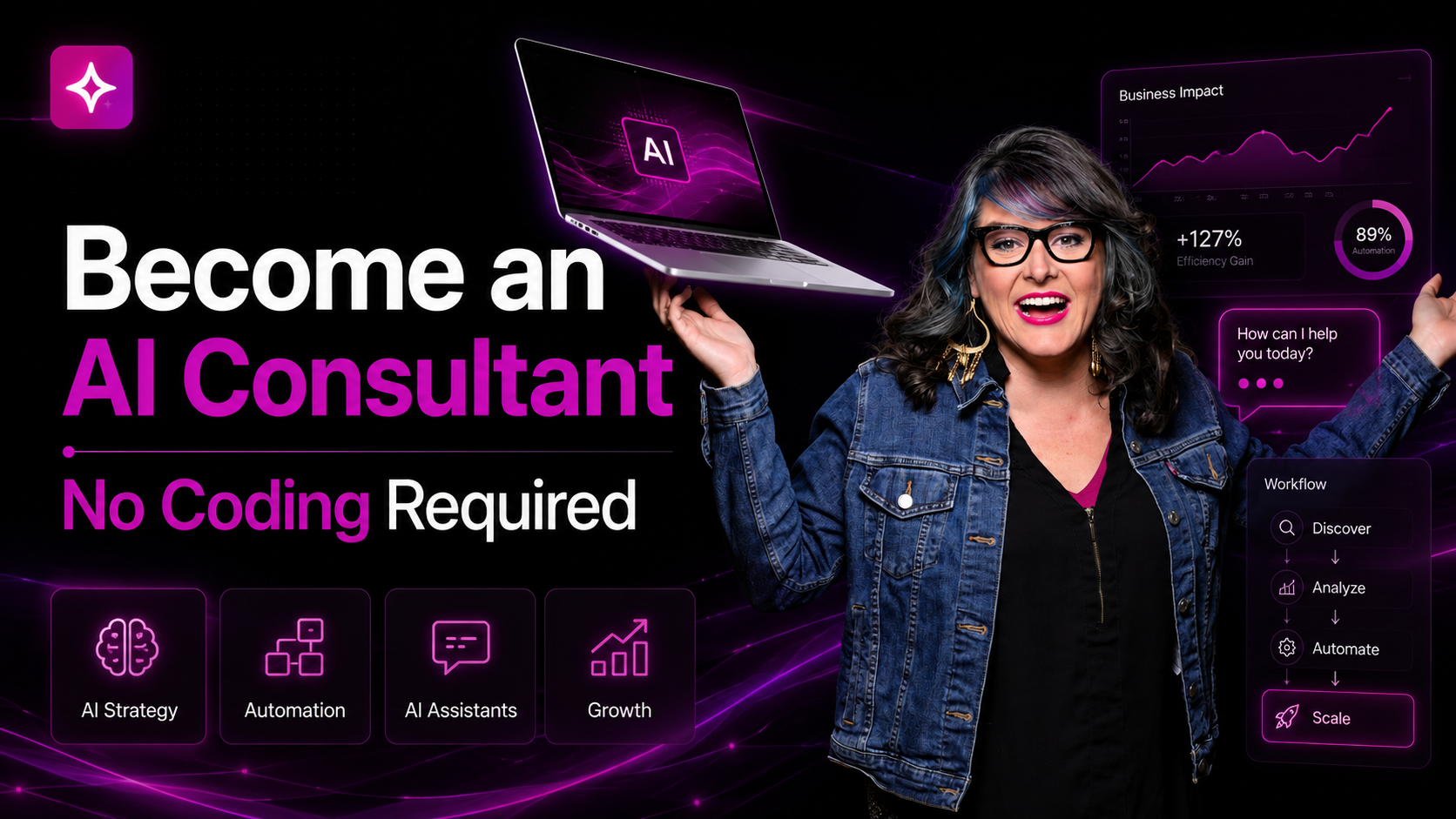
How to become an AI consultant starts with understanding what the role actually is. An AI consultant helps a business decide what to do with AI, not how to code it.
They identify which problem is worth solving, design the system around it, and package that work into a defined, priced engagement with a clear deliverable at the end. The technical implementation is usually the smallest part of the job and increasingly, it’s the part AI tools handle themselves.
The real qualification isn’t a computer science degree. It’s domain expertise paired with a repeatable method for applying AI within that domain.
Who This Is For
You are a coach, consultant, agency owner, or subject matter expert with real years behind you. You have watched AI reshape your industry from the sidelines and you have quietly wondered whether there is a business in it for you.
You have tried some tools. You have bookmarked a lot of content. You have not built anything you could hand someone an invoice for.
And somewhere in the back of your head there is a sentence that goes: I’m not technical enough to charge for this.
This is written for that person specifically.
Key Takeaways
- Businesses hire AI consultants for judgment, not implementation. Knowing which problem is worth solving is the billable skill.
- Technical ability is the fastest-depreciating asset in this market. Domain expertise is the appreciating one.
- You need three things to be hireable: a named problem, a tangible deliverable, and a jargon-free explanation of the result.
- Building the offer before defining your positioning is the single most common reason AI offers come out generic.
- The working order is identity, then documented methodology, then AI systems, then offer, then sale. Skipping steps produces something nobody buys.
- Real practitioners using this sequence have closed engagements from $6,000 to $22,000. Those results are not typical and not guaranteed.
- A paid audit or assessment is the fastest first offer, because it is small, scoped, and produces a document the client can act on.
Table of Contents
1. Do You Need To Be Technical To Be An AI Consultant?
No. And the belief that you do is currently costing a lot of very experienced people their entire shot at this market.
Here is the uncomfortable math.
The technical skill in AI is being commoditized in real time by the very tools everyone is talking about. What required a developer in 2023 requires a well-written paragraph in 2026. That curve is not slowing down. Anything you learn on the pure implementation side has a short and shrinking shelf life.
What is not being commoditized: knowing which problem in a business is actually expensive. Knowing what a decision-maker will change their behavior for. Knowing which twenty percent of a workflow produces eighty percent of the frustration. Knowing how to say a hard thing to a client so they hear it instead of getting defensive.
That is judgment. Judgment takes years and does not download.
The reframe that matters: you are not competing with engineers. Engineers are not particularly good at diagnosing business problems, and most of them do not want to be. You are competing with other domain experts, and most of them are still sitting at home deciding whether they are qualified to have an opinion.
A quick definition
Technical implementation is building the thing. AI consulting is deciding what thing is worth building and making sure it gets adopted. The second one is what gets paid, and it is what gets paid more.
2. What Are Businesses Actually Buying When They Hire AI Help?
They are buying the end of their own confusion.
Walk into almost any small or mid-sized business right now, and you will find some version of the same situation. Three people are using AI tools they expensed personally. Nobody knows what anyone else is doing. Leadership has read enough headlines to feel anxious and not enough to feel directed. There is a vague sense that they are behind and no clarity on what “ahead” would even look like.
They do not want a chatbot. They want someone to walk in, look at the whole thing, and say “here is what matters, here is what does not, here is the order.”
That is a diagnosis. Diagnoses are consulting, and consulting has always paid better than building.
The four things a client is really asking
- Where are we losing time or money that AI could actually fix? Not theoretically. Specifically, in our business, this quarter.
- What should we do first? They are drowning in options and starving for sequence.
- What is this going to cost us in disruption? Every honest AI project has a change-management cost and almost nobody names it.
- How do we know it worked? They need a before and an after they can show someone.
Notice that not one of those is a technical question.
3. Why Does My AI Offer Keep Coming Out Generic?
Because you built it before you decided who you were.
This is the most common failure in the entire category and it is nearly invisible while it is happening. Someone sits down to “create an AI offer,” opens a blank document, and tries to reverse-engineer a business from a price point.
What comes out is competent, beige, and completely interchangeable. “AI strategy consulting for small businesses.” “AI implementation services.” “Helping teams use AI better.”
Of course it is interchangeable. There was nobody inside it.
An offer is a container. If you have not decided what goes in the container, you end up shaping a container around nothing in particular, and it looks like every other empty container on the market.
The order that fixes it
Identity first. Who are you in this market, and what about your specific background is an advantage here rather than a footnote? A former hospital administrator selling AI to healthcare practices is not the same business as a generalist selling AI to anyone. One of those is a category of one.
Documented methodology second. The way you already solve problems, written down in enough detail that a system could follow it. This is the part almost everyone skips and it is the part that makes you uncopyable.
AI systems third. Now you are installing AI around a defined method rather than bolting a method onto some tools.
Offer fourth. By this point the offer more or less writes itself, because there is finally something specific to package.
Sale fifth. With a specific offer built on a documented method, the sales conversation stops being a pitch and starts being a diagnosis.
4. What Are The Three Things That Make An Expert Hireable?
Expertise alone does not make you hireable. That is annoying and it is true, and it is why extremely capable people stay unbooked while less experienced people get the microphone.
Three things have to exist.
One: a named problem
Not “I help with AI.” A specific, expensive, recognizable problem the buyer already knows they have.
Weak: I help businesses use AI.
Strong: I help clinic owners cut the six hours a week their front desk spends on intake paperwork.
The second one lands because the buyer has already had that thought. You did not have to educate them into caring.
Two: a tangible deliverable
Something that exists at the end and can be held up in a meeting. An audit document. An assessment scorecard. A documented workflow map. A built system with a handover doc.
Consulting that produces only conversations is hard to sell and harder to renew. A deliverable gives the buyer something to justify the spend with internally, which matters enormously if they are not the only decision-maker.
Three: a jargon-free explanation of the result
If your explanation requires the buyer to already understand the technology, you have not made a sale. You have assigned homework.
Practice saying what changes for them in one sentence with no acronyms in it. If you cannot, you do not yet understand your own offer well enough to sell it.
5. How Do I Turn My Existing Expertise Into An AI Offer?
Start with what you already do repeatedly and well, then ask which part of it AI makes faster, cheaper, or possible at a scale it was not possible at before.
Step by step
- List every recurring problem you solve. Not services. Problems. Write fifteen of them without editing.
- Circle the expensive ones. Which of those cost the client real money, real time, or real risk when left alone? Cross off anything that is merely annoying.
- Pick the one you have solved the most times. Frequency beats prestige here. You want the problem where your pattern recognition is deepest.
- Write down how you actually solve it. The real steps, including the ones you do unconsciously. This is your methodology, and most experts have never written theirs down.
- Find the point where AI actually speeds you up. Which step in that method is slow, manual, or capacity-limited? That is where AI goes. It goes inside your method, not on top of it.
- Define the deliverable. What document, system, or artifact does the client hold at the end?
- Scope it to something you can complete in weeks, not quarters. First offers should be small enough to say yes to and finish.
An example
A fifteen-year operations consultant lists “clients cannot onboard new staff without the founder in the room” as a recurring problem. She has solved it maybe forty times. Her method is a documented interview process that extracts what the founder knows and turns it into training material.
The place AI actually speeds her up is obvious once she has written the method down: the extraction and drafting steps used to take her three weeks of interviews and writing. Now they take four days.
Her offer is not “AI consulting.” It is a founder knowledge extraction sprint with a documented onboarding system as the deliverable. Nobody else is selling that, because nobody else has her method.
6. What Should My First AI Consulting Offer Be?
An audit or assessment. Almost always.
There are three reasons this works better than leading with a build.
It is a small yes. A client who will not commit to a six-month engagement with someone they just met will often commit to a scoped diagnostic. You are asking for a much lower-risk decision.
It produces a document. Audits naturally end in an artifact, which satisfies the deliverable requirement from section four without any extra design work.
It sells the next thing for you. A good audit surfaces three to five specific problems worth fixing. You are the person who found them and who understands the context. The implementation conversation happens on its own.
What goes in an AI audit
- A current-state map of where AI is already being used, including shadow usage nobody has admitted to
- A short list of the highest-value opportunities, ranked by effort against impact
- A risk and governance section covering data handling, accuracy exposure, and who is accountable
- A recommended ninety-day sequence, not a wish list
- A clear statement of what you would do first and why
7. How Do I Price An AI Audit Or Assessment?
Price against the value of the decision, not the hours of the work.
An audit that redirects a company away from a bad six-figure build is worth a great deal more than the time it took to produce, and the buyer knows that.
Practical guidance
- Anchor on the problem’s cost, not your calendar. If the process you are examining is burning fifteen hours a week across a team, do that arithmetic out loud in the proposal.
- Do not price your first one at zero. A free audit trains the client to treat your judgment as free, and it is the exact thing you are selling.
- Use a fixed fee. Hourly pricing on diagnostic work punishes you for being fast, and being fast is the whole advantage of your experience.
- Build in a next-step conversation. The audit fee is often best understood as the front of a longer engagement, and pricing it as a standalone product with an obvious sequel is more honest than pretending otherwise.
Practitioners using this exact sequence have closed audits and builds ranging from $6,000 to $22,000. Those are real reported outcomes, they are not typical, and they are not a promise of what any individual will earn.
8. How Do I Explain AI Value To A Skeptical Client?
Lead with the business result. Mention the technology last, or not at all.
Most AI pitches fail because the consultant is excited about the mechanism and the buyer is only interested in the outcome. Those are different conversations and only one of them closes.
A structure that works
Name what you observed. “Your team is re-entering the same client information in three systems.”
Quantify it. “That’s roughly eight hours a week between two people.”
State the change. “After this, it’s entered once and flows to the other two.”
Then, briefly, the how. “We do that with a workflow layer plus an AI step that reads the intake form. You won’t touch it.”
Address the fear before they raise it. Skeptical clients are usually worried about accuracy, data privacy, or their team quietly refusing to use it. Name whichever one applies before they have to.
The word “AI” should appear once in that whole sequence, and late.
9. What Is A Soul System And Why Does It Matter Here?
An AI Soul System is a documented, structured record of your expertise, stories, frameworks, voice, and intellectual property, organized so that AI tools can actually use it.
It matters because it is the difference between generic AI output and output that sounds and thinks like you.
Without one, every AI tool you use starts from zero and produces the statistical average of everyone. That average is exactly what your prospects can get for free, which makes it worth roughly free.
With one, the AI is working from your positioning, your method, your language, and your past decisions. The output stops being a commodity, and so do you.
Why it is the moat: prompts can be screenshotted and shared in an afternoon. A documented body of expertise built over years cannot be. If your differentiation lives in your prompts, you will be undercut quickly. If it lives in a documented methodology with AI installed around it, there is nothing for a competitor to copy.
This is also why the order in section three puts documentation before tooling. Tools built on top of nothing produce nothing distinctive.
10. How Long Does It Take To Build This?
Faster than most people assume, and only if it is sequenced.
The reason this typically takes people a year is not difficulty. It is that they work on it in scattered hours with no deadline, restart their thinking every time they sit down, and stall out at the first ambiguous decision.
Compressed into a focused sprint with a fixed order, the realistic shape is about six weeks:
- Weeks 1 and 2: identity, positioning, and documented methodology
- Week 3: installing AI systems around that method
- Week 4: defining the offer, the deliverable, and initial pricing
- Week 5: the sales message and conversation structure
- Week 6: implementation, refinement, and the first real conversations
The compression works because each stage feeds the next. You are never staring at a blank page, because the previous week produced the input for the current one.
Frequently Asked Questions
Do I need a technical background to become an AI consultant?
No. You need domain expertise and a repeatable method. The technical implementation layer is increasingly handled by the tools themselves, and clients are paying for diagnosis and sequencing rather than construction.
What if I don’t know what to sell yet?
That is normal and it is the actual starting point for most people. The offer gets built from your existing recurring work. Trying to invent an offer from nothing is what produces generic packages.
How much can an AI consultant charge?
It varies enormously by niche and scope. Reported engagements among practitioners using this method range from around $6,000 for a scoped phase one to $22,000 for a full build. Audits and assessments typically sit below that and function as an entry point. These figures are examples, not benchmarks or guarantees.
What is the difference between an AI consultant and an AI developer?
A developer builds systems to spec. A consultant determines what should be built, in what order, and whether it is worth building at all. Consultants are hired earlier in the process and usually paid for judgment rather than output volume.
Is AI consulting a saturated market?
The bottom of it is getting crowded fast, particularly anyone selling prompt libraries and general tool training. The specialist end is not remotely saturated. Very few people are combining fifteen years of vertical expertise with AI implementation in a specific industry.
How do I find my first AI consulting client?
Usually inside your existing network. The people who already trust your judgment in your domain are the shortest path to a first paid engagement, and they need less convincing that you know what you are talking about.
Should I get an AI certification?
Certifications rarely close deals on their own. Buyers respond to a relevant deliverable and a clear explanation of the outcome. A certification with no offer attached to it produces very little. A defined offer with no certification produces revenue.
What tools do I need to start?
Fewer than you think. A capable AI assistant, a place to document your methodology, and a way to deliver the artifact. Tool selection is a downstream decision and it is a poor place to start.
What if the technology changes and my offer becomes obsolete?
This is why the offer is built on your method rather than on a specific tool. The tool underneath swaps out. The diagnosis, the sequencing, and the client relationship do not.
How do I handle a client who wants a guarantee?
Guarantee the deliverable and the process, not the business outcome, which depends on their adoption. An audit can be guaranteed to be delivered and to be actionable. It cannot be guaranteed to be implemented by a team you do not manage.
Can I do this alongside my existing business?
Yes, and most people do. AI consulting is frequently added as a branch of an existing practice rather than a replacement for it, particularly where the existing client base is already asking AI questions.
What is the fastest first offer to launch?
A scoped audit or assessment. It is small enough for a client to approve quickly, it produces a document, and it naturally generates the next engagement.
How do I know if my expertise is valuable enough?
If people already ask you questions in your domain and take your answers seriously, it is valuable enough. The thing you dismiss as “just what I know” is usually the asset, precisely because it feels obvious to you and is not obvious to them.
Recommended Tools And Resources
- Claude for documentation-heavy work, long-context reasoning, and building an assistant that works from your own material
- A structured knowledge base (Obsidian, Notion, or a well-organized Drive) to hold your documented methodology
- HighLevel or a comparable platform for the delivery infrastructure of a consulting business: pipelines, scheduling, contracts, invoicing
- A transcription tool for turning your existing calls and talks into documented method rather than writing from scratch
- A simple audit template so your first deliverable is a fill-in rather than a design project
- A defined pricing sheet written before your first sales conversation, so pricing happens on paper and not under pressure
Final Summary
You do not need to be technical to become an AI consultant. You need domain expertise, which you already have, plus a structure that turns it into something a business can buy.
Clients are not paying for implementation. They are paying for judgment about what to implement, in what order, and why.
Three things make you hireable: a named problem, a tangible deliverable, and an explanation with no jargon in it. Most experts have none of the three and assume the missing piece is technical skill.
Build in order. Identity, then documented methodology, then AI systems, then offer, then sale. Building the offer first is why offers come out generic.
Start with an audit. It is a small yes, it produces a document, and it sells the work that follows.
The window where being early matters more than being perfect is open right now, and it will close the way these windows always close, quietly, while everyone is still deciding.
Ready To Build Yours?
AI Stars PRO is a six-week sprint where you build exactly this, with me in the room.
Identity. Soul System. AI team. Sellable offer. Sales process.
You walk in with expertise. You walk out with a business asset, not a folder of notes.
The founding cohort begins Thursday, August 13, 2026, and founding pricing ends the moment it starts.




Leave a Reply