
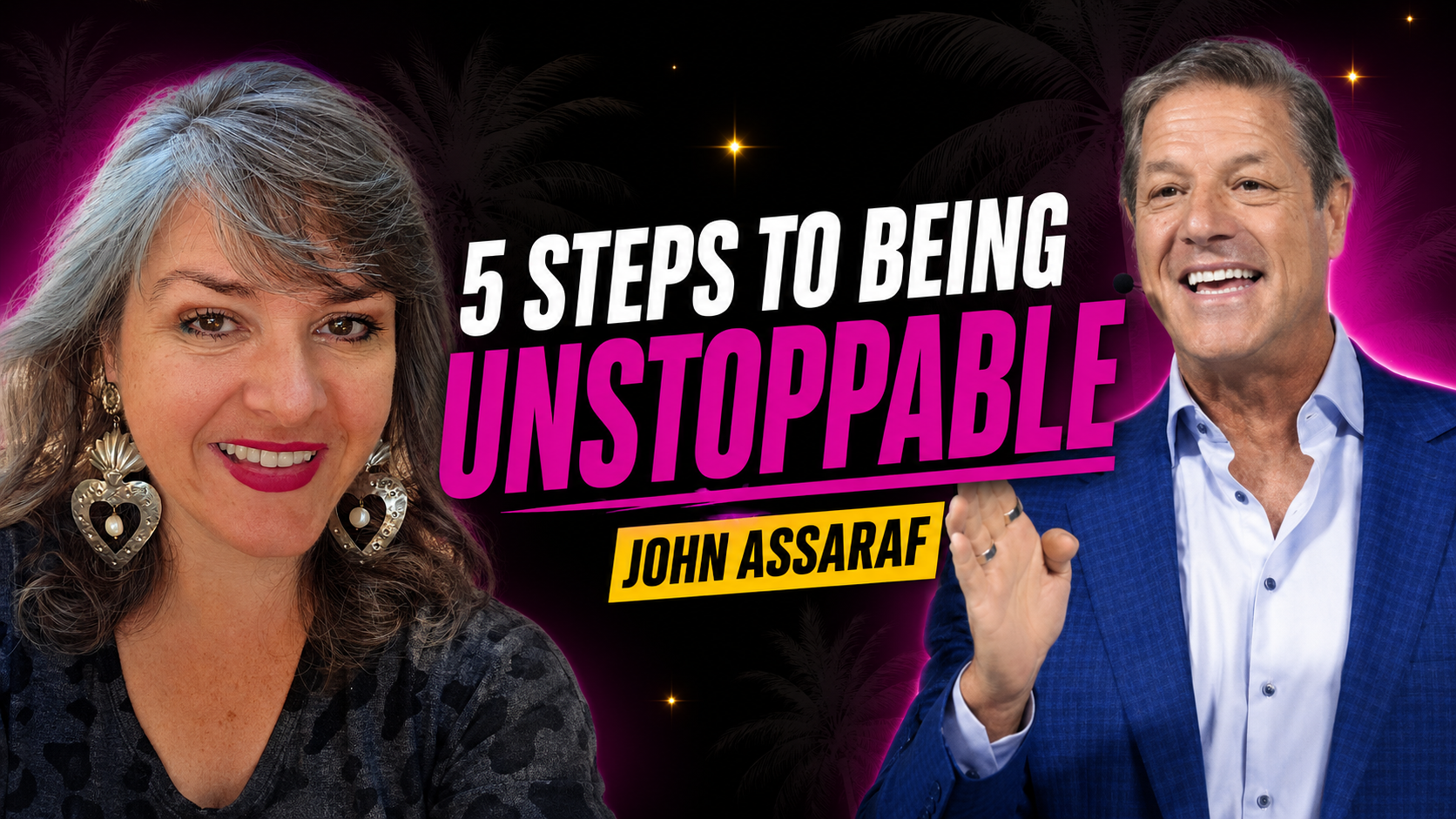

What Is This Framework?
The 5-Step Framework is a simple but powerful approach to reaching your goals. I brought behavioral neuroscience researcher John Assaraf into my community to teach this, and I’ve been using it in my own business ever since.
It’s a five-step, neuroscience-based framework for closing the gap between the goals you set and the goals you actually achieve. Most goal-setting advice stops at the vision board. This goes further, into the exact reason a clear goal so often doesn’t turn into consistent action.
Here’s the short version. Setting a goal is a conscious-mind job. Achieving it depends on whether your identity, beliefs, habits, and emotions already support that goal, or are quietly working against it. This framework walks through both halves, in order, so nothing gets skipped.
Who This Is For
This is for you if you’ve set a goal, know exactly what needs to happen to hit it, and still find yourself stalling. Procrastinating. Sliding back into the old pattern the second things get hard.
I built my entire business around AI-powered systems, and I’ll tell you straight, that’s not where most people get stuck anymore. AI can hand you the strategy in minutes. What it can’t do is make you use it. That’s a mindset job, and it’s exactly what this framework is for.
Key Takeaways
- Achievement takes three things lined up together. Mindset, skill set, and action. Skill set is the easy one now, which means mindset is where the real work actually is.
- A detailed, written vision is where you start, but it’s not enough on its own. It has to be matched by an identity, a set of beliefs, and a set of habits that back it up.
- Most self-sabotage has a real, identifiable cause behind it. It’s not a character flaw. Which means you can actually work on it instead of just white-knuckling through.
- Discipline is trainable. There’s a specific part of your brain responsible for resistance, and it responds to small, repeated practice, not one big burst of motivation.
- These five steps go in order. I learned this the hard way. Skip straight to habits and discipline without a clear vision and matching identity first, and it doesn’t stick.
Table of Contents
Step 1: Write Down A Specific Vision
The 5-Step Framework starts here, and John was blunt about it. Your brain needs a concrete target. “Grow the business” or “make more money” doesn’t give it enough to work with.
A real vision has timelines. Specific outcomes. Enough detail that it actually functions as a target instead of a nice thought you have in the shower. That’s why the 5-Step Framework starts with getting clear on exactly what you want to achieve.
You also need a real reason why. Not a soft one. John’s line and I wrote this one down word for word is that a weak why produces a weak, easily abandoned pattern. Your reason has to be strong enough to outweigh the discomfort of doing something new.
That’s the foundation of the 5-Step Framework: get specific about where you’re going, understand why you want it, and give your brain a target worth working toward.
What I’d actually do: Write the vision in full sentences. Put dates on it. Don’t just keep it in your head. Look at it often, because that repeated attention is part of what wires the pattern in.
Step 2: Get Your Identity To Match The Vision
Here’s where it gets interesting. If your vision doesn’t match who you believe you are right now, you don’t get progress. You get resistance.
John’s point, and I loved this one, is that nobody is born with a fixed identity. Not you, not me. Identity gets built the same way a belief or a habit does: through repetition. Which means it can be rebuilt the same way, too.
That’s one of the reasons the 5-Step Framework goes beyond simply setting goals. You’re not just deciding what you want; you’re also working on the identity that will help you actually achieve it.
He used the actor comparison, and it stuck with me. An actor doesn’t wait to feel like the character before they perform. They rehearse the role until it’s natural. Identity change works exactly the same way. You don’t wait to feel like the person who does the thing. You do the thing, on repeat, until your brain stops treating it as a stretch.
That’s what makes the 5-Step Framework so powerful: you’re not waiting for your identity to change before you take action. The action is part of how your identity changes.
What I’d actually do: Name the specific identity your vision requires. “Someone who ships content every week,” say. Then find small, repeatable actions that reinforce it daily. Don’t wait around for confidence to show up first. It won’t.
Step 3: Update The Beliefs And Habits Running The Show
Your beliefs and habits work like a thermostat setting. If your results already match that setting, working harder inside it won’t get you a different number. You have to reset the setting itself.
Since beliefs and habits are learned, not innate, that means they’re changeable. A belief like “I’m not good at sales” or “this never works out for me” isn’t a fact about you. It’s a trained pattern. Which means it can be retrained.
What I’d actually do: Pick one limiting belief tied directly to your vision. Write a more accurate, more useful one to replace it. Then go get evidence for the new one. Small actions that prove it’s true.
Step 4: Deal With What’s Actually Driving The Avoidance
As part of the 5-Step Framework, John taught the room something called the law of secondary gain, and I haven’t stopped thinking about it since. When a goal carries real risk, failure, embarrassment, rejection, avoiding that risk can actually release a reward chemical. Your brain gives you dopamine for staying safe.
Read that again. Not doing the thing can be chemically reinforced. Right alongside the fear.
That’s an important piece of the 5-Step Framework because once you understand what’s happening in your brain, self-sabotage stops looking like a character flaw. It becomes a pattern with a cause. And causes can be worked with.
John also gave the room a fast physical reset for those moments when panic or overwhelm shows up: a physiological sigh. Two short inhales through the nose, followed by one long exhale through the mouth.
It’s a simple tool, but it fits perfectly into the 5-Step Framework: understand what’s happening, recognize the pattern, and have something practical you can do when your brain starts pushing back.
What I’d actually do: When you catch yourself avoiding something, name the actual risk out loud. Failure, embarrassment, whatever it is. Then use the physiological sigh before you try to think your way through it.
Step 5: Train Discipline Like A Muscle
Last piece. There’s a part of your brain John calls the AMCC, the anterior mid-cingulate cortex, and it’s responsible for that “I don’t want to” feeling.
Untrained, it runs everything. “I don’t feel like it” becomes your identity. “It’s not the right time” becomes your go-to excuse. But when you train it, the response starts to shift: “I know, but I’m doing a little bit anyway.”
That’s the muscle-building move at the heart of the 5-Step Framework. Not a dramatic overhaul. Not forcing yourself to completely change overnight. Just a little bit, on purpose, especially when you don’t want to.
This is another reason the 5-Step Framework focuses on action, not just intention. You’re teaching your brain that discomfort doesn’t automatically mean stop.
John also broke procrastination down into three actual causes: fear, self-image, or what he calls arousal, meaning you’re waiting for the pressure itself to force your hand.
The 5-Step Framework gives you a more useful question than “Why am I procrastinating?” Which one is actually running your specific stall? Figure that out, and you have something concrete to work with instead of simply telling yourself to just do it.
What I’d actually do: The second resistance shows up, take the smallest possible version of the action. Don’t wait to feel ready. Track it. The muscle builds from reps, not intensity.
Frequently Asked Questions
What’s the difference between setting a goal and actually achieving it?
Setting the goal is a conscious-mind job. Achieving it depends on whether your subconscious identity, beliefs, habits, and emotions already support it. That gap is exactly where most people get stuck, even with a perfectly clear goal.
Why do I procrastinate on things I genuinely want to do?
Usually it’s fear, self-image, or waiting for pressure to force the action, not a lack of willpower. And avoidance itself can carry a real chemical reward, which is why it’s so sticky.
Can I actually change my identity, or is it just who I am?
You can change it. Identity gets built through repetition, mostly starting in childhood, which means it can be rebuilt the same way. Repeat the new action until your brain treats it as familiar.
What is the AMCC and why does it matter here?
It’s the part of your brain tied to resistance, your “I don’t want to” response. It’s trainable. The trained version does a small piece of the task anyway, even without motivation.
Does this replace needing the right skills or tools?
No, and that’s the whole point. Skill set is the easy part now, especially with AI doing so much of the heavy lifting. Mindset determines whether you actually use what you already have.
What’s a fast way to interrupt panic in the moment?
The physiological sigh. Two quick inhales through the nose, one long exhale. It calms your stress response fast and gets clear thinking back online.
Is this framework only for a specific kind of business?
Nope. I’m teaching it in the context of AI-powered businesses because that’s my world, but the mechanism, lining up your conscious goals with your subconscious identity, beliefs, habits, and emotions, applies everywhere
Recommendation
Go through the five steps in order. Don’t jump straight to discipline and expect it to hold. A vision with no matching identity behind it gives you a burst of motivation that fades. Identity work with no clear vision gives you vague improvement and nothing to aim at.
If you’re building an AI-powered business specifically, this pairs directly with the execution side. The content, the offer, the systems your rewired mindset actually has to run through. That’s exactly what I teach inside AI Stars, mindset and the AI systems, together, not in separate corners.
Final Summary
Achieving a goal takes more than being clear about the goal. It takes your identity, beliefs, habits, and emotions actually backing it instead of quietly fighting it.
This five-step framework, straight from John Assaraf of NeuroGym, closes that gap. A specific written vision. An identity that matches it. Updated beliefs and habits. Awareness of what’s really driving your avoidance. And discipline you’ve actually trained.
Work it in order, and inconsistent follow-through stops being a character flaw. It becomes a pattern you can actually fix.
Train Your Mind for the Results You Want
If you’re serious about reaching bigger goals, the next step is training your brain to support the life and business you’re trying to create.
If you’re ready to strengthen the internal side of achieving what you want, John Assaraf’s resources are a powerful place to continue.



Leave a Reply