


There is no universal deadline for seeing results from a content strategy: attention, qualified inquiries, and sales are different outcomes with different paths. For your 2027 plan, define the result first and use a 30-day review cycle to check progress not as a promise that sales will arrive within 30 days. Publishing alone does not establish whether your content is reaching the right buyer or helping that buyer take action.
- How long until you see results from a content strategy? Judge attention, qualified inquiries, and sales separately.
- Use a 30-day review cycle to evaluate progress, not to promise a revenue deadline.
- We offer AI marketing coaching for coaches, creators, and entrepreneurs focused on authentic content strategy.
- Keep your message recognizable, connect content to an offer, and track what happens after someone responds.
Why this matters
You can get applause without getting a customer. A post that attracts reactions and a post that helps someone decide to work with you serve different purposes; treating them as the same result makes your strategy hard to evaluate.
Our AI marketing coaching is best for coaches, creators, and entrepreneurs seeking help with authentic content strategy. Explore this if that is the kind of support you need. Coaching is a service option, not evidence that a particular publishing schedule will produce sales by a particular date.
Your content plan needs a business destination. Decide whether you want more relevant people to recognize your expertise, more prospects to start a conversation, or more prospects to become customers. Those goals belong together, but they should not share one scoreboard.
How long until you see results from a content strategy?
You see a result when the outcome you chose changes not simply when another week of publishing ends. A relevant reply is evidence of a conversation starting. A qualified inquiry is evidence of buying interest. A completed purchase is evidence of a sale.
None of those events establishes a standard waiting period for another business. Your audience, offer, distribution, and sales process shape what happens between someone noticing your content and choosing to buy.
Use this comparison to decide what you are actually waiting for:
| Result you want | Best for | Evidence to track | What that evidence does not prove |
|---|---|---|---|
| Relevant attention | Checking whether your message reaches intended buyers | Relevant visitors, substantive comments, audience questions | That those people intend to purchase |
| Qualified inquiries | Checking whether content creates buying conversations | Inquiries that fit your offer and intended customer | That each inquiry will become a customer |
| Content-assisted sales | Checking content's role in commercial outcomes | Purchases with a documented content touch point | That content alone caused the purchase |
Each result has value and a limitation. Attention helps you assess reach and resonance, but it is not revenue. Inquiries reveal interest, but you still need to qualify prospects. Sales are commercial outcomes, but the path to a sale can involve referrals, conversations, and other influences alongside content.
Use a review schedule, not a sales countdown
Choose a 30-day review interval as an operating routine. This is a recommended planning cadence, not a forecast or a category benchmark. It gives you a recurring point at which to inspect your message, distribution, audience response, and next step.
At the first review, ask whether you published the planned content and whether intended buyers encountered it. At the next review, look for changes in the quality of responses. When sales occur, document the content touch points you can actually identify.
If your buying process takes longer than the review interval, keep open inquiries in view rather than labeling them failures. Equally, do not keep repeating an ineffective approach just because someone told you that content takes time.
Build a content strategy you can actually evaluate
A useful review starts before publication. Otherwise, you are trying to explain performance after the fact without having decided what success meant.
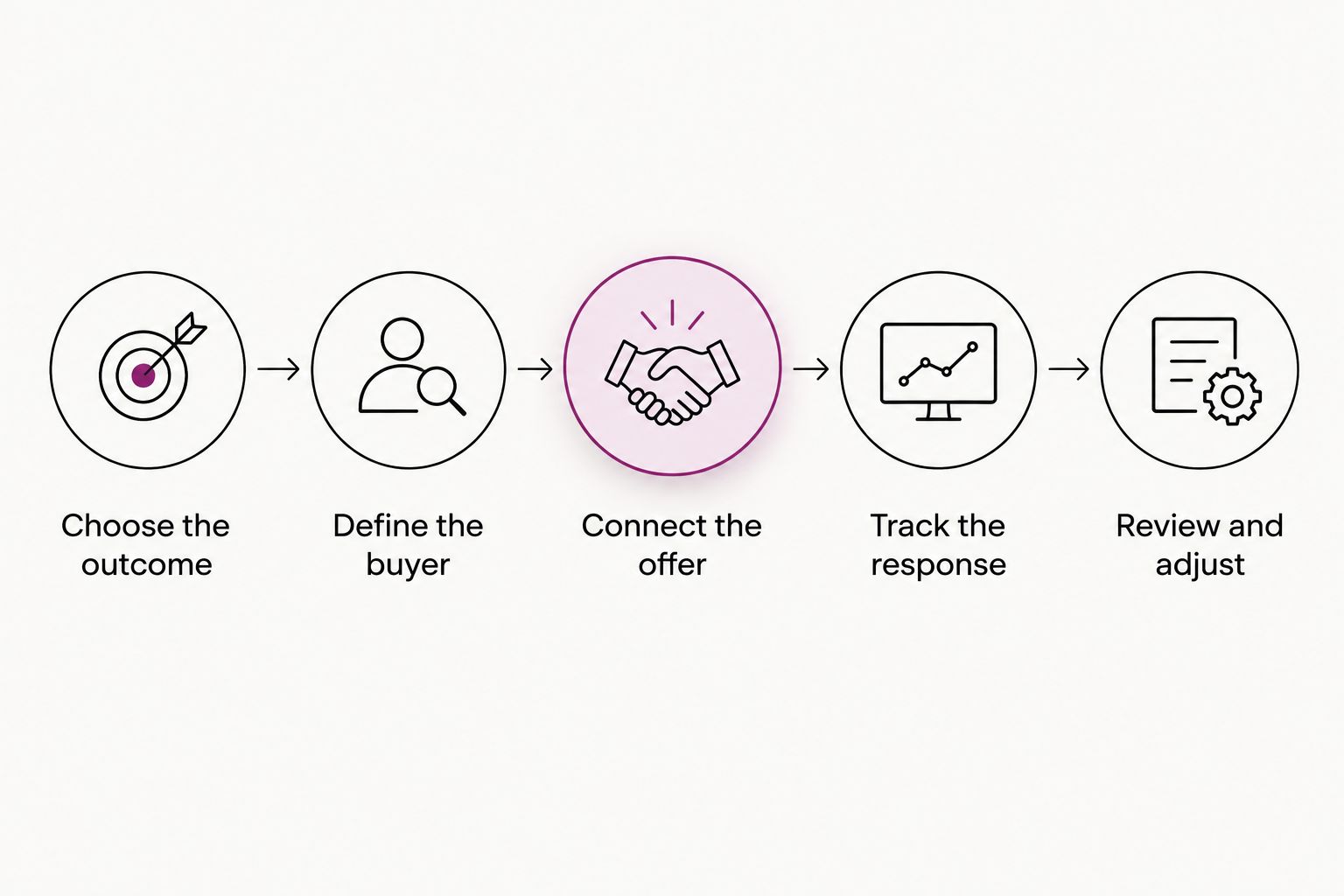
For your strategy, use the following sequence. Keep it simple enough that you will maintain it during a busy working week.
- Choose the outcome. Pick 1 primary outcome for the current content effort: relevant attention, qualified inquiries, or content-assisted sales. Record secondary outcomes separately so they do not replace the goal whenever results disappoint.
- Define the buyer. Describe who the content should help and what decision that person faces. A coach selling a service needs to distinguish a potential client from someone who simply enjoys the topic.
- Connect the offer. Explain how the topic relates to what you sell. You do not need a sales pitch in every paragraph, but a reader should understand why your expertise matters to their problem.
- Track the response. Record useful replies, inquiries, and purchases alongside the content that preceded them. Ask prospects what prompted their interest without assuming they remember every interaction.
- Review and adjust. Compare the response with your chosen outcome. Keep what addresses a real buyer question; revise the weak point instead of replacing the entire strategy automatically.
The sequence matters because measurement cannot rescue an unclear goal. If your intended outcome is a qualified inquiry, a large reaction count does not answer the question you set out to test.
Why the time to content results varies
The waiting period is not one isolated number. It reflects the work your content needs to do and the decisions your prospective customer needs to make.
- Your starting relationship with the audience. Content shown to people who already know your work has a different job from content introducing you to strangers. Separate those audiences when reviewing responses.
- The result you chose. A comment, inquiry, and purchase require different actions. Do not use the arrival of one to predict a deadline for another.
- The clarity of your offer. Readers need to understand who you help and what problem you address. Interest in a topic does not automatically establish interest in your service.
- Your distribution. Publishing a useful answer and getting that answer in front of intended buyers are separate tasks. Inspect where your audience actually encounters the content.
- The next step. A reader needs a relevant action to take after the content. An unclear invitation makes it harder to distinguish lack of interest from confusion.
- Your sales process and records. An inquiry is not the end of the journey. Follow-up and accurate records help you see what happens after content starts the conversation.
These factors are diagnostic questions, not a formula that produces a delivery date. Use them to locate the weak point before deciding whether you simply need more time.
What should you measure during the first 30 days?
During the first 30 days, measure execution, relevant response, and movement toward your chosen outcome. The purpose is to establish an interpretable starting point, not to demand a particular sales total.
Keep a simple record for each content piece: its intended buyer, the question it answers, where you shared it, its invitation, and the responses you received. Record actual inquiries and purchases when they happen. Do not count a friendly comment as a lead unless it contains genuine buying interest.
For a review, compare like with like. If one post answers a practical buyer question and another shares a personal story, their immediate responses need interpretation rather than a winner selected solely by reaction count.
Use the first review to answer these questions:
- Did you publish what you intended, or are you evaluating a plan you did not execute?
- Did the content reach people who fit your intended audience?
- Did responses show understanding of the problem you address?
- Could an interested reader identify the next step?
- Did you record inquiries consistently enough to connect them with content?
A quiet response deserves investigation. Check distribution and message clarity before concluding that your audience does not want the offer. A lively response deserves investigation too: make sure the people engaging are relevant to your business.
How do you tell whether your content strategy is working?
Your content strategy is working toward its goal when the evidence matches that goal. If you want qualified inquiries, evaluate the fit and intent of the inquiries not just how many people saw the post.
Look for specific buyer language. A reader explaining their situation, asking about your approach, or requesting a conversation gives you something concrete to assess. A general compliment is welcome, but it answers a different question.
Consider the path between events as well. A prospect might encounter an article, return through another channel, and then contact you. Record known touch points without turning an incomplete history into a claim that one post caused the sale.
Keep two distinctions clear:
- Activity versus outcome: publishing is an activity; a relevant response is an outcome.
- Contribution versus causation: content appearing in a buyer's journey shows a contribution; it does not prove content was the only reason they bought.
This is also where authenticity earns a practical role. Review whether your content sounds like you and accurately represents your expertise. A message that attracts inquiries for work you do not offer is not a useful commercial result.
Should you change your strategy if you are not getting leads?
Change the identifiable weak point, not everything at once. Without a clear diagnosis, a new format or publishing schedule gives you another moving target rather than a better explanation.
Start with the path to an inquiry. If intended buyers are not encountering the content, inspect distribution. If they encounter it but misunderstand what you do, inspect positioning. If they understand the offer but cannot find an appropriate next step, inspect the invitation.
If inquiries arrive but do not fit, refine who the content addresses. If qualified prospects inquire but do not buy, inspect what happens in the sales conversation rather than assuming the content failed.
Make one focused change and record it. That does not create a controlled experiment, but it makes the next review easier to interpret than changing the audience, topic, format, and offer together.
Where does AI fit into the timeline?
AI can help you work on drafts, organize ideas, and create variations. Those are production tasks. They are not proof that the resulting content addresses a buyer's question or generates a qualified inquiry.
Use AI to support a decision you have already made about audience and purpose. Give the tool your actual offer, your intended reader, and examples of language you use. Review the output for accuracy and remove any invented examples, claims, or promises before publishing.
We offer AI marketing coaching and training for coaches, creators, and entrepreneurs. That support fits the task of learning to use AI within an authentic content strategy; it should not be treated as a guaranteed shortcut to a sales deadline.
For your plan, evaluate production efficiency separately from business results. Getting a draft finished is useful. Getting the right prospect into a relevant conversation is a different outcome, and both deserve accurate labels.
FAQ
How long until you see results from a content strategy?
There is no universal deadline: relevant attention, qualified inquiries, and sales are separate outcomes. Choose the outcome first, then use a consistent review schedule to assess evidence of progress.
Should I expect sales within 30 days of starting content marketing?
A 30-day review cycle is not a promise of sales within 30 days. Use that interval to check execution, audience fit, responses, and any documented movement toward a purchase.
What is the best sign that my content is attracting the right people?
Responses that match your intended buyer and the problem your offer addresses are useful evidence of audience fit. Assess the substance of questions and inquiries rather than treating every reaction as buying interest.
Does posting more often mean I will get results faster?
Posting more often does not establish a deadline for business results. Evaluate whether the content reaches intended buyers, answers their questions, and gives them a relevant next step.
Can AI make my content strategy produce sales sooner?
AI-assisted production does not establish how soon sales will occur. Use AI for drafting and organization, then evaluate qualified inquiries and sales separately from production output.
Can content be working even when I have not made a sale?
Content can meet an attention or inquiry goal before a sale occurs. If sales are the primary goal, record those earlier signals as progress rather than reporting them as revenue results.
Who is our content’s strategy coaching for?
We offer AI marketing coaching and training for coaches, creators, and entrepreneurs focused on authentic content strategy. That is a service fit, not a guarantee of a particular results timeline.
One last thing
Read the inquiry, not just the counter. Before your next review, look at the language prospects actually use when they contact you. Does it describe the problem you solve, the audience you serve, and the help you offer?
An inquiry for the wrong service is a message to inspect, not simply a lead to celebrate. Use that distinction to make your next content decision more precise and keep your own voice in the work.
Related guides

Leave a Reply