

Building an AI content system from scratch takes as long as you need to establish a repeatable path from your own ideas to approved, published content; there is no universal build time. Treat setup as complete only after you have tested that path, because connecting tools does not finish the work of checking facts, preserving your voice, and deciding what deserves to go live.
- How long does it take to build an AI content system? Define completion by a tested workflow, not a deadline.
- Start with one audience, one channel, and a human approval step before adding automation.
- We offer AI marketing coaching for coaches, creators, and entrepreneurs focused on authentic content strategy.
- Separate initial setup from ongoing fact-checking, voice editing, and content review.
How long does it take to build an AI content system from scratch?
The useful answer depends on what you mean by built. A workflow that helps you draft a post has a different finish line from a system that coordinates several channels, approvals, and publishing tasks.
For your plan, choose the smallest scope that solves an actual content problem. Use this comparison to define the work before you put a completion date on your calendar.
| Scope | Best for | What must work before launch | Advantage | Trade-off |
|---|---|---|---|---|
| Single-channel workflow | A coach or creator publishing in one place | Source material, drafting instructions, review, and publishing handoff | Fewer handoffs to test | Other channels remain separate |
| Multi-channel workflow | A business adapting ideas across formats | Everything above, plus format rules and channel-specific review | Shared source material across channels | More versions and approval decisions |
| Connected workflow | A business coordinating content with other business processes | Everything above, plus permissions, triggers, and failure handling | Less manual movement between approved steps | More dependencies to maintain |
If choosing software is blocking the first version, use the AI marketing tools for coaches guide to inform that decision. Keep tool selection separate from the question of whether your content process works.
Why this matters
A draft is an output. A content system is a process you can repeat without reinventing the instructions each time. Confusing the two leaves you with a folder of generated text and the same publishing bottleneck you started with.
Your finish line should describe behavior: you can supply an idea, produce a useful draft, check it, approve it, and publish it. That is more actionable than declaring the system finished because an account is connected.
For coaches, creators, and entrepreneurs seeking AI marketing coaching around authentic content strategy this guide is a relevant fit. Coaching supports the person making the decisions; it does not remove the need for that person to approve the message.
Define the finish line before estimating the work
Write a completion statement before choosing more tools. Describe what the system will produce, who it serves, and who owns the final decision. Keep it narrow enough that you can test it with a real piece of content.
For example, your first version might turn your own teaching notes into a social post that you review before publishing. That is a proposed scope, not a promise about how quickly you will finish.
Use these boundaries for a manageable first build:
- 1 audience: Identify the person whose question the content answers.
- 1 channel: Choose where the approved content will appear.
- 3 test pieces: Run different source ideas through the same instructions to expose weaknesses.
- 1 approval owner: Name the person responsible for the final version.
These are planning choices, not industry benchmarks. Increase the scope only when your business needs justify the additional work.
A narrow build has a downside: it will not cover every format or campaign. Accept that limit deliberately. A clear boundary gives you something you can finish, inspect, and improve instead of an open-ended project called content automation.
Build the system in a testable sequence
The build becomes easier to estimate when you separate decisions from execution. Work through the sequence below, and use the completion check at each stage to decide whether you are ready to move on.
1. Gather source material
Start with material you are entitled to use: your teaching notes, approved offer descriptions, published explanations, and questions your audience asks. Keep confirmed facts separate from brainstorms so an unfinished idea does not become a published claim.
Completion check: You can point to the source behind the central claim in your draft. If the material includes someone else's private information, resolve permission and privacy questions before using it.
2. Capture your voice
Choose examples that sound like you and explain what makes them work. Describe your vocabulary, sentence style, humor, and boundaries. Include examples of phrasing you would reject, rather than relying on a broad instruction to sound authentic.
Completion check: You can explain why a draft sounds right or wrong. That makes revisions specific: keep the direct question, remove the inflated promise, or replace an expression you would never say.
3. Write instructions
Tell the drafting tool who the content serves, what question it answers, which source material to use, and what action fits the message. Specify the format without asking the tool to fill factual gaps with confident-sounding details.
Completion check: Another person can follow the instructions without needing you to explain the whole process again. Save the approved version somewhere the person running the workflow can find it.
4. Review the draft
Separate factual review from voice review. First check names, claims, offer details, and source accuracy. Then check whether the content sounds like you, answers the intended question, and leads naturally to the next action.
Completion check: The approval owner can accept or reject the draft against written criteria. A general reaction such as not quite right needs to become an actionable editing instruction.
5. Test the handoff
Move the approved draft into your publishing process. Confirm who handles formatting, images, links, scheduling, and the final published check. Keep these responsibilities visible even if you use software to move content between steps.
Completion check: An approved piece reaches its intended destination without uncertainty about who acts next. Record any recurring fix in the workflow rather than solving it from memory every time.
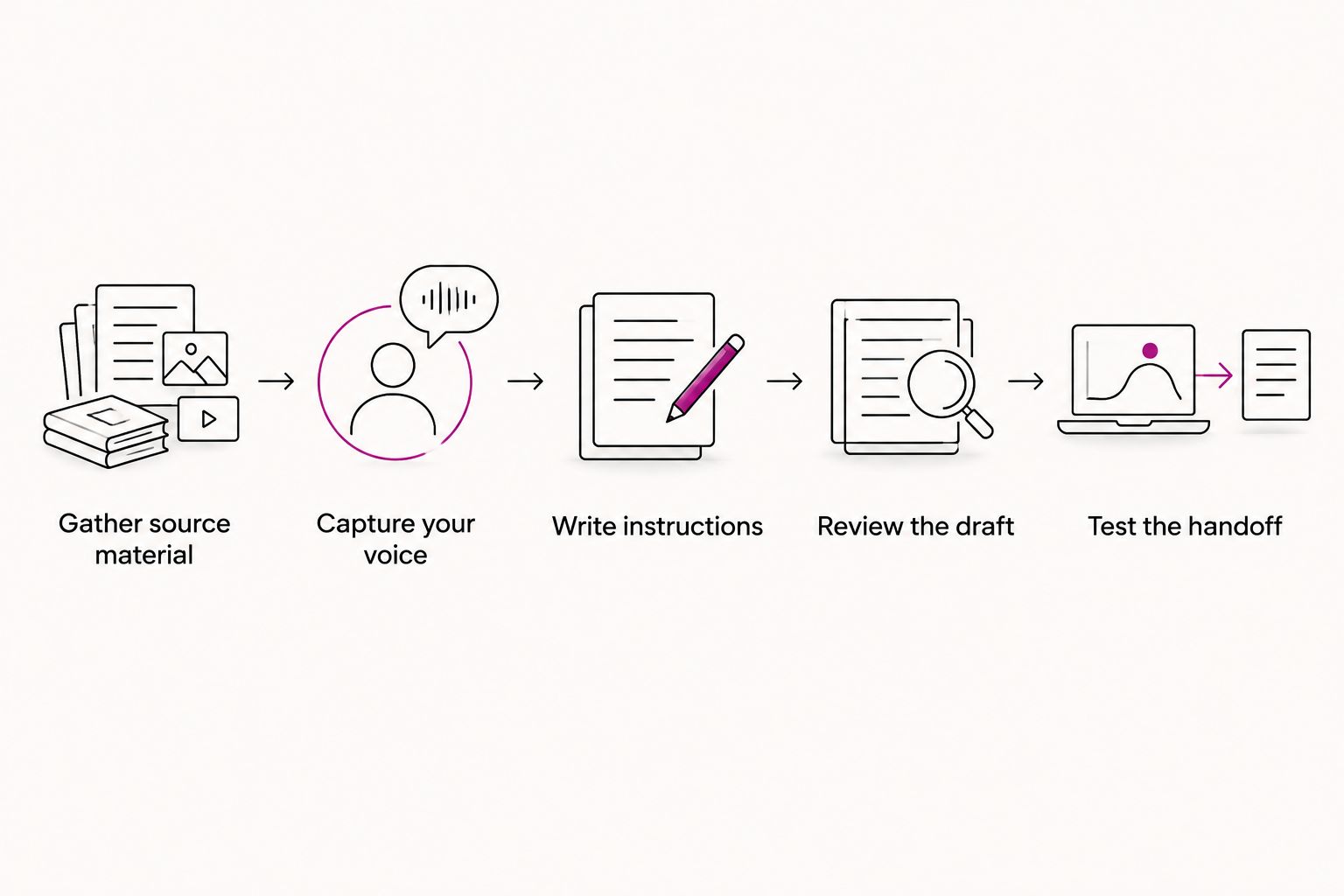
Your workflow does not need every available feature. It needs a clear route through these stages, with an owner for each decision and a way to handle work that fails review.
Why build time varies
The work changes with the starting material and the scope you choose. Use these factors to explain your estimate rather than assigning the same deadline to every business.
- Source readiness: Approved teaching material gives you something to work from. Unwritten ideas still need to be captured and checked.
- Voice clarity: Specific examples give editing decisions a reference point. Conflicting examples require a decision about which voice represents the business.
- Channel scope: Each format needs its own requirements for structure, context, and the reader's next action.
- Approval ownership: A named decision-maker creates a clear handoff. Shared responsibility still needs an agreed way to resolve disagreements.
- Connections between tools: Each connection adds behavior to configure, test, and maintain, including what happens when a step fails.
- Claim sensitivity: Content about client outcomes, personal information, or regulated subjects needs appropriate review before publication.
Do not treat these as reasons to postpone everything. Use them to distinguish essential launch work from additions that can wait until the basic process works.
Can you start publishing before the whole system is finished?
Yes. You can publish approved content while you are still building the wider workflow. Keep the unfinished parts manual and make the approval boundary explicit.
Suppose drafting instructions work, but the scheduling handoff does not. You can review and publish the content yourself while documenting what the handoff needs. That is a limited workflow, not a failure to automate everything.
The benefit is a smaller set of dependencies before you publish. The drawback is continued manual work, which belongs in your capacity planning rather than being hidden behind the word automated.
For your launch, write down which steps are manual, which use AI, and which require approval. This prevents a collaborator from assuming that a generated draft is already cleared to publish.
How do you know the system is ready?
The system is ready for its defined scope when you can repeat the workflow with different source material and apply the same approval standard. A polished demonstration is not enough to establish that the instructions work beyond that example.
Use your 3 test pieces to challenge different parts of the process. Choose a straightforward explanation, a personal perspective you are comfortable sharing, and a message tied to an approved offer. These are test assignments, not claims about the amount of content every business needs.
Check each piece against the same questions:
- Does the draft answer the intended audience question?
- Can you verify its factual claims against the source material?
- Does it preserve your meaning rather than merely imitate your phrasing?
- Is the next action appropriate to the message?
- Can the approval owner complete the publishing handoff?
If the same correction appears repeatedly, change the source material or instructions. Do not make endless manual edits and call the underlying process finished.
What should stay manual after launch?
Keep ownership of your point of view, factual accuracy, permissions, and final approval. Those are business decisions. A tool can assist with drafting and organization without becoming the authority on what your business promises.
You can also keep an awkward step manual while you decide whether it deserves automation. The advantage is direct control; the cost is your attention. Automating that step introduces its own work, including setup, testing, and maintenance.
Before expanding your system, ask whether the next connection removes a documented problem. If you cannot name the problem, leave the connection out of the current scope.
AI marketing coaching is relevant when you want guidance on content strategy while preserving your own voice. The limitation remains practical: you still need to supply your expertise, make business decisions, and approve what represents you.
Explore AI marketing coaching
Review coaching and training for coaches, creators, and entrepreneurs building an authentic content strategy.
FAQ
How long does it take to build an AI content system from scratch?
The build time depends on the workflow’s scope, source readiness, review requirements, and tool connections. Define completion as a tested path from source material to approved publication, rather than a fixed number of days.
Can I build an AI content system without connecting several tools?
Yes. You can use AI for drafting and keep review and publishing manual. Test that process before deciding which handoffs need a software connection.
What should I prepare before building an AI content workflow?
Prepare approved source material, examples of your voice, a defined audience, and an approval owner. Keep factual references separate from brainstorming so unfinished ideas do not become published claims.
Should I build for every social media channel at once?
Start with the channel that fits your defined publishing goal. Adding channels also adds format rules, versions, and review decisions, so expand the scope deliberately.
How do I stop AI content from sounding generic?
Give the drafting process specific source material and examples of language you use and reject. Review the meaning and point of view as well as sentence style.
Can my AI content system publish without human review?
Keep a named approval owner responsible for published content. Automated movement between tools does not establish that claims, permissions, or offer details are correct.
Who is Molly Mahoney’s AI marketing coaching for?
Molly Mahoney offers AI marketing coaching and training for coaches, creators, and entrepreneurs. The site’s stated focus includes growing a business through authentic content strategy.
One last thing
A rejection rule belongs in your content system just as much as a drafting instruction. Decide what happens when a claim cannot be verified, a story lacks permission, or a draft misrepresents your offer. Return it for correction; do not let the next automated step turn uncertainty into publication.
Before adding anything else to your build, run a piece through that rejection path. A system that knows when to stop is more useful than a publishing sequence with no clear way to interrupt it.
Related guides



Leave a Reply