

Six tools make sense for a small, engaged audience in 2026, not the twelve-seat enterprise stack built for a marketing department you don't have. Here's the ranked list, the honest tradeoffs, and where coaching beats software.
- AI Content Club is the best content strategy tools for small audiences pick when you need coaching, not just another app.
- Notion wins for building a content calendar and idea bank without adding a second subscription.
- Metricool and Buffer both handle scheduling — Buffer is the leaner, simpler pick.
- ChatGPT speeds up drafting hooks and scripts but won’t build your strategy for you.
- Canva turns written content into visual posts fast, no design background required.
Why this matters
Most "best content strategy tools" lists are written for teams of ten posting across nine platforms. If you're a coach, speaker, or creator with a small but engaged following, that stack is overkill, you end up paying for features you'll never touch and learning software instead of making content. We built AI Content Club around the opposite premise: strategy first, tools second, and never at the cost of sounding like everyone else.
A small audience isn't a weakness to fix with more software. It's a reason to pick tools that fit a lean operation, one person, maybe two, running content on a schedule that's realistic, not aspirational. That's the filter behind every pick below.
What makes the best content strategy tools for small audiences
- Fits a lean operation — no dedicated social media manager required to run it
- Ties every post to a strategy, not a blank calendar you're filling to feel productive
- Works across the platforms you actually post on, not a single-channel tool that forces a second subscription
- Uses AI to draft faster without flattening your voice into generic marketing copy
- Takes under an hour to learn — time you'd rather spend making content
- Scales with you so you're not switching tools the moment your list grows
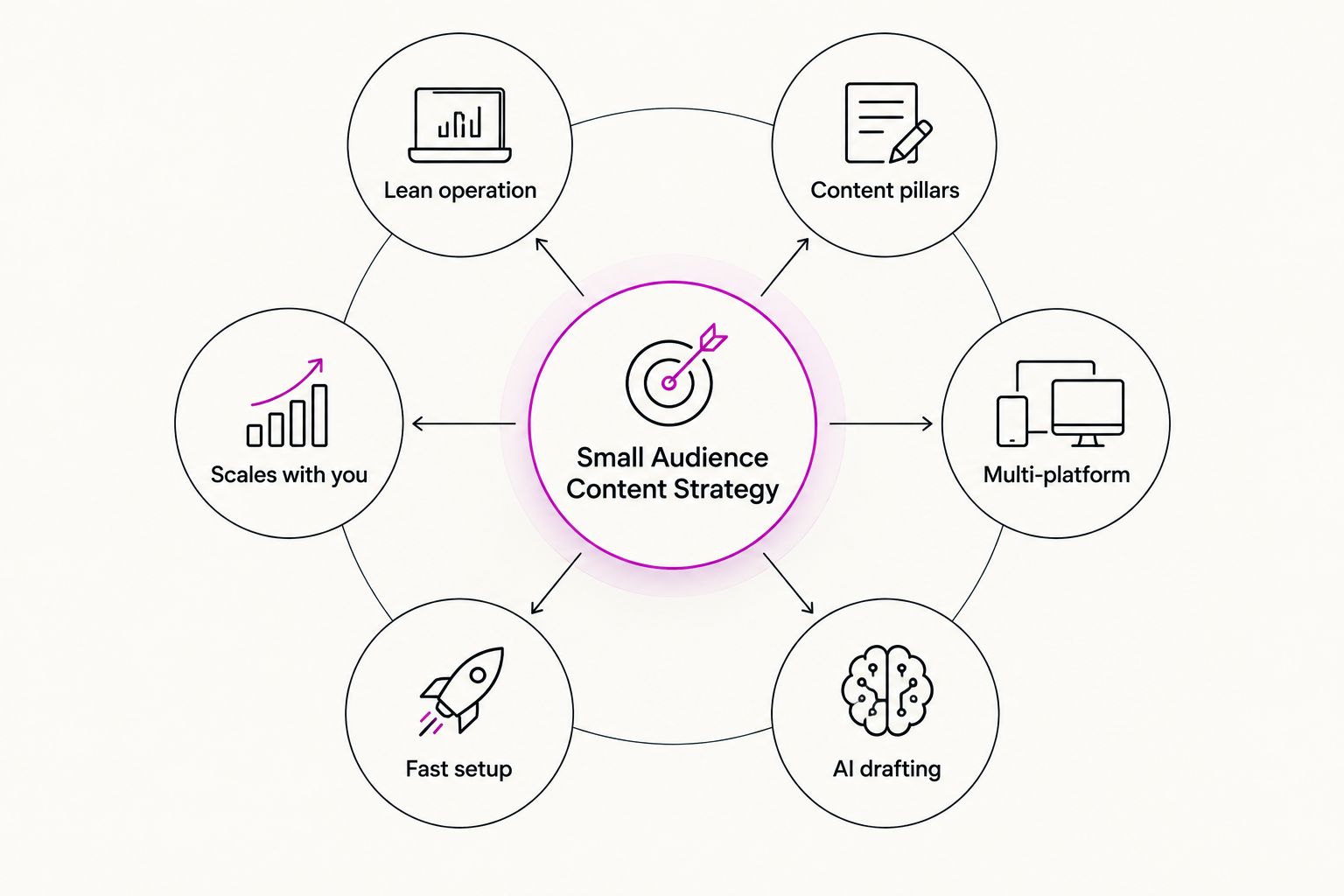
Best content strategy tools for small audiences in 2026 — at a glance
| Tool | Best For | Standout Feature | Key Limitation |
|---|---|---|---|
| AI Content Club | Hands-on content strategy coaching | Live guidance turning your voice into a repeatable content system | Not stand-alone software — pair it with a scheduler or doc tool |
| Notion | Organizing a content calendar and idea bank | Flexible databases you can turn into a calendar, script bank, or pillar tracker | No built-in scheduling or publishing |
| Metricool | Scheduling and analytics across platforms | One dashboard for scheduling, analytics, and competitor tracking | Steeper learning curve than simpler schedulers |
| Buffer | Lean, budget-friendly scheduling | Simple queue-based posting across major platforms | Thinner analytics and AI features than bigger suites |
| ChatGPT | Fast idea generation and scripting | Turns a rough thought into hooks, captions, or a script draft in seconds | Raw output needs a voice pass or it sounds like everyone else |
| Canva | Turning written content into visual posts | Drag-and-drop templates sized for every platform | Templates look same-y if you skip customizing them |
1. AI Content Club: best content strategy tool for small audiences that want coaching, not just software
AI Content Club is a training program built around one idea: your content strategy should sound like you, and AI should speed that up instead of erasing it. It walks you through building content pillars, writing hooks, and repurposing one idea into a week's worth of posts, the strategy layer most tools skip entirely.
AI Content Club pros:
- Guided strategy instead of guessing what to post next
- Built on the "Your Awesome + AI = Content that Converts" approach, not generic prompts
- Works for coaches, speakers, and creators with small but engaged followings
- Teaches the thinking behind the content, not just clicks inside a dashboard
AI Content Club cons:
- It's a program, not a scheduling or design app, you'll still need something like Notion or Buffer to execute
- Requires time to go through the training; it's not an instant fix you install
If you're running a coaching business specifically, the roundup of the best AI chatbot tools for coaching businesses covers the client-facing side that pairs with the strategy work here.
Best for: creators who've bought three tools and still don't have a strategy.
Verdict: Buy.
2. Notion: best content strategy tool for small audiences building a calendar and idea bank
Notion is a flexible workspace you turn into whatever you need, a content calendar, a script bank, a pillar tracker, all in one place, all free of extra software fees stacking up.
Notion pros:
- Fully customizable databases for calendars, drafts, and idea capture
- One place to track content pillars alongside actual posts
- Works solo or shared with a small team later
Notion cons:
- No built-in scheduling or publishing, it's a planning layer, not a posting tool
- Blank-page setup takes longer than a pre-built calendar template
Best for: creators who think better in lists and databases than sticky notes.
Verdict: Buy.
3. Metricool: best content strategy tool for small audiences that need scheduling and analytics in one place
Metricool combines scheduling, analytics, and competitor tracking in a single dashboard, which matters when you're the only person checking what's working.
Metricool pros:
- Scheduling and analytics without switching apps
- Competitor tracking built in, useful for a small niche audience
- Covers most major platforms in one queue
Metricool cons:
- Interface has a learning curve compared to simpler schedulers
- More features than a true beginner needs on day one
Best for: solo creators who want data, not just a posting queue.
Verdict: Buy.
4. Buffer: best content strategy tool for small audiences on a lean budget
Buffer is a straightforward queue-based scheduler, you load posts, set times, and it publishes. No dashboard to learn beyond the basics.
Buffer pros:
- Simple, fast setup across major platforms
- Lean interface that doesn't bury scheduling under extra features
- Good fit if you're posting a handful of times a week, not daily across five channels
Buffer cons:
- Analytics and AI features are thinner than Metricool or bigger suites
- Less useful once you need competitor or audience-growth data
Best for: creators who want scheduling and nothing else to manage.
Verdict: Buy for basics; upgrade later if you outgrow it.
5. ChatGPT: best content strategy tool for small audiences that need faster drafting
ChatGPT turns a half-formed idea into a hook, a caption, or a full script draft in seconds, the speed layer, not the strategy layer.
ChatGPT pros:
- Fast first drafts for hooks, captions, and scripts
- Good for repurposing one piece of content into several formats
- Useful for brainstorming when you're staring at a blank page
ChatGPT cons:
- Raw output sounds like everyone else's raw output, it needs a voice pass
- Won't tell you what your content pillars should be; that's strategy work, not drafting
Best for: creators who know their strategy and just need words faster.
Verdict: Buy, but never publish the first draft untouched.
6. Canva: best content strategy tool for small audiences turning words into visuals
Canva takes a written post and turns it into something sized correctly for Instagram, LinkedIn, or wherever you're posting, using drag-and-drop templates.
Canva pros:
- Templates sized for every major platform
- No design background needed to produce something clean
- Fast enough to use daily without slowing down your posting schedule
Canva cons:
- Templates look same-y across creators if you skip customizing them
- Doesn't help with strategy or copy, purely visual execution
Best for: creators who write well but don't design.
Verdict: Buy.
How this list was ranked
Each tool got measured against the six criteria above: fit for a lean operation, tie to actual content pillars, multi-platform coverage, useful AI drafting, fast setup, and room to grow. AI Content Club ranks first because it's the only one solving the strategy gap directly, the rest are execution tools that work better once that gap is closed. For a broader shortlist beyond strategy specifically, the best AI marketing tools for coaches roundup covers adjacent picks like email and funnel tools.
Which content strategy tool should you choose?
If you only do one thing in 2026, fix the strategy before you buy another app, start with AI Content Club, then add Notion or Buffer to execute what you build. Skip trying to run a small audience through an enterprise suite built for a team you don't have; you'll spend more time learning the dashboard than making content.
Fix your content strategy first
See how AI Content Club turns your voice into a repeatable system.
FAQ
What are the best content strategy tools for small audiences in 2026?
AI Content Club, Notion, Metricool, Buffer, ChatGPT, and Canva cover strategy, planning, scheduling, drafting, and visuals for a solo or small-team creator in 2026. AI Content Club is the pick when the gap is strategy, not software.
Is Notion good for content planning?
Yes! Notion works well as a content calendar and idea bank because its databases are fully customizable. It doesn’t publish or schedule posts, so it’s a planning layer, not a full solution.
Do I need Metricool or Buffer, or both?
Most small-audience creators only need one. Buffer is simpler and leaner for basic scheduling; Metricool adds analytics and competitor tracking if you want data alongside the posting queue.
Can ChatGPT replace a content strategy?
No. ChatGPT drafts hooks, captions, and scripts fast, but it doesn’t decide your content pillars or audience strategy. It’s a drafting tool, not a strategy tool.
What makes a content strategy tool ‘for small audiences’ specifically?
It fits a lean operation without extra headcount, ties posts to an actual strategy, and doesn’t require learning enterprise-level features built for bigger teams.
Does AI Content Club replace a scheduling tool?
No. AI Content Club teaches the strategy and voice work behind your content. Pair it with a scheduler like Buffer or Metricool to actually publish.
Is Canva enough for a full content strategy on its own?
No. Canva handles visual execution once you know what you’re posting and why. It doesn’t build the strategy or write the copy behind the design.
One last thing
The tool most small-audience creators regret buying first isn't the cheapest one, it's the fanciest one, built for a marketing department they don't have. Fix the strategy with something like AI Content Club before you add another dashboard to your morning routine; the tools on this list only pay off once the strategy underneath them is actually yours.


Leave a Reply