


Yes, AI-generated content can convert to sales when it addresses a real buying question, makes a credible offer, and gives the reader a clear next step. In 2026, the caveat is the same as with human-written content: producing a draft does not establish trust, prove your claims, or show that the content caused a purchase.
- Can AI generated content convert to sales? Yes, but buyer relevance and verified claims matter more than the drafting method.
- We offer AI marketing coaching for coaches, creators, and entrepreneurs building an authentic content strategy.
- Use AI for drafting; keep offer accuracy, brand voice, and purchase measurement under human control.
- Judge conversion content by qualified inquiries and purchases, not engagement alone.
Can AI-generated content actually convert to sales?
Yes. But AI-generated is a production method, not a reason to buy. Your reader still needs to understand the problem you solve, believe your explanation, and decide whether your offer fits.
Consider a coaching business answering a prospect’s question about whether coaching suits their situation. An AI-assisted draft can explain the service, address an objection, and invite an inquiry. The business must supply the actual service details and approve every claim before publishing.
The useful comparison is not simply AI versus human. It is how much accurate business knowledge and editorial judgment each approach receives.
| Content approach | Best for | Main advantage | Main limitation |
|---|---|---|---|
| Unreviewed AI draft | Internal exploration, not publication | Produces material for you to evaluate | Claims, voice, and offer details remain unchecked |
| Human-reviewed AI content | Businesses with clear offers and source material | Combines drafting assistance with business-specific editing | Requires an accountable reviewer |
| Human-written content | Firsthand stories and nuanced explanations | Lets the person with direct knowledge shape the argument | Still needs fact-checking and conversion measurement |
None of these approaches guarantees a sale. Choose human-reviewed AI content when you can supply the facts and take responsibility for the final message. Choose human writing when the substance depends on experience you have not yet documented.
Why this matters
For a coach, creator, or entrepreneur, a content mistake is not just an awkward sentence. An invented promise can set the wrong expectation before a sales conversation begins. A polished paragraph that avoids the buyer’s actual question leaves that question unanswered.
We offer AI marketing coaching and training for those audiences. This article is best for coaches, creators, and entrepreneurs seeking AI marketing coaching centered on authentic content. Coaching fits a need for guidance; it is not a substitute for your own offer details, approvals, or sales tracking.
Your 2026 content plan needs a clear division of responsibility: AI helps produce the material; your business owns what it says. That distinction keeps convenience from becoming permission to publish unchecked claims.
How do you turn an AI draft into sales content?
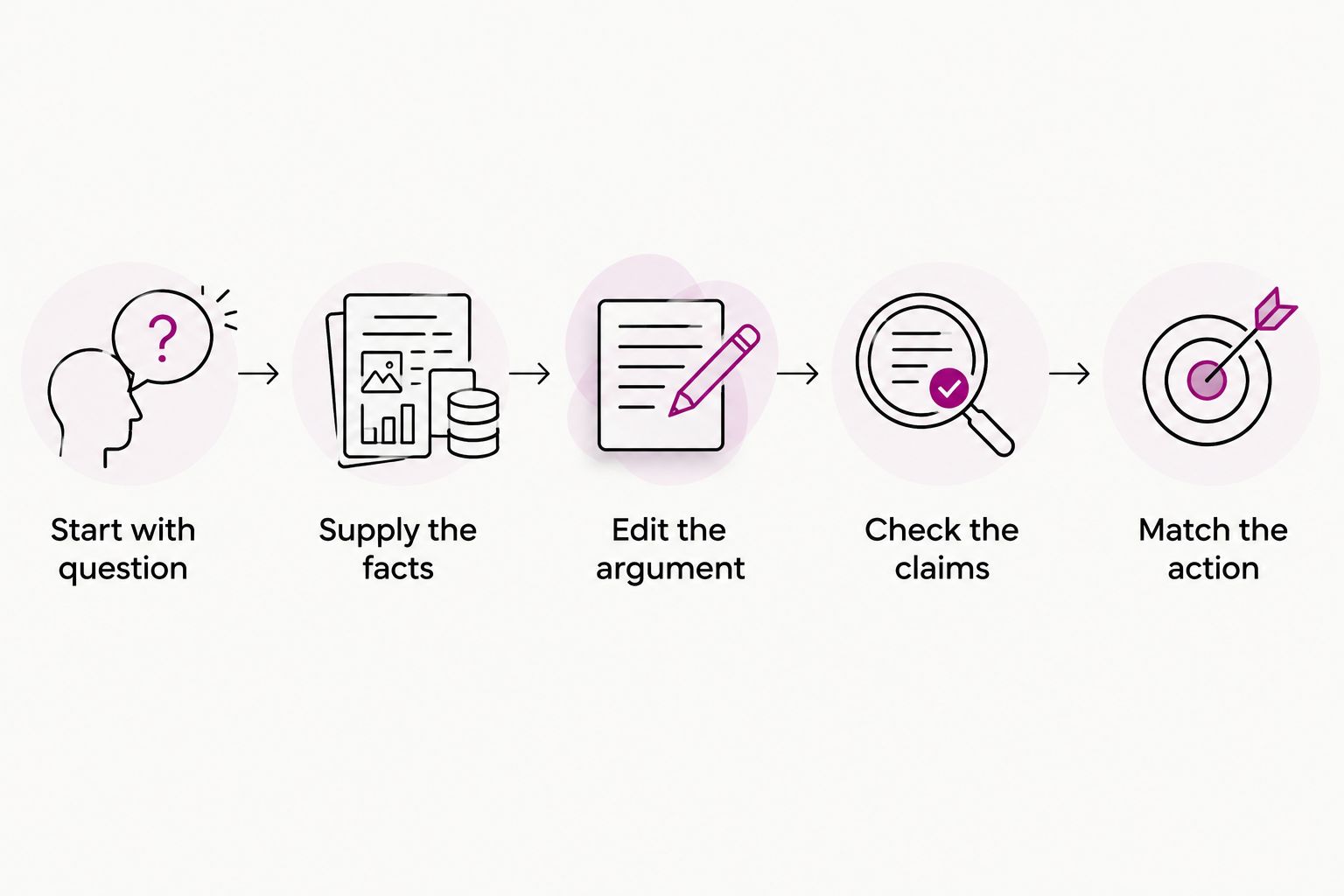
Use a repeatable editing process instead of asking for a persuasive post and accepting whatever appears. Start with the buyer’s decision, then work toward the words.
Start with the question
Choose a question that belongs in a real buying conversation. Look at inquiries, consultation notes, customer emails, or comments you have permission to use. Remove identifying information before sharing material with a tool.
Useful subjects include who your service fits, what participation involves, what the buyer needs to contribute, and what happens after an inquiry. These questions give the draft a job beyond sounding interesting.
Do not invent audience research to fill the brief. When you have not heard a particular objection, treat it as an editorial idea to investigate not something your customers supposedly say.
Supply the facts
Give the drafting tool approved information about your offer, audience, process, and boundaries. Include examples of your own writing and explain which promises you do not make.
Your prompt should distinguish facts from suggestions. Ask the tool to leave unsupported details out rather than complete the story. Then check the output anyway; an instruction is not verification.
A simple brief might read:
Draft an answer to this buyer question using only the approved information below. Keep my conversational voice. Explain who the offer fits, address the stated concern, and end with the supplied next step. Do not add testimonials, results, credentials, or service details.
This is a drafting instruction, not a customer quote. Adapt it to the material you actually have.
Edit the argument
Read for meaning before polishing style. Does the opening answer the question? Does the explanation connect the buyer’s concern to something your offer actually provides?
Delete paragraphs that praise the service without explaining it. Replace broad assurances with accurate descriptions of what the buyer does, receives, or needs to decide. If the offer does not address the concern, say so rather than forcing a connection.
A clear limitation is more useful than a confident claim you cannot defend. Your content should help someone recognize a mismatch as well as a fit.
Check the claims
Review names, service descriptions, testimonials, and statements about outcomes against approved source material. Remove anything you cannot substantiate, even when it sounds plausible.
Check the proposed next step, too. The invitation must lead to a real action your business supports. Do not promise an assessment, resource, or consultation unless it exists.
For 2026 content, current offer information matters more than a current date in the headline. Recheck the underlying details whenever the service changes.
Match the action
Give the reader a next step that suits the question. Someone asking whether a service fits needs a way to assess fit; someone ready to inquire needs clear inquiry instructions.
Do not make every paragraph ask for a sale. Answer the question fully, then explain the action and what it is for. A call to action should continue the conversation the content started.
Why AI content’s sales performance varies
The drafting method does not explain every difference in sales performance. Check these factors before crediting or blaming AI:
- Buyer relevance: The content must address a question your intended customer recognizes. A general motivational post and a service-fit explanation serve different purposes.
- Offer clarity: Readers need to understand what you provide and what falls outside it. Editing cannot repair an offer description that remains undefined.
- Evidence quality: Use approved examples, documented experience, and accurate explanations. Never turn a hypothetical result into a customer story.
- Voice consistency: The published message should sound like the business the buyer will encounter. Remove expressions you would never use in a conversation.
- Next-step fit: Match the invitation to the question being answered. Do not send a reader somewhere that fails to continue that discussion.
- Measurement quality: A purchase after a content interaction is an observable sequence. It is not, by itself, proof that the content caused the purchase.
These factors also apply to human-written work. The practical advantage of AI assistance is drafting support; the responsibility for relevance and truth stays with you.
How can you tell whether AI content helped a sale?
Start by deciding what counts as the outcome. A purchase is a sale; a qualified inquiry is a different event. Track both if both matter, but do not combine them under a vague success label.
Connect published content to the next action using your existing analytics and customer records. Where your setup supports it, preserve the content source through the inquiry and purchase process. Ask buyers what helped them decide, while recognizing that their answers are another source of context rather than a complete attribution system.
For a 2026 review, keep a record of the content version, distribution channel, offer, and outcome definition. Without that context, a change in results cannot be assigned confidently to a change in writing.
Separate observation from explanation
An observation says that a tracked reader purchased after interacting with a piece of content. An explanation says why that happened. The first does not automatically establish the second.
Existing relationships, other messages, and sales conversations can also be part of a buying journey. Report the connection you can observe without claiming the article deserves all the credit.
Compare like with like
If you compare an AI-assisted draft with a human-written version, keep the offer, audience, and intended action consistent wherever your testing setup allows. Record other changes rather than ignoring them.
Do not declare a winner because a post attracted attention. Look at the outcome you chose before publishing. If the evidence does not establish a difference, keep improving the content without inventing a result.
Can AI-written content sound like you?
AI-written content can reflect your voice when you provide genuine examples and edit the result. A personality adjective in a prompt is not a substitute for your actual language, opinions, and explanations.
Read the draft aloud. Would you say this to a prospect? Would you make this promise during a consultation? If either answer is no, revise it before publication.
Your personality belongs in the details: the comparison you naturally make, the objection you address directly, or the phrase your audience already hears from you. Authenticity does not require a joke in every paragraph. It requires consistency between the message and the person delivering the service.
Keep your point of view; delegate the drafting work. That is a more useful boundary than trying to make every sentence sound unusually clever.
Should you automate the whole sales conversation?
- Content drafting and buyer conversations involve different responsibilities. A published article can be reviewed before it reaches a reader; an automated conversation needs boundaries for questions that were not anticipated.
Define which approved information a system can provide and when a person takes over. Do not allow automation to invent service terms or promise outcomes to keep a conversation moving.
For your 2026 workflow, map the handoff before expanding automation. The buyer should not have to untangle an automated promise from the service you actually provide.
Our AI marketing training is relevant when you want guidance on using AI while retaining an authentic content strategy. It does not remove the need to decide what your own business can truthfully say.
FAQ
Can AI generated content convert to sales?
Yes, AI-generated content can convert to sales when it answers a relevant buying question, presents an accurate offer, and supports a clear next step. The drafting method alone does not establish effectiveness.
Is AI-written content better than human-written content for sales?
Neither approach is automatically better for sales. Compare the accuracy, buyer relevance, voice, and measured outcomes of the finished content rather than treating authorship as the deciding factor.
How do I stop AI content from sounding generic?
Supply examples of your real writing, approved offer information, and a specific buyer question. Edit out language you would not use and add your own documented experience where relevant.
Can I publish AI marketing content without checking it?
Do not publish AI marketing content without reviewing its claims, offer details, and next step. Your business remains responsible for what the published message promises.
What should I measure besides likes?
Measure the action the content is intended to support, such as a qualified inquiry or purchase. Keep engagement separate from sales and distinguish observed interactions from proof of causation.
Should AI write my customer testimonials?
AI should not invent customer testimonials or change what a customer meant. Use only authentic, approved material and check any edits against the original statement.
Who is Molly Mahoney’s AI marketing coaching for?
Molly Mahoney’s AI marketing coaching serves coaches, creators, and entrepreneurs seeking business growth through authentic content strategy. The site also offers training programs and keynote speaking services.
One last thing
Before improving the prompt, check the offer explanation. If you cannot plainly explain who the service helps, what it includes, and what the buyer should do next, a longer draft only gives the confusion more room.
Try this on your next piece: write the buyer’s question above the draft, then underline the sentence that answers it. If you cannot find that sentence, fix the answer before adjusting the tone.
Your content does not need to hide the use of AI behind more personality. It needs a truthful answer worth acting on. Let the tools assist with expression; keep the judgment yours.


Leave a Reply