
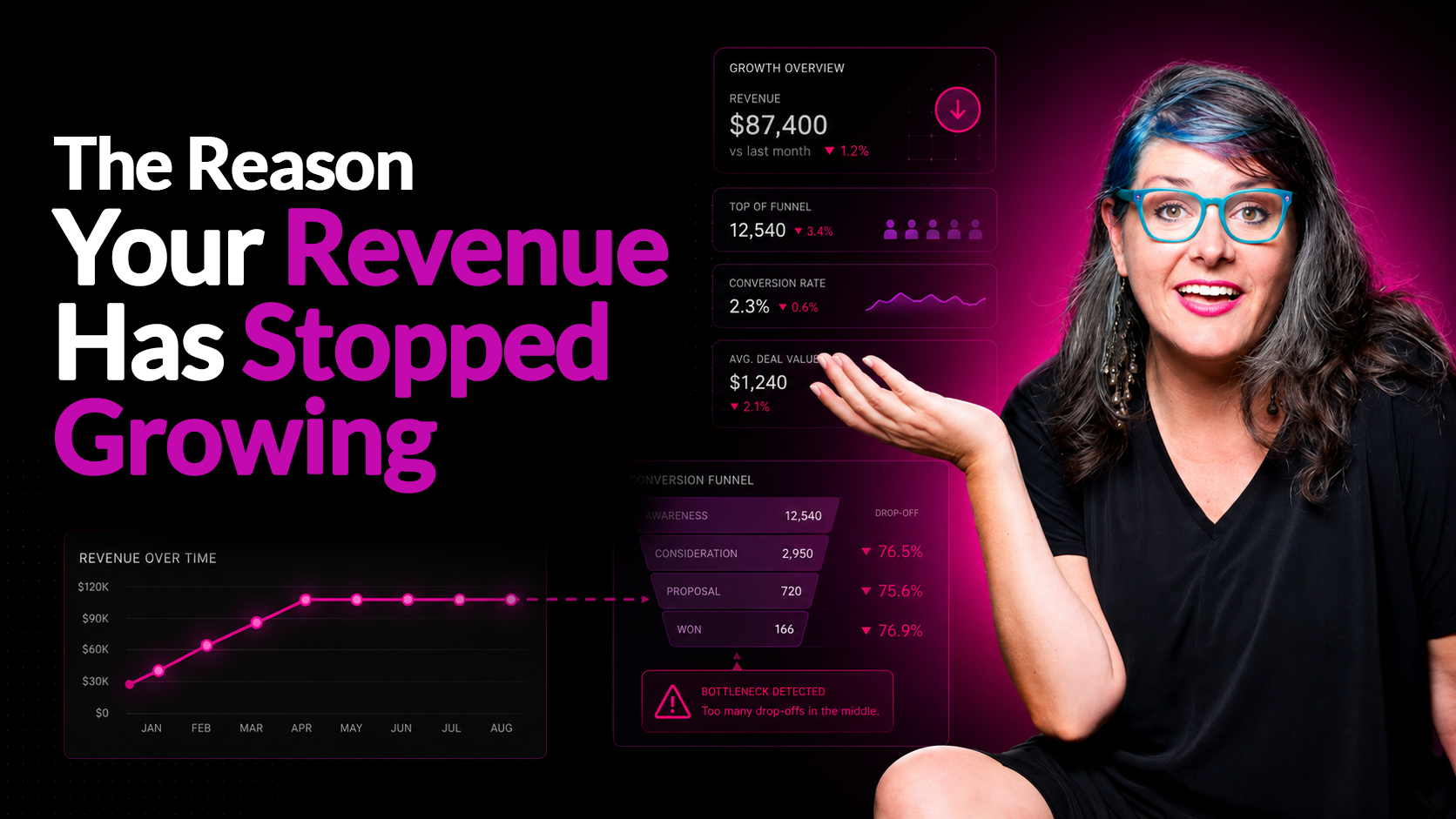

What It Means to Hit a Revenue Ceiling
Stuck at the same revenue even though you’re working harder, learning more, and doing everything that used to work?
A revenue ceiling is the point where a business stops growing despite all that effort. It is not caused by a lack of information, effort, or talent. It is caused by isolation: the owner has run out of feedback, not out of ideas. Ceilings are most common for coaches and consultants between $5,000 and $30,000 per month, where the problems become specific to that one business and generic solutions stop touching them.
The fix is not another course. The fix is having a person who has done it look at your actual business.
Who This Is For
You are a coach, consultant, or course creator. You have a real offer that real people pay for. You are doing $5K a month or more, consistently, and you have been doing roughly that for longer than you would like to admit.
You are not confused about AI. You own the tools. You show up. You post.
And nothing is moving.
You have started to quietly wonder if the problem is you, which is the most expensive thought in business, and it is almost always wrong.
Key Takeaways
- A revenue ceiling is a proximity problem, not an information problem. The two look identical from the inside and have opposite solutions.
- The skills that got you to a proven offer are not the skills that get you past it. Learning more is the correct move at $0. It is the wrong move at $5K.
- Buying another tool or course after you’ve hit a ceiling is usually relief, not progress. Relief feels like progress for about 48 hours.
- The single strongest diagnostic: ask whether your last five purchases failed because the tool didn’t work, or because nobody was watching whether you used it.
- Being the most successful person in every room you’re in is a growth risk, not an achievement.
- The cost of a ceiling is invisible because it arrives as sameness, not as failure. You do not crash. You just stay.
- Proximity cannot be bought in a course, because it is the one thing that cannot be delivered in a login.
Table of Contents
1. Why does getting better stop working at a certain point?
Because “getting better” solved a different problem than the one you have now.
At the beginning, everything you didn’t know was worth money to learn. You didn’t know how to price. You didn’t know what to post. You didn’t know how to run a discovery call without apologizing three times. Every course you took closed a real gap, and closing the gap produced revenue. Learning was the highest-return activity available to you.
So you built a habit. A good one. It worked for years.
Then you got to a proven offer… and the gaps closed.
Here is what nobody warns you about: once the obvious gaps are closed, learning stops producing revenue, but it keeps producing the feeling of producing revenue. You still get the dopamine. You still feel like you’re working on the business. The activity is identical. Only the return went to zero, and returns are invisible in the moment.
That is why you can spend a year learning and end the year exactly where you started, and be genuinely bewildered about it. You did the thing that always worked.
You just did it long after it stopped working.
The tell: if you can teach the content of the last course you bought, and your revenue didn’t move, you did not have an information problem.
2. What is the difference between an information problem and a proximity problem?
An information problem is a gap between what you know and what you need to know. You can close it alone, in a room, with a book or a course. Nobody needs to look at your business. The answer is general, and general answers are cheap and abundant.
Examples: how to structure an offer. What a hook is. How to run a launch. What to charge for a VIP day.
A proximity problem is a gap between what you know and what you are actually doing. It cannot be closed alone, because the thing you cannot see is, by definition, the thing you cannot see. The answer is specific to your business, and specific answers require somebody to look at your business.
Examples: why your offer isn’t landing even though it’s a good offer. Why your content sounds like everyone else even though you know it shouldn’t. Why you keep not doing the thing you know you should do.
Here is the trap.
Both problems produce the exact same feeling: “I don’t know what to do.”
That sentence gets you to buy a course, every single time, because a course is what “I don’t know what to do” has always meant. But at a ceiling, the sentence has changed meaning underneath you. What you mean now is closer to “I know what to do, and I cannot see why it isn’t working, and I cannot make myself do it consistently.”
Those are different sentences.
They just sound the same.
The 60-second diagnostic
Ask yourself one question about the last thing you bought:
Did it fail because the material was wrong… or because nobody was watching whether I used it?
If the material was wrong, buy a better course. That is an information problem and it has a cheap solution.
If nobody was watching, you can buy forty more courses and nothing will change, because you will not watch yourself. Nobody watches themselves. That is not a character flaw. It is a structural fact about human beings, and every high performer in every field solves it the same way: they get a coach, a room, or a witness.
Athletes do not self-coach. Neither do actors. Neither should you.
3. Why do smart people keep buying courses that don’t help?
Because buying feels like solving, and it is available immediately.
Look honestly at what happened the last time you bought something for your business. You were excited. You could genuinely see how it was going to fix things. For roughly 48 hours, you felt lighter.
That feeling was not progress.
That feeling was relief. Relief that you had done something about the problem, which is not even slightly the same as doing something about the problem. And relief is addictive precisely because it is instant, whereas actual progress is slow, uncomfortable, and starts with someone telling you something true that you did not want to hear.
Nobody gets a dopamine hit from being told the truth about their offer.
It is just the only thing that has ever worked.
There is a second reason, and it is less flattering, so people rarely say it out loud: a course is safe. A course cannot look at you. A course cannot tell you that your positioning is muddy or that the reason you’re stuck is that you’ve been avoiding the one thing you already know you need to do. A course lets you keep working on the business without ever being seen by it.
The ceiling is often protecting you from something.
That is worth sitting with for a second.
4. Is being the smartest person in the room actually bad for my business?
Yes. Quietly, and expensively.
For a while, becoming the most successful person in your rooms feels like winning. It is evidence you have grown. You are the one people ask.
But a room where nobody can tell you anything is a room where you cannot learn anything.
And most people at a ceiling have, without noticing, curated their entire professional life into rooms exactly like that. The mastermind you outgrew. The Facebook group full of beginners. The friend who is always impressed. It feels supportive. It is also, functionally, a sealed container.
You cannot see your own ceiling from inside it. That is what makes it a ceiling instead of a decision.
The people who break through do a specific and slightly uncomfortable thing: they deliberately go be the least experienced person in a room again. They pay to be surrounded by people who are further along and who are entirely unimpressed by them.
It stings for about a week.
Then it changes everything, because for the first time in years, someone can actually tell you something.
5. What does the cost of staying stuck actually look like?
This is the part that is genuinely hard to see, so let’s make it concrete.
A ceiling does not present as a crisis. That is what makes it dangerous.
If your business collapsed, you would act. Immediately, decisively, with total clarity. Collapse is loud and it demands a response.
A ceiling is silent. Nothing goes wrong. Revenue holds. Clients are fine. You do not fail.
You just stay.
And the cost compounds anyway, in four places, none of which send you an invoice:
1. The revenue you didn’t make. Not a loss on a balance sheet. Just a number that should have been bigger and wasn’t. Twelve months of that is a real amount of money that will never exist.
2. The audience quietly forgetting you. Every week you are inconsistent is a week the algorithm shows you less and your people look for you less. You are not holding steady. You are losing ground slowly enough that it never announces itself, until one day the post that used to get 200 comments gets 11.
3. The burnout, which does not hold. You are running a business on willpower and caffeine. That has an expiry date. If you do not build a system, you will not gracefully plateau. You will crash. And then, because this is what we do, you will blame yourself for crashing rather than for the twelve months of running on fumes that caused it.
4. The version of you that doesn’t get built. This is the expensive one. Twelve months from now, there is a version of you who is the person in the room who knows, not the person taking notes. She is closer than you think. She just doesn’t get built by accident.
The honest question is not “can I afford to fix this.”
It is: what does next month look like if I don’t?
Not the version you’d tell people. The real one.
6. How do I know if AI is the problem or if I’m the problem?
Neither. The order is the problem.
Here is the mechanic that almost nobody gets right.
A tool is an amplifier. It makes whatever you already have louder.
If you have clarity, an AI tool makes you fast. Genuinely, dramatically fast. Content that took three hours takes twenty minutes and sounds more like you than what you wrote by hand.
If you have fog, an AI tool makes you fast at producing fog. You now generate mediocre, slightly-robotic content at ten times the previous speed, hate all of it, and conclude that AI makes you sound like everyone else.
It didn’t. It amplified what you gave it.
And nobody sells clarity, because clarity cannot be delivered in a login. It is not a feature. It comes from a human being who has done this looking at your offer, your voice, and your ideal client, and saying the specific true thing you cannot see from inside your own business.
The correct order:
- Get clarity on your voice, your offer, and the beliefs your ideal client has to hold before they buy.
- Then point the tools at it.
Almost everyone does this backwards, buys the tools first, gets amplified fog, and blames the tools.
The tools are fine. They were always fine.
7. What actually breaks a revenue ceiling?
Three things, in this order.
A room where you are not the most experienced person
The fastest way to change your ceiling is to spend regular time with people whose ceiling is higher. Not for the strategies. For the recalibration. What is “ambitious” to you is Tuesday to them, and proximity to that quietly resets what you believe is normal.
You cannot think your way out of a ceiling. You can be pulled out of one.
A witness
Someone who sees the draft before it goes out. Someone who notices you’ve been avoiding the launch for three weeks. Someone who says “not that, this” on a Tuesday, in real time, about your business.
The presence of a witness changes behavior more reliably than any amount of motivation, and it is the entire reason accountability works when discipline doesn’t.
A system built on your actual voice
Here is the variable that has been broken the whole time.
Every system you have quit, you quit because sustaining it meant being someone you are not. It asked you to sound corporate, or to post six times a day, or to be a person who enjoys cold DMs.
You did not fail at those systems. Those systems failed to be survivable.
A system sticks when it sounds like you when you use it. That is not a soft, feel-good criterion. It is the single strongest predictor of whether you will still be running it in six months, and six months is the only timeframe that matters, because nothing in business works in less.
8. How do I find the right room?
Four filters. Use all of them.
1. Has the person leading it actually done the thing? Not read about it. Done it. Ask for the specific number, the specific post, the specific launch. Anyone who has done it will tell you immediately and in detail, because it is the most interesting thing that ever happened to them.
2. Do the people who come out of it sound like themselves, or like the leader? This is the sharpest test and almost nobody applies it. If everyone who graduates sounds identical, you are looking at a template, and a template will flatten you. If they all sound like themselves, the voice work is real.
3. Is it high-touch, or is it a course with a Facebook group? At a ceiling, your problems are specific to you. Generic support does not touch specific problems, no matter how much of it there is. You need access, not content.
4. Is there an actual filter on the way in? A room that takes anyone with a credit card is not a room, it is an audience. The application is not a marketing gate. It is what protects the quality of the people you will be sitting next to, which is the entire thing you are paying for.
Frequently Asked Questions
How do I know if I’ve actually hit a ceiling, or if I just need to be patient?
Patience is the right call when the trend line is up and slow. A ceiling is flat. If your revenue has been roughly the same for six months or more while your effort has gone up, that is not patience territory. That is a ceiling, and waiting is not a strategy for it.
Isn’t $5K a month too early to need high-touch support?
It is the opposite. $5K a month with a proven offer means the thing works and the constraint is no longer knowledge. That is exactly the moment high-touch produces the biggest return, because there is a working machine to optimize instead of a hypothesis to test.
I genuinely can’t afford it right now. Isn’t that a real objection?
Sometimes. But if you are doing $5K+ a month, the money exists, and what you usually mean is “I am scared it will not work, and I have been calling that a budget problem because it sounds more responsible.” That is worth being honest about, because the two have completely different solutions. One is a cash flow issue. The other is a risk fear, and no amount of waiting resolves it.
I’ve tried programs before and they didn’t work. Why would this be different?
Ask what specifically failed. If every program you have bought asked you to become someone else and then blamed you for not sustaining it, the broken variable was never your discipline. It was that the system was not built on your voice. Change that variable and the outcome changes. Keep it and it will not, regardless of who you buy from.
I don’t have time. How would I even fit this in?
You are currently spending three hours on a post you hate. The time is not being protected by staying where you are. It is being spent, badly, every day. A system does not cost you time. It hands it back.
Will using AI make me sound like everyone else?
Only if you point it at fog. AI amplifies what you give it. Give it a clearly defined voice, and it will sound more like you than what you write when you are tired and second-guessing yourself at 11 pm.
Does an application mean I’m committing to buy?
No, and this is the misunderstanding that costs people the most months. An application starts a conversation. It is followed by a short call where someone looks at your business and tells you the truth about it, whether or not you ever pay them anything. Nobody takes your card at the end of a conversation you did not say yes to.
What if I apply and it’s not a fit?
Then you will be told so, which is a genuinely useful outcome. Putting the wrong person in a high-touch room is bad for that person, bad for the room, and bad for whoever runs it. A real filter protects you as much as it protects them.
What if I’m too far ahead for it?
That is the same fear as “too far behind,” wearing better clothes. Both are guesses. An application exists precisely so you do not have to guess.
How long before something actually changes?
The first thing that changes is clarity, and that usually moves within the first couple of weeks, because it only requires someone to look. Revenue follows clarity, not the other way around, and it follows on the timeline of your sales cycle, not on the timeline of your impatience.
Is this just accountability? Can’t a friend do that?
A friend can notice you didn’t do the thing. A friend cannot tell you why your offer isn’t converting, because they have not looked at four hundred offers. Accountability is one of the three ingredients. It is not sufficient on its own.
What if I’m in a weird niche?
The mechanics of belief, voice, and organic selling do not change by niche. What changes is the language, and the language is the part that comes from you anyway. A niche is not an exception to how buying decisions work.
Do I need a big following for this to work?
No. The proof point most people find hardest to believe is that $179,000 in sales came from a single text post with no ad spend. That is not a following story. It is a clarity story.
Recommended Tools and Resources
- A written brand voice document. Not a vibe. An actual file listing the words you use, the words you never use, and how your sentences are shaped. This is the input that makes every AI tool stop sounding generic.
- A Tree of Beliefs for your offer. The complete list of things your ideal client must believe before they buy. Content written against beliefs converts. Content written against topics does not.
- One AI tool you actually use. Not seven. One, pointed at a clear voice document, used weekly.
- A room with people ahead of you. Non-negotiable and non-substitutable.
- A witness. Someone who sees your work before the internet does.
- A weekly content system, not a weekly content decision. Deciding what to post is the tax. Remove the decision and the consistency stops requiring willpower.
- A ceiling audit, every quarter. Ask the diagnostic question from section 2 about every purchase you made. It takes ten minutes, and it will save you thousands.
What to Remember
You are not behind. You are alone, and those two things feel identical from the inside.
The skills that built your offer are not the skills that break your ceiling. Learning was the right move at zero. At $5K it is a comfortable, expensive detour.
Every tool you own would work if someone was watching. That is not a knock on the tools. It is a fact about human beings, and every high performer in every field solves it structurally rather than through willpower.
The cost of a ceiling never arrives as a crisis. It arrives as sameness, twelve months at a time, and it will not announce itself.
You do not need more information.
You need someone to look.
Ready to Stop Doing This Alone?
Multiply is a high-touch mastermind for established experts doing $5K+ per month with a proven offer, who are ready to build an AI-powered organic social selling system in their own authentic voice.
Not a course. A room, a witness, and a system that sounds like you.
Applications are read as they come in, and the room has a size.
Become a Multiply Member here and make some magic with us!


Leave a Reply