
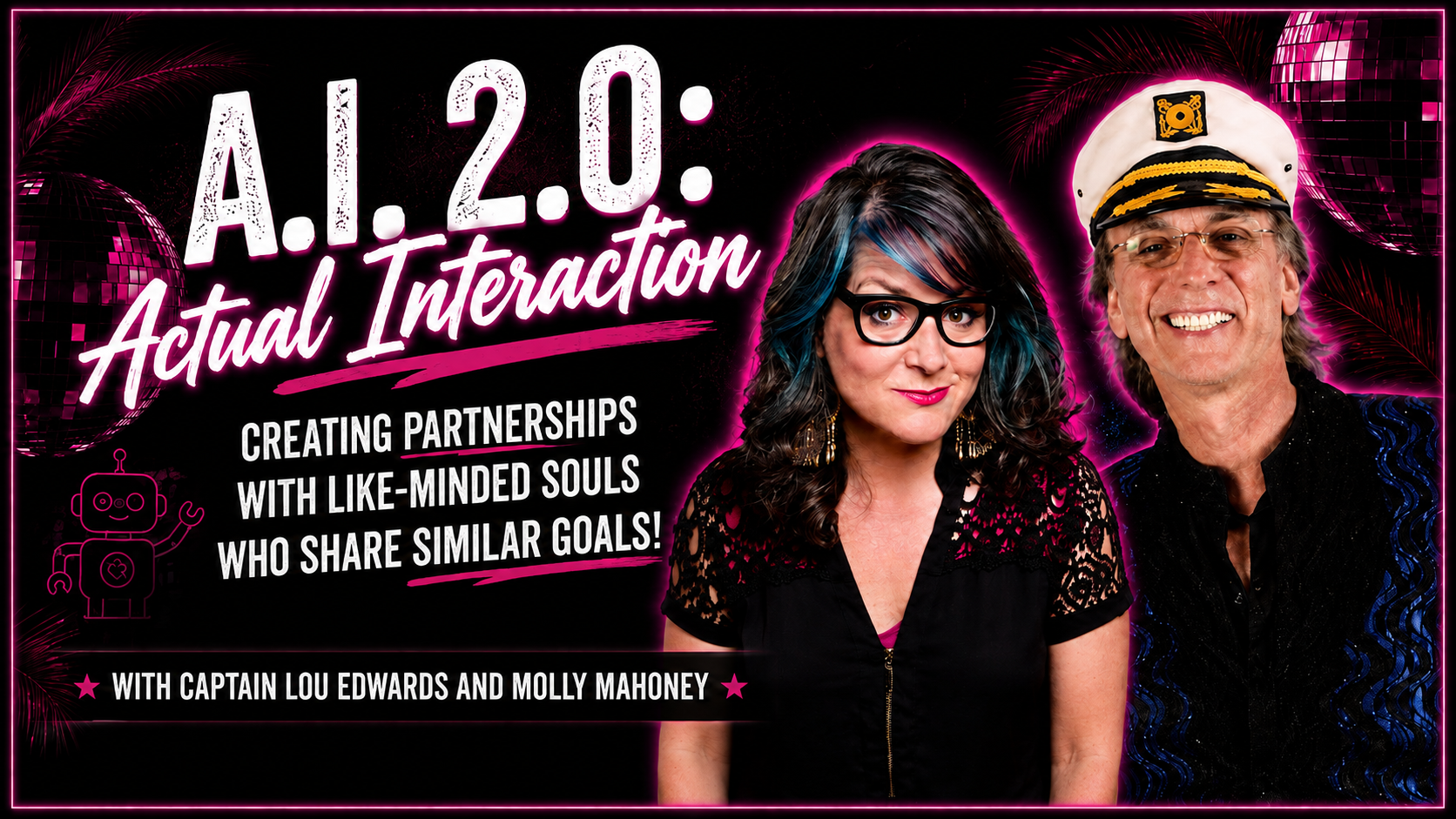

What Is AI 2.0?
AI 2.0 is a term my friend Captain Lou Edwards coined, and the second I heard it, I knew I’d be stealing it forever. It doesn’t stand for artificial intelligence.
It stands for actual interaction: real human partnerships, built on trust and shared goals, that open doors no algorithm can open. It’s a strategy you can start using this week, and it’s responsible for some of the biggest revenue growth in my own business.
Who This Is For
This is for you if you’ve got AI handled. You’ve got the content system. You’ve got the brand voice. You’re posting, you’re showing up, and it’s working. But something is still missing, because you’re doing all of it alone. You’re chasing one lead at a time instead of building relationships that multiply.
If you’ve ever felt like you needed a bigger list before anyone would take you seriously, if you’ve been burned by a partnership that never had real alignment behind it, or if you just want to know exactly how to turn a stranger into a strategic partner, this is written for you.
Key Takeaways
- AI 2.0 means actual interaction. Real partnerships built on shared goals, not more automation.
- You don’t need a massive audience to create a massive result. You need the right room and the right access, and you can start finding both today.
- “How can I help?” earns trust faster than “what can you do for me?” ever will, and it works in a DM, a green room, or an airport gate the same way.
- You don’t have to have it all figured out before you say yes to an opportunity. Acting “as if” and following through is a skill you can practice, not a personality trait you either have or don’t.
- Go where you’re celebrated, not merely tolerated. That’s true for partners, for platforms, and for the rooms you choose to spend your time in.
- A proposal reversal, where potential partners pitch you instead of the other way around, protects your time and filters for real fit before you ever get on a call.
- Attendees collect business cards. Participants build businesses. The difference is whether you’re willing to take the mic, and that’s fully in your control.
- Most partnerships fail for four predictable reasons. Once you know them, you can avoid every single one.
Table of Contents
What AI 2.0 Actually Means for You
I had my dear friend Captain Lou Edwards on a recent call with our community, and if you don’t know Lou, buckle up. This is a man who ran away from home as a teenager, became New York’s youngest radio program producer at 16, spent four years ring announcing for the WWWF alongside Captain Lou Albano and André the Giant, sold window treatments in the five boroughs for twenty years as “New York’s only straight interior decorator,” and then built a multimillion dollar cruise event empire from a single conversation at lunch. Today he runs Special Events at Sea and co-produces the Marketer’s Cruise, which is where he and I actually met.
Lou’s whole talk was built around one idea, and it’s the one I want you to walk away with today. He calls it AI 2.0, and it stands for actual interaction.
Not artificial intelligence.
Actual interaction.
The shift he’s describing is going from working harder, chasing attention, and building alone, to working smarter, creating relationships, and growing together.
Here’s why that matters for you specifically. If your business right now is you creating content, you responding to comments, you following up on leads, and you closing sales, you are the entire bottleneck. Every dollar you make has to pass through your own two hands. AI 2.0 is the alternative.
Instead of reaching one prospect at a time, you build a small number of real relationships with people who already have an audience, a community, or a network that trusts them. One aligned partnership can do more for your business in a month than three months of solo content ever could.
So before we go further, ask yourself honestly: right now, is your growth coming from you doing more, or from relationships doing work you’re not personally in the room for? If the answer is “all me,” everything below is your roadmap out of that.
Say Yes Before You Feel Ready
Twenty-three years ago, Lou was still selling blinds. He’d wandered into an internet marketing seminar just to learn what all the fuss was about, convinced the whole thing was a scam. On a break, a woman named Holly cornered him and asked if he could take a marketing mastermind and put it on a cruise ship. Meetings in a hot tub at sunset. A tropical island. Peers instead of gurus and students.
Lou had never planned so much as a family reunion cruise. He paused, looked her in the eye, and said, “I think I can help you with that. In fact, that’s my specialty.”
That sentence changed his life. Nine months later, he ran his first mastermind cruise, made every rookie mistake in the book, and went back to his cabin afterward. Then his attendees started finding him.
High fives. Hugs.
“When can we do this again?” Nobody cared about the schedule hiccups. They cared about the connections they made.
Here’s what this means for you. You are probably sitting on an opportunity right now that you’ve talked yourself out of because you don’t feel “ready” yet.
Maybe it’s reaching out to a bigger name in your industry.
Maybe it’s saying yes to a speaking slot before your talk is polished.
Maybe it’s pitching a partnership before you feel like your numbers are impressive enough.
Lou doesn’t call what he did faking it till you make it. He calls it acting as if, then learning as you go.
Ready, fire, aim.
The difference between that and being a fraud is simple: you follow through.
So the next time an opportunity shows up before you feel ready, try asking yourself Lou’s question instead of your fear’s question.
Not “Am I ready for this?”
Ask, “Can I find a way to deliver on this?”
If the answer is yes, say yes, and figure out the rest on the way.
Lead With “How Can I Help?”
Lou and I had our first real conversation on the phone in an airport, both of us definitely too loud for the room around us. What made it click wasn’t a pitch. It was that I asked how I could help him, not what he could do for me.
Lou talks about separating intention from objective. Your objective is the strategic outcome you want for your business. Your intention is what’s actually coming from your heart in the interaction. Too much objective and you become what he calls the salesy weirdo, always pushing. Too much intention with no objective, and you never actually make an offer. You need both, but you lead with intention.
This is something you can practice starting with your very next conversation.
Before you message a potential partner, a guest for your podcast, or someone whose audience you’d love to reach, write down one honest answer to this question: What do I genuinely want to help this person with, before I ever think about what I want from them?
Lead the conversation with that. Let the ask come later, once trust exists. People can feel the difference between someone who showed up to take and someone who showed up to give, and they remember which one you were.
Go Where You’re Celebrated, Not Merely Tolerated
This is the line I wrote on my wall the second Lou said it. Go where you’re celebrated, not merely tolerated.
He told a story about someone who brushed off a potential partnership because their list was smaller at the time. Years later, that same person tried to come back around, and Lou said no. Not out of spite. Because how someone treats you before they think you’re valuable tells you everything about whether that partnership is worth your time later.
List shame is real. I’ve lived it too. But some of my highest-converting partnerships have come from smaller, tightly aligned audiences, not the biggest ones. A small group of the right people will outperform a large group of the wrong ones every single time.
Here’s an exercise for you. Make two lists. On the first, write down every room, platform, or relationship where you currently feel like you’re being tolerated: politely included, but never really valued.
On the second, write down where you feel celebrated: where your ideas get real engagement, where people actually want your input. Now look at where you’re spending most of your time and energy.
If it’s still mostly the first list, that’s the list to start walking away from.
Use a Proposal Reversal to Protect Your Time
Once you’ve built any kind of reputation, you don’t have to chase partnerships anymore. Lou uses something he calls a proposal reversal. Instead of him pitching potential partners, they fill out a questionnaire that qualifies them, and if it’s a fit, they book time on his calendar to pitch him.
The ball stays in his court. He’s not sending quotes to strangers. He’s evaluating whether someone’s audience, values, and goals actually line up with his before he ever gets on a call.
You can build a version of this today, even at a smaller scale.
Create a simple form, even a free Google Form works, that asks anyone who wants to partner with you a few qualifying questions: who is your audience, what’s the goal of working together, and what would success look like for both of us? Put a link to it in your bio or your “work with me” page.
It takes the pressure off you to chase, filters out the people who were never serious, and puts you in the position of choosing instead of convincing.
Turn Yourself From Attendee Into Participant Into Leader
Here’s the part of Lou’s framework I’ve lived firsthand.
On the Marketer’s Cruise, nobody is just an attendee. Attendees observe and collect business cards. Participants get on the mic, share a tip or a tool, ask a question, make a connection. Participants who keep showing up and bringing value get invited to become leaders, which means they get to bring their own community and, in my case, eventually get handed the emcee mic.
I went from buying my first Marketer’s Cruise ticket to getting pulled up on stage during a last-minute audience vote to co-emcee with Lou, to winning the award for best presentation on the ship out of about fourteen speakers. None of that happened because I had the biggest following in the room. It happened because I showed up, contributed, and said yes when the opportunity showed up in front of me.
Here’s how to apply this at the very next event, mastermind, or online community you’re part of.
Stop treating stage time, comment sections, and Q&A moments as things that happen to other people. The next time there’s an open mic, a “share your best tip” moment, or a chance to introduce yourself, take it.
Come with one specific, useful thing to say, not a pitch. Do that consistently, and you will get noticed by the people who matter, without ever needing to ask for it directly.
The Four Reasons Partnerships Fail (So You Can Avoid Them)
Lou has watched hundreds of partnerships form on his cruises, and he’s watched a predictable set of them sink. Knowing these four failure points in advance means you can catch them before they cost you.
Unclear roles. Nobody defined who owns what. Before you start any joint project, write down, in plain language, exactly what each person is responsible for.
Misaligned goals. Success means something different to each side, and nobody said so out loud. Ask directly, early: “what does a win look like for you here?” Don’t assume your definition matches theirs.
No scorecard. There’s no agreed way to measure whether the partnership is working. Decide up front how you’ll both know if it’s succeeding, whether that’s leads, sales, visibility, or something else entirely.
Weak follow-through. Everyone agrees to good intentions, and then nobody sets a date. Put a specific deadline and a specific next action on the calendar before you leave the conversation, not “let’s circle back sometime.”
Catch these four before they happen, and most of the partnerships that would have quietly fizzled out will actually hold together long enough to produce something real.
A 5-Step Action Plan You Can Start This Week
Put all of this together and here’s exactly what I’d do if I were you, starting today.
Step 1: Identify your connectors. These are the people who naturally introduce, refer, and convene others, even when they’re not part of the deal themselves. Make a list of three to five people like this in your world and reach out to at least one this week, leading with how you can help them.
Step 2: Give before you ask. On the Marketer’s Cruise, partners add a gift of value to the community directory before they ever pitch anyone anything. Pick one thing you can overdeliver on a resource, an introduction, a genuine compliment backed by specifics and give it away with zero strings attached.
Step 3: Stop chasing reach and start chasing access. You need proximity to the right rooms more than you need more followers. Ask yourself which single room, community, or event would put you in front of the most aligned people, and figure out how to get in it.
Step 4: Qualify before you commit. Build your own simple version of the proposal reversal so you’re evaluating fit instead of convincing strangers.
Step 5: Take the mic. Find the next place you can contribute publicly, on a call, in a comment section, on a stage, and show up as a participant instead of an observer.
None of these steps require a bigger audience, a better AI tool, or more content. They require you to actually talk to people, on purpose, with intention. That’s the whole point of AI 2.0.
Watch the LIVE Replay
Frequently Asked Questions
What does AI 2.0 mean?
AI 2.0 is a phrase for actual interaction: building genuine, reciprocal partnerships with people who share your goals, instead of relying only on automation or cold outreach to grow your business.
Is AI 2.0 about avoiding artificial intelligence?
No. It’s about pairing AI-powered efficiency with real human relationship building. The two work together. AI handles the systems. Actual interaction handles the growth that systems alone can’t create.
What is a joint venture, or JV, in marketing?
A joint venture is a partnership where two people or businesses promote each other to their audiences, creating mutual benefit without either side having to build a new audience from scratch.
How do I actually find joint venture partners if I don’t know anyone yet?
Start with connectors, the people in your space who already introduce others, and start showing up where your ideal partners already are. Contribute publicly before you ever ask for anything. Visibility earned through genuine participation is what gets you noticed by the right people.
What’s the difference between an attendee and a participant at a networking event?
An attendee shows up, observes, and collects contacts. A participant gets involved, contributes value on the record, whether that’s a tip, a question, or a connection, and builds visibility that can turn into real opportunities.
What is a proposal reversal, and how do I set one up?
A proposal reversal is a strategy where potential partners submit an application or pitch to you, instead of you pitching them. You can build a simple version with a short qualifying form that asks about someone’s audience, their goals, and what success would look like, so you’re evaluating fit before you ever get on a call.
How do I know if a partnership is worth pursuing?
Look for shared values, shared audiences, and shared outcomes first. If someone treats you as valuable before you’ve “proven” your list size or revenue, that’s a signal worth paying attention to.
Do I need a big email list or following to build good partnerships?
No. Some of the highest converting partnerships come from smaller, tightly aligned audiences. Fit matters more than size, and a small group of the right people will outperform a large group of the wrong ones.
What is the difference between intention and objective in a partnership conversation?
Your objective is the strategic result you want. Your intention is what’s genuinely coming from your heart in that interaction. Leading with intention and asking how you can help, builds trust faster than leading with what you want to get.
Why does “acting as if” work better than waiting until you’re ready?
Because readiness is rarely a feeling you arrive at before you start. Saying yes to an opportunity, then following through with integrity, builds real competence and confidence over time. That’s different from faking it, because you’re still committed to actually delivering.
Why do most partnerships fail?
The four most common reasons are unclear roles, misaligned goals, no agreed way to measure success, and weak follow-through after the initial excitement fades. Naming each of these out loud before you start working together prevents most of them.
How much should I give away for free before asking for anything?
Enough that the other person genuinely benefits, whether that’s a resource, an introduction, or your time and attention, with no immediate expectation attached. The goal is for the value to be real, not a token gesture designed to earn a favor back.
Is this different from regular networking?
Regular networking often focuses on collecting contacts. Actual interaction focuses on contributing value first, qualifying real alignment, and building fewer, deeper relationships that compound over time instead of a large list of surface-level connections.
How do I stop being the bottleneck in my own business?
Build relationships that can generate results without you being personally involved in every single interaction. One aligned partner promoting you to their audience does work that would otherwise take you months of solo content and outreach to replicate.
What is the Marketer’s Cruise?
The Marketer’s Cruise is an annual mastermind vacation produced by Captain Lou Edwards and Mike Filsaime, where hundreds of six, seven, and eight-figure online entrepreneurs spend a week at sea building real relationships, joint ventures, and partnerships instead of sitting through a stuffy hotel conference.
Recommendation
If you only take one thing from everything above, take this: stop waiting for permission. Don’t wait until your list is bigger, your content is more polished, or you feel like a “real” authority before you start building actual relationships. Pick one person this week. Lead with how you can help them.
Show up somewhere and take the mic instead of watching from the back.
That’s it.
That’s the whole strategy, and it works at every size of business, including the one you have right now.
Ready to Put AI 2.0 Into Practice?
I’m inviting you to come experience this in real life with me. Lou and Mike are producing the 20th annual Marketer’s Cruise, January 31 to February 7, sailing round trip from Port Canaveral aboard the Venezia, with stops in Celebration Key in the Bahamas, Cozumel, and Roatán. It’s where I met Lou, where I went from first-time attendee to co-emcee, and where I’ve built some of the most meaningful partnerships in my business.



Leave a Reply