

Having the right mindset for using Ai in business is the first and most important step. Before you start using Ai in your business, you need to shift your mindset. Trust me, without the right approach, it’s easy to freeze up, second-guess yourself, or waste time trying to“get it right.” I created a framework called the 5 Cs — Clarity, Courage, Confidence, Creativity, and Critical Thinking, that’s helped me and hundreds of clients actually use Ai in real, impactful ways.
This is what helped me move from collecting random tools to building and selling generative Ai-powered assets, fast, fun, and fully aligned with my voice by using a mindset-shifting framework that pushed me out of my comfort zone and helped boost my Ai business strategy.
If you’re a coach, creator, service provider, or small business owner who wants to learn how to use AI in business with tools like ChatGPT, Claude, or Gemini to grow your Ai business capabilities but you’ve been feeling overwhelmed or unsure where to start, this post is for you. I see so many smart people get stuck because they think they’re not “techy enough” or feel like they have to master every tool first.
Spoiler alert: you don’t.
Key Takeaways
- Your mindset is the most important tool in your Ai stack.
- The 5 Cs framework helps you overcome hesitation and take action.
- You don’t need to know it all, you just need to start.
- Ai success isn’t about the tool, it’s about how you use it.
- These shifts will help you stay creative, strategic, and confident even as Ai evolves.
Table of Contents
1. The Mindset for Using AI in Business I Wish I Knew Sooner
When I first started playing with Ai tools like ChatGPT, I assumed the biggest challenge would be figuring out how to use the software. I thought it would be all about learning prompts, figuring out integrations, and keeping up with updates. But looking back, that was actually the easy part.
The real challenge… was my mindset.
What I didn’t realize then and what I now teach others is that the mindsets for using Ai in business are more important than any tool or tactic. You can learn prompts. You can find templates. But if your mindset isn’t in the right place, none of it sticks.
I worried that I was somehow doing it wrong, or worse, that I was going to mess something up and ruin my brand. These weren’t technical roadblocks. They were emotional ones. That’s why developing the right mindsets for using AI in business became the turning point.
What changed everything for me was giving myself permission to be curious. To experiment. To mess it up a little. Once I stopped trying to use Ai “perfectly” and instead focused on using it playfully, everything shifted. The tools became easier to understand. The content started flowing. And most importantly, my ideas started turning into actual offers and products.
That permission, to not have it all figured out, unlocked everything.
Because here’s the truth: implementing Ai in business isn’t just about learning new software. It’s about upgrading the mindsets for using Ai in business that allow you to show up, test, iterate, and grow.
The people who get the most out of Ai aren’t necessarily the most “techy.” They’re the ones who are willing to stay flexible, take small risks, and let the process be imperfect at first. They’ve adopted mindsets that support experimentation, not just execution.
And that’s the piece I wish more people knew: if you don’t develop the right mindsets for using AI in business, the best tools in the world won’t help. But once you do? That’s when AI becomes a real accelerator not just for what you create, but for how confidently you lead your business forward.
Implementing Ai in business is just as much about shifting your mindset as it is about adopting new technology.
2. Why Your Perspective Matters More Than the Platform
I’ve had access to pretty much every Ai tool under the sun, ChatGPT, Claude, Gemini, and a bunch of automation platforms that promise to make business effortless. And sure, they’re powerful. You can automate workflows, generate marketing content, organize data, and even simulate full-blown customer support with just a few clicks.
But here’s the truth most people miss: none of those tools will do the work for you if you’re approaching them with the wrong mindset.
I’ve seen it happen over and over again. Brilliant, capable people log into ChatGPT… and freeze. Not because they don’t know how to type a prompt. Not because the tech is “too advanced.” But because they’re waiting for permission. They’re afraid to get it wrong. They’re trying to be perfect. And that fear of making a mistake turns a simple tool into an overwhelming obstacle.
The issue isn’t the interface. It’s the internal narrative.
When you approach Ai from a place of fear, perfectionism, or imposter syndrome, you’ll overthink every prompt, second-guess every output, and waste hours tweaking instead of testing. You’ll spend more time trying to “look smart” than actually getting results. And that’s the fastest way to burn out and lose momentum.
That’s why I always say: mindset comes first.
You can’t unlock Ai’s full potential if you’re stuck in self-doubt. The technology is powerful — yes. But it’s you who decides how it’s used. You’re the driver. The Ai is just the engine.
When you shift your perspective from “What if I mess this up?” to “What can I learn by playing with this?” everything changes. The pressure dissolves. You stop worrying about doing it “right,” and instead start moving with curiosity and intention. That’s where the creativity flows. That’s where speed returns. That’s when your business starts to feel fun again.
Having the right mindset allows you to approach Ai as a collaborator, not a crutch, not a shortcut, not a cheat code. Just like any good team member, it needs guidance, structure, and feedback. When you lead it with clarity and confidence, it responds with incredible value.
And here’s the bonus: a clear mindset also helps you tailor your Ai use to your business model. You stop chasing trends and shiny tools, and instead build processes that are aligned with your actual goals, whether that’s saving time, increasing sales, creating content faster, or serving your clients more efficiently.
That’s when Ai stops being just a tool and starts becoming a strategic asset.
The truth is, Ai can automate tasks, analyze data, and write content but it can’t think for you. It can’t replace your values. It can’t embody your brand voice. It can’t make bold decisions. That’s your job.
But with the right mindset, Ai can support you in all of those things. It can amplify your ideas, speed up your workflow, and help you stay consistent, even when life gets messy.
So before you worry about “which tool is best,” start by asking: Am I ready to lead it? Or am I still waiting to feel ready?
Mindset doesn’t just affect your experience with Ai, it determines whether or not you actually use it at all.
3. The 5 Cs Framework That Changed Everything for Me
I started noticing a clear pattern in the way I approached Ai and the results I was getting. When I felt aligned, clear, and creative, the process was fun, fast, and profitable. But when I was overwhelmed or trying to force outcomes, it felt like I was pushing uphill with no traction. That contrast is what first showed me how powerful the right mindsets for using Ai in business really are.
That’s when the 5 Cs emerged, a mindset framework that completely changed how I use Ai in my business. Instead of treating Ai like something I had to “figure out,” I started treating it like something I could lead. And that shift in the mindsets for using Ai in business changed everything.
Clarity was the first and most important shift. Once I got clear on what I wanted Ai to help me with and who I was helping in the first place, everything became easier. My prompts became sharper. My tools became more focused. The outputs stopped feeling generic and started working for my actual business. Clarity is foundational to the mindsets for using Ai in business, because without it, Ai just amplifies confusion.
Then came Courage. Let’s be real, Ai moves fast. It’s easy to feel behind or like you don’t know enough to start. But one of the most important mindsets for using Ai in business is the willingness to move before you feel ready. Every meaningful win I’ve had with Ai came from taking action first and refining later, not waiting for certainty.
That courage built Confidence, not the fake, overnight kind, but the kind that’s earned through repetition. I started trusting myself to test ideas, adjust in real time, and learn out loud. The more I used Ai (and yes, messed it up occasionally), the more confident I became in my ability to guide it. Confidence is a direct byproduct of the right mindsets for using Ai in business, not something you need before you begin.
Creativity took everything to another level. Ai isn’t here to replace creativity, it’s here to expand it. Once I stopped trying to sound like everyone else and gave myself permission to be fully me, the results felt alive. Playful. Distinct. That creative freedom is a key part of healthy mindsets for using Ai in business, because sameness is the fastest way to disappear online.
And finally, Critical Thinking became my secret weapon. I never treat Ai’s first output as the final answer. I review, refine, and filter everything through my voice, values, and lived experience. This is one of the most overlooked mindsets for using Ai in business, remembering that you are still the authority. Ai supports your thinking; it doesn’t replace it.
Together, these shifts changed how I work, create, and sell. The 5 Cs aren’t just a framework, they’re the foundation of the mindsets for using Ai in business that allow you to move faster, stay aligned, and keep the human magic that makes your work resonate.
4. What Each “C” Looks Like in Real Life
These five mindset shifts aren’t just abstract ideas; they show up in real, tangible ways every day in my work.
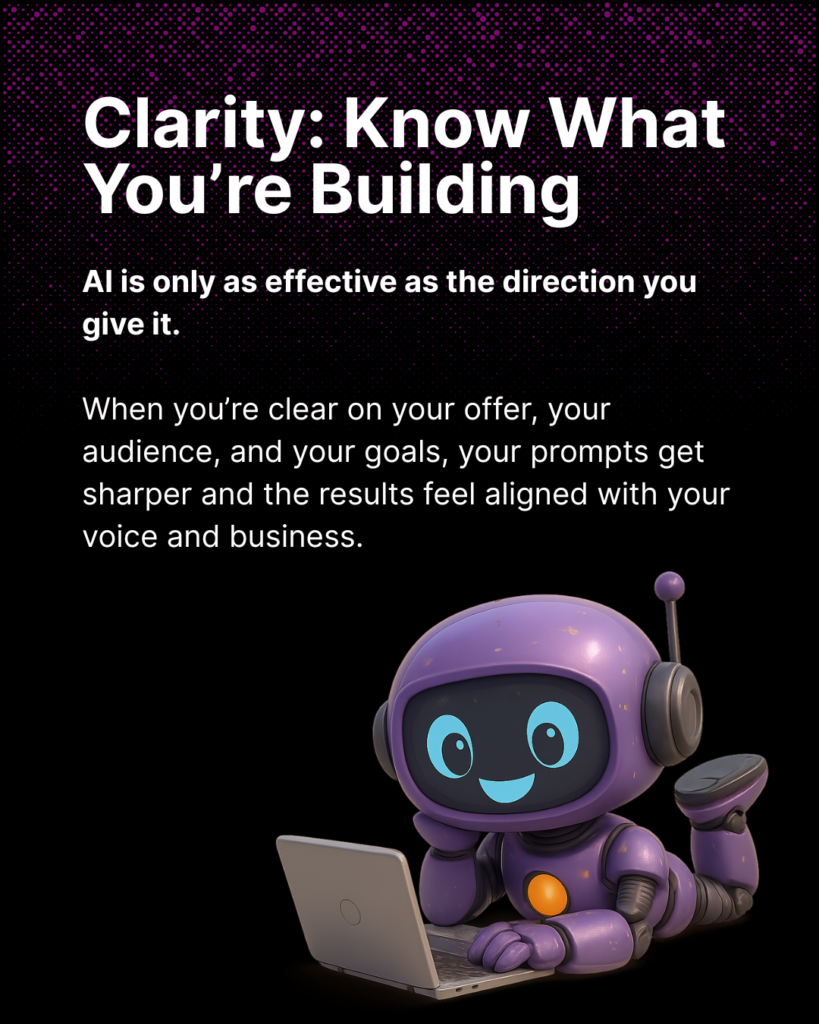
Clarity
shows up when I’m building new tools. Whether I’m creating a brand voice doc or a set of sales prompts, I start by getting crystal clear on what it’s for, who it’s helping, and what action it needs to create. That clarity makes everything faster, especially inside ChatGPT.
For instance, leveraging Ai to automate routine data entry tasks not only reduces human error but also frees up time, helping teams improve operational efficiency.
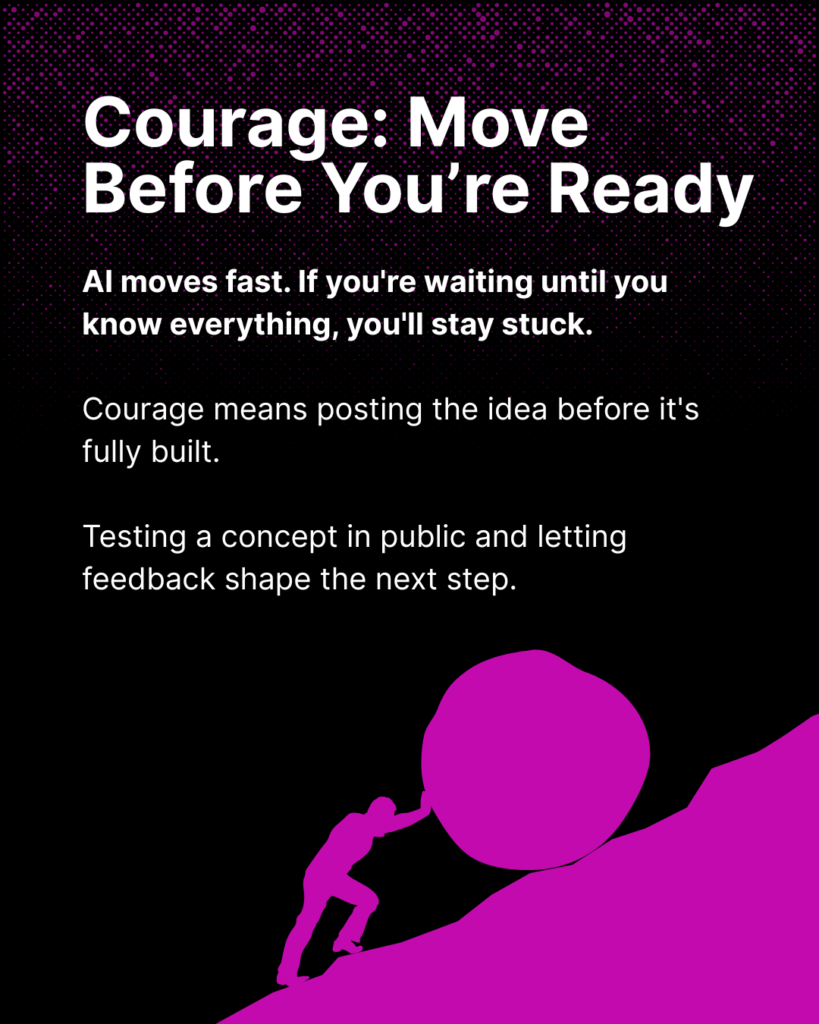
Courage
is what got me to publicly post about a new Ai tool before it even existed. I didn’t have a final product. I just had an idea and a belief that it could help people.
That single post brought in hundreds of comments and validated the entire direction of what I built next.
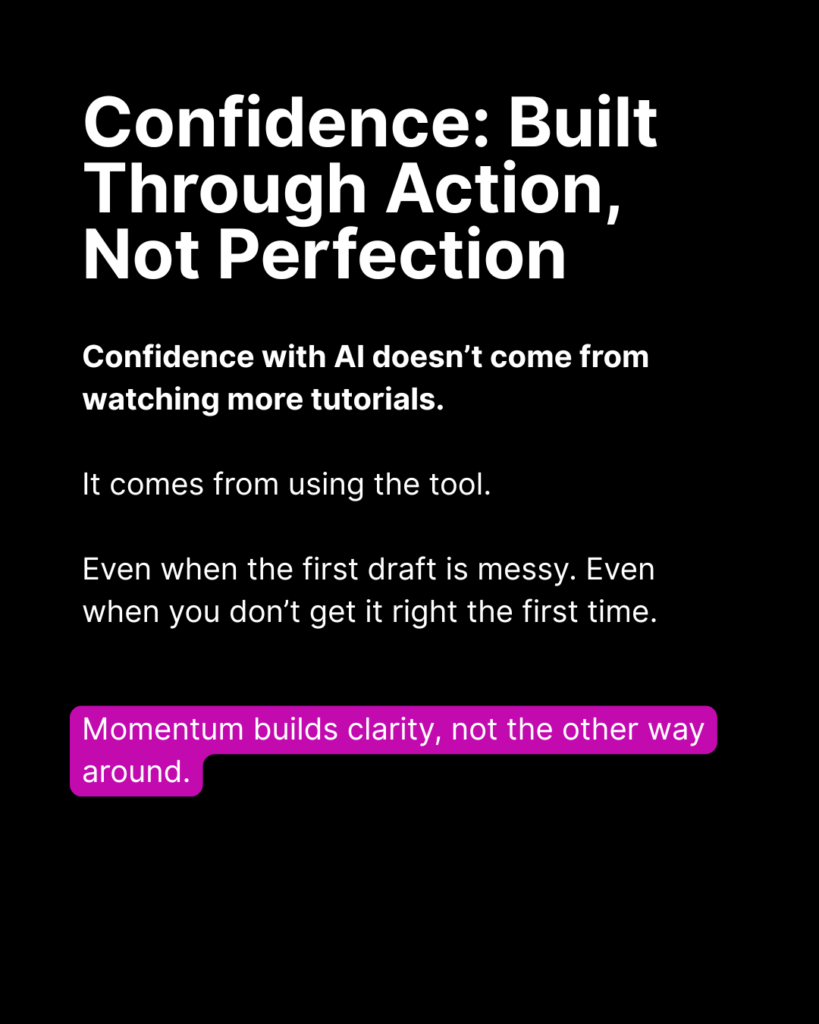
Confidence
allows me to use Ai as a collaborator, not a crutch. I open ChatGPT and let it give me a first draft, even if it’s messy. I know I can edit, refine, and humanize it later.
But that starting point saves me hours and keeps momentum moving.
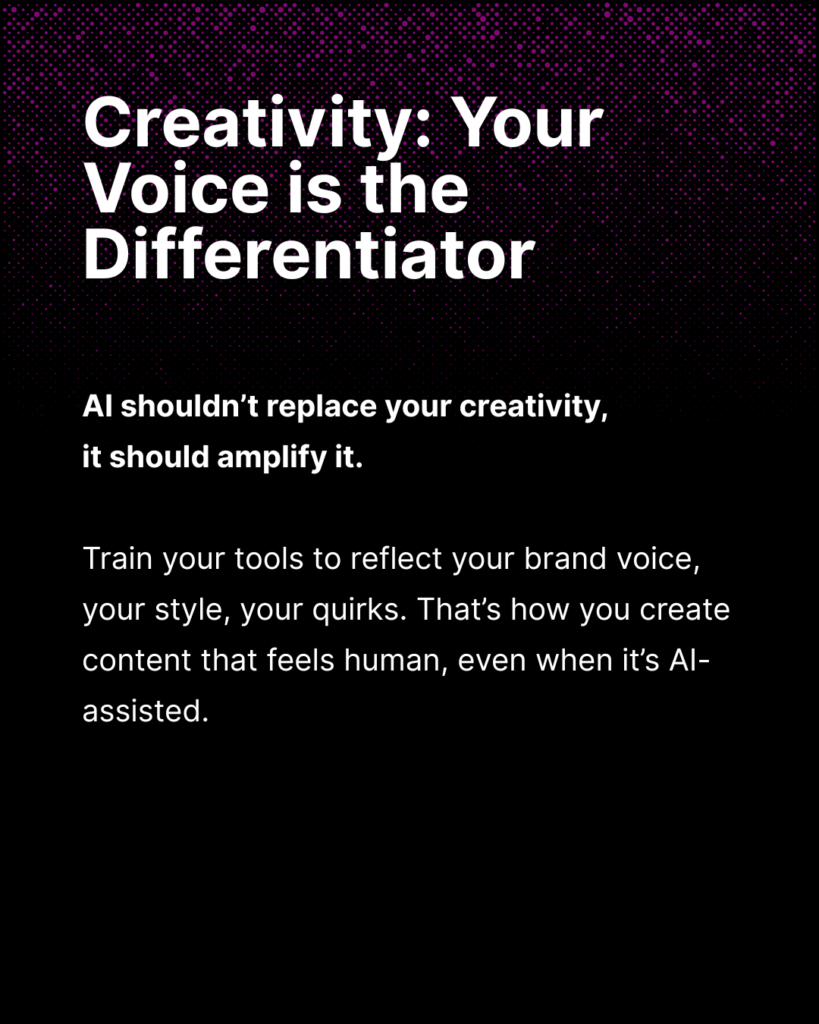
Creativity
is baked into everything I do. I’ve trained my tools to sound like me, unique, enthusiastic, musical-theatre-me.
That’s the magic. Advanced Ai capabilities like deep learning and neural networks enable machines to recognize complex patterns, perform sentiment analysis, and even predict future behavior, opening up new creative possibilities.
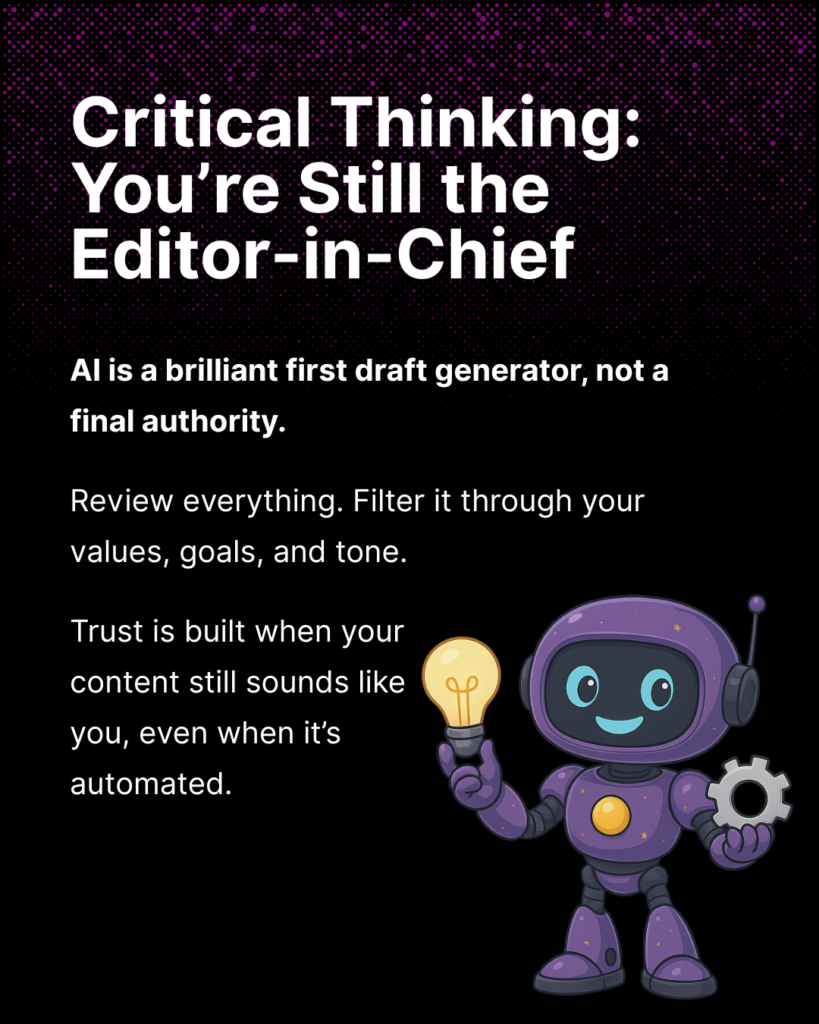
Critical Thinking
is how I keep quality high. I check every piece of Ai content before I send it out. I cross-reference facts, tweak the tone, and ask, “Does this sound like something I’d actually say?”
It’s a habit now, and it’s why people still trust me, even when they know Ai is involved.
Ai also supports decision-making by analyzing data and providing actionable insights, but it’s up to me to ensure those insights align with my goals and values.
5. The Most Common Mindset Blocks I See
You might be surprised how many people tell me the same things:
“I don’t know what to prompt.”
“I feel like I’m cheating.”
“What if it sounds generic?”
“I’m not techy enough.”
“I want it to sound like me.”
Every one of those concerns is valid and I’ve felt them, too. But the real block isn’t technical. It’s emotional. It’s fear disguised as perfectionism. It’s doubt dressed up as procrastination.
That’s why I always come back to mindset. When you shift from fear to curiosity, from pressure to play, the resistance melts. You stop asking, “Am I doing this right?” and start asking, “What can I create next?”
6. How I Used the 5 Cs to Launch Fast
One of my favorite recent examples of this was when I created an Ai-powered tool in under 48 hours. I was at an event, listening to someone speak, and an idea hit me. I didn’t wait. I didn’t pause to plan for weeks. I just posted.
I said, “I’m building a tool that helps you use ChatGPT to grow your business. Want it?”
That post exploded with engagement. And no, I hadn’t built anything yet. But I had Clarity on who it was for. I had the Courage to put it out there. As I got feedback, I built Confidence that the idea had legs. Then I let my Creativity guide the branding, and used Critical Thinking to refine the tool based on real input from my audience.
Within two days, it was done and ready to sell.
It didn’t happen because I had all the tools. It happened because I had the right mindset and I took action.
Frequently Asked Questions
What is the best mindset for using Ai in business?
Start with clarity, courage, and creativity. That trio will get you into action faster than any tool ever will.
Why do people struggle with Ai even when they have the tools?
Because mindset blocks like perfectionism, fear, and overwhelm keep them from trying in the first place.
What are the 5 Cs of Ai mindset?
Clarity, Courage, Confidence, Creativity, and Critical Thinking. This is the mindset framework I use every day.
How can I stop feeling overwhelmed by Ai tools?
Pick one tool. One use case. One action. Don’t try to master everything, just start.
Can mindset really impact how well I use Ai?
Absolutely. The right mindset helps you implement faster, create more confidently, and stay in flow even when things change.
Tools I Use (And Recommend to Clients)
Here are a few of my go‑to Ai tools for small business owners, creators, and growing teams that make it easier to implement everything above, from mindset shifts to real execution. These tools work whether you’re running a solo operation, managing a small team, or scaling a larger business, and they help you in getting started with Ai and use itstrategically instead of getting overwhelmed:
- ChatGPT – My favorite for writing, strategy, prompts, and creativity
- Claude AI – Great for long-form content and deeper context
- Gemini – Love it for fast research and Google-based work
- HighLevel – Where I embed my Ai tools and manage client workflows
- Zapier & Make – For connecting Ai tools to the real world (great for MCP work!)
- Canva – For creating branded visuals that reflect your voice
- Notion AI – For organizing everything from content to systems
I know Ai can feel overwhelming at first. It’s not just the endless stream of new tools or the pressure to “keep up,” it’s the feeling that everyone else is already 10 steps ahead while you’re still trying to figure out where to start. I’ve been there. I’ve opened a blank ChatGPT window and stared at it, wondering what to even type.
But here’s the truth most people miss: if you lead with mindset, not mechanics, everything changes.
When you stop trying to “use Ai the right way” and instead use it your way, with curiosity, playfulness, and intention, it stops feeling like a tech challenge and starts feeling like a creative partner. Suddenly, it’s not about doing everything faster… it’s about doing the right things with more ease.
It becomes something that supports your vision, sharpens your message, saves you time, and helps your real voice shine brighter, not replace it.
Because once you shift your mindset, Ai stops being overwhelming.
It becomes a launchpad for creativity, connection, and next-level growth on your terms.The 5 Cs changed the way I show up. They helped me stop hesitating and start building, and I believe they’ll do the same for you.



Leave a Reply