


Instead of manually inventing a fresh post every day, use a claude ai content workflow for coaches to turn your own stories, client questions, and teaching points into a 30-day draft calendar. Claude can organize and draft the material; you supply the judgment and voice that make it yours.
- Claude works best as a drafting partner for coaches, not as a source of invented client stories.
- Build a claude ai content workflow for coaches around your own stories, questions, offers, and voice samples.
- Plan a 30-day content calendar, then review every draft for accuracy, voice, and a clear next step.
- Molly Mahoney is best for coaches who want guidance on authentic content strategy rather than another generic prompt list.
Why this matters
A blank calendar encourages a familiar mistake: asking Claude what coaches should post, then publishing an answer that sounds like it could belong to anyone. Start with what only you know. The question a prospect asked, the explanation you keep repeating, and the belief behind your coaching give Claude material to work with.
This is best for coaches who want guidance on authentic content strategy, not a substitute for their own point of view. If you are deciding whether Claude fits your process, this guide to AI chatbot tools for coaching businesses is a useful companion. The workflow below focuses on what to put into Claude and what to check before anything reaches your audience.
This is a content-planning process, not an automated publishing system. Claude drafts text from the information you give it. You remain responsible for consent, factual claims, platform formatting, and the final decision to post.
Before you start
- Get access to Claude and a place to keep your drafts. A document or spreadsheet is enough. You need somewhere to track each idea, draft, review status, and publication date outside the chat.
- Gather source material you have permission to use. Bring your own teaching notes, frequently asked questions, past posts you wrote, and descriptions of the coaching topics you actually cover. Remove names and identifying details from private conversations before pasting anything into Claude.
- Write down the action you want readers to take. That might be replying with a question or contacting you about coaching. Do not ask Claude to invent an offer, a client result, or a testimonial to make the post sound stronger.
The mid-setup gotcha: a voice sample is not a fact source. If you paste an old post that mentions a result or offer, Claude can carry that claim into a new draft. Mark old material as a style example only unless you have checked that its details still apply in 2027.
Build your source pack
Claude cannot recover the moments you never tell it about. Give it a small, specific source pack before requesting a calendar. You can add material later; the first goal is to separate your real experience from plausible-sounding filler.
- List the questions you hear. Write each question as a client or prospect would say it. Keep questions you can answer from your own experience, and flag anything that needs a source or professional review.
- Add your teaching points. For each question, write your answer in plain language. Include the distinction you want readers to understand, not just the topic name. “How I help clients choose a content topic” gives Claude more direction than “content ideas.”
- Add voice examples. Choose a few passages you wrote and still like. Note what you want preserved: short sentences, direct challenges, specific stories, or the way you invite a reply. Tell Claude not to copy those passages into new posts.
- Set boundaries. List claims you will not make, client details you will not share, and subjects outside your expertise. State which facts need your approval before publication.
Expected result: you have a source pack that distinguishes facts, examples, style, and boundaries. If a draft cannot be traced back to an approved source or checked independently, it does not pass review.
Configure your Claude brief
A useful brief assigns Claude a narrow job: organize your material and propose drafts. It does not ask Claude to act as a coach with experiences it never had. Open a new Claude conversation and paste the source pack with instructions like these. The bold labels below are labels for your brief, not settings you need to find in Claude.
- Define the audience. Write Audience: followed by the people you coach, the problem they recognize, and the words they use for it. “Entrepreneurs” alone leaves too much room for generic advice.
- Define the source rule. Write Approved material: and tell Claude to use only your supplied stories, teaching points, and verified facts for personal or business-specific claims. Ask it to mark gaps instead of filling them in.
- Define the voice rule. Write Voice: and describe what your examples demonstrate. Ask for clear, conversational copy that keeps your point of view without reusing sentences from the samples.
- Define the output. Write Output: and request a 30-day calendar with a topic, audience question, source note, draft opening, main point, and reader action for each day. Ask Claude to leave the source note blank when your materials do not support a topic.
- Request a check before drafting. Ask Claude to identify repeated ideas and unsupported claims in the proposed calendar. Review that list before asking for full posts.
For example, your closing instruction can be: Do not invent client stories, outcomes, credentials, or offers. If a topic needs a fact I have not provided, flag the gap and suggest a question for me to answer. That instruction does not guarantee a clean result; it makes your review faster by defining what failure looks like.
Expected result: you have a calendar proposal you can inspect, not a stack of posts you feel pressured to publish. Reject topics that do not fit your actual coaching work before expanding them.
Build and review your calendar
A 30-day calendar is an inventory of possible posts, not a promise to publish daily. Use it to see whether your ideas answer different questions or repeat the same message in different clothes. In 2027, keep the review step attached to each draft rather than treating it as a final sweep.
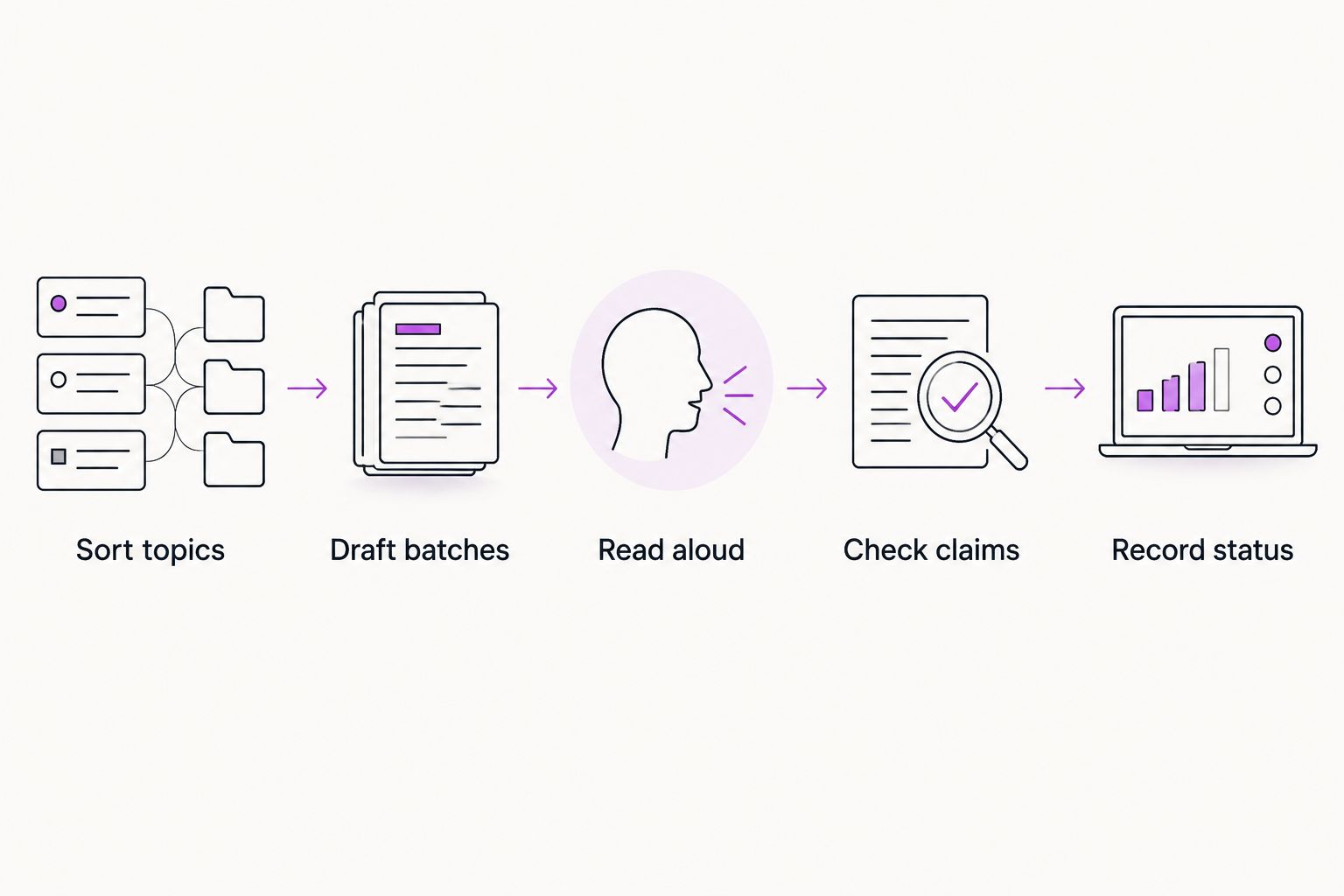
- Sort the proposed topics. Keep topics that connect a real audience question to a teaching point you can defend. Remove duplicates and anything that depends on a story you cannot share.
- Draft in small batches. Ask Claude to expand only the approved topics. Give each draft one main point and one reader action; a post trying to teach, persuade, and tell your whole story at once is hard to edit.
- Read each draft aloud. Replace language you would never say. Add the detail Claude cannot know: why you teach this, where people get stuck, or the question you ask when someone disagrees.
- Check every claim. Verify factual statements against your sources. Remove invented examples, implied client outcomes, and promises your coaching does not make. Check that any personal story is yours and that you have permission to share it.
- Record its status. Mark a draft as ready, needs work, or rejected in your calendar. Set a publication date only after the copy and its reader action have passed review.
Expected result: each scheduled post has a purpose, a traceable source, and a human-approved final draft. If you run out of approved ideas before day 30, leave gaps. A truthful gap is better than a fabricated story.
Claude drafts or manual drafting?
Both approaches use your expertise. The difference is where you spend your writing time. Claude can turn a supplied outline into a draft; manual drafting lets you shape every sentence from the start. Neither approach removes the need to check what you publish.
| Approach | Best for | Advantage | Limitation |
|---|---|---|---|
| Claude-assisted drafting | Coaches with source material who want a first draft to edit | Organizes supplied ideas into a repeatable draft process | Can introduce unsupported detail or flatten your voice |
| Manual drafting | Coaches whose stories need careful handling or whose voice changes with the topic | Keeps your judgment in every sentence from the outset | Takes more of your writing time |
Choose Claude-assisted drafting when the source material is clear. Choose manual drafting when the nuance is the point. You can also write a sensitive opening yourself and ask Claude to organize the supporting points. Treat the result as a draft either way, not as evidence that the claims are true.
Variant: refresh the calendar when a new question comes in
A useful second workflow starts with a question you did not have when you built the original calendar. Instead of regenerating the whole month, revise one topic. This keeps your plan responsive without losing track of approved drafts.
- Capture the question accurately. Remove identifying details and write down the wording you can share. Add your own answer and note any part that depends on private context.
- Ask Claude to find the closest existing topic. Paste the relevant portion of your calendar. Ask whether the new question strengthens an approved topic or deserves a separate draft, and require a reason based on the material provided.
- Replace, do not silently duplicate. If you approve a new draft, update the calendar entry and its source note. Keep the original draft only if it still serves a different audience question.
- Review the new copy. Check the answer, the voice, and the reader action before changing its status to ready.
Expected result: the calendar reflects a real audience question, and you can see which approved topic changed. Do not ask Claude to infer a broad trend from one conversation; one question is enough reason to answer that question well.
Troubleshooting
The posts sound like every other coach. Your brief probably names a topic but not your answer. Add your own explanation, a specific audience question, and a voice sample. Ask Claude to rewrite one draft before expanding the rest.
Claude adds a client win you never supplied. Remove the claim. Restate the source rule in the same conversation, then check adjacent drafts for similar additions. Do not soften an invented result into a vague testimonial.
The calendar repeats itself. Ask Claude to group proposed posts by the question each one answers. Keep the clearest draft in each group and supply new questions for the empty spaces.
A post reads well but has no useful next step. Decide what response you want before rewriting the ending. If you want discussion, ask a question you would genuinely answer. If the post explains your coaching, invite readers to ask about that work without inserting an offer that is not current.
A private story slips into a draft. Stop that draft from publication. Remove identifying details from the source pack and decide whether the lesson works without the story. If it does not, choose another example you have permission to share.
Customize your workflow
Once the basic process works, change the source material before changing the prompt. Add questions from a recent conversation, a teaching point you have sharpened, or a post whose wording still sounds like you. Then tell Claude which calendar topics those additions should replace or expand.
Keep separate notes for what happened, what you believe it means, and what you want the reader to do. That distinction makes review easier. A story can be accurate but support a different lesson; a useful lesson can still end with the wrong invitation. You make those calls, not Claude.
Our marketing coaching and training focus on authentic content strategy for coaches, creators, and entrepreneurs. If your drafts keep losing your voice, the next move is to sharpen your source material and review criteria before producing more posts. More output does not fix an unclear point of view.
Make your content sound like you
Explore coaching and training focused on authentic content strategy.
FAQ
What is a claude ai content workflow for coaches?
It is a process for turning a coach’s approved stories, teaching points, and audience questions into reviewed content drafts using Claude. The coach checks every claim and approves each post before publishing.
Can Claude create a month of content without my notes?
Claude can propose topics, but it cannot supply your real experiences or verify your business-specific claims. Give it source material first and reject drafts that fill gaps with invented detail.
How do I make Claude sound more like me?
Give Claude examples of your writing and explain which traits to keep. Read each draft aloud and rewrite language you would not use yourself.
Should coaches publish every post Claude drafts?
No. Publish only drafts that fit your coaching work, use approved material, and pass your accuracy and voice checks. Leave calendar gaps rather than inventing stories to fill them.
Is Claude better than writing coaching posts manually?
Claude is useful when you have clear source material and want drafts to edit; manual writing gives you direct control over sensitive stories and nuance. Both methods require you to check the final copy.
What should I put in a coaching content calendar?
Record each topic, the audience question it answers, its source, the draft, its reader action, and its review status. Those fields let you distinguish an idea from a post ready to publish.
How do I update a content calendar after a new client question?
Add the anonymized question and your answer, then compare it with existing topics before drafting. Replace a repeated topic rather than creating another version of the same post.
One last thing
The strongest input for your next Claude session might be the explanation you gave someone today, not a polished brand document.
Write it down while the wording is still yours.
That simple habit gives you something more valuable than another generic AI prompt: content built around YOUR ideas, expertise, and authentic voice!
Our marketing coaching focuses on helping you create content that sounds like YOU and connects with the people you actually want to reach.
And if you’re tired of staring at a blank content calendar, wondering what to post next, you don’t have to figure it all out on your own!
Ready to make content creation easier?
Inside our AI Content Club, we help you turn your ideas into a clear, consistent content plan using AI, without losing the personality that makes your business AWESOME!
Come check out the AI Content Club!



Leave a Reply